Loading...
Louis III of Hesse vs Napoleon Bonaparte
Napoleon Bonaparte leads by 26.3 pts · 2 figures compared
…
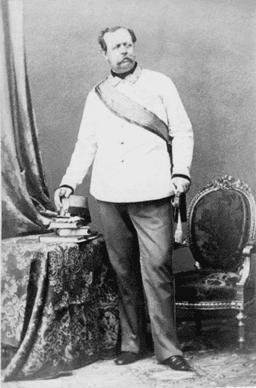
Louis III of Hesse
Emperor · Modern
44.6Total

Napoleon Bonaparte
General · Modern
70.9Total
Basic Information
Born
1806
1769
Died
1877
1821
Era
Modern
Modern
Nationality
Hesse-Darmstadt
France
Occupation
Emperor
General
Civilization
Western
Western
Score Comparison
Military (10%)
11.2
94.0
Political (20%)
37.9
72.0
Influence (20%)
48.6
40.0
Legacy (20%)
38.3
80.0
Leadership (15%)
67.0
78.0
Strategy (15%)
60.0
90.0
TOTAL
44.6
70.9
Louis III of Hesse — Complete Timeline
1848 AD
Accepted Liberal ReformsReform◆ Major
Louis III agreed to a series of liberal reforms, including the abolition of feudal privileges, freedom of the press, and the establishment of a more democratic parliament. These reforms were later partially reversed.
Reforms1848 Revolution
Impact: regionalprogressive
Became Grand Duke of HessePolitical Action◆ Major
Louis III succeeded his father Louis II as Grand Duke of Hesse-Darmstadt during the 1848 revolutions. He was more pragmatic than his father and accepted some liberal reforms to stabilize his rule.
SuccessionHesse-Darmstadt
Impact: regional
1866 AD
Supported Prussia in Austro-Prussian WarPolitical Action◆ Major
Louis III sided with Prussia during the Austro-Prussian War. After Prussia's victory, Hesse-Darmstadt was forced to cede some territories but was allowed to remain independent, unlike Hesse-Kassel.
Austro-Prussian WarPrussian Alliance
Impact: regional
1871 AD
Joined German EmpirePolitical Action◆ Major
Louis III led Hesse-Darmstadt into the newly formed German Empire under Prussian leadership. He became a constituent prince of the empire, losing much of his sovereignty but preserving his throne.
German UnificationEmpire
Impact: regional
Napoleon Bonaparte — Complete Timeline
1799 AD
Coup of 18 BrumaireOther◆ Major
Napoleon Bonaparte, with support from his brother Lucien and key political figures, overthrew the Directory in a bloodless coup. He established the Consulate with himself as First Consul, effectively becoming the ruler of France. This event ended the French Revolution's most unstable period.
French RevolutionCoupRise to Power
Impact: regional
1804 AD
Promulgation of the Napoleonic CodeOther◆ Major
Napoleon enacted the Civil Code of the French, known as the Napoleonic Code, a comprehensive set of laws that replaced the fragmented feudal legal systems. The code established legal equality, protected property rights, and secularized law. It became the basis for legal systems in many European and world countries.
Legal ReformNapoleonic CodeCivil Law
Impact: globalconstructive
1805 AD
Battle of AusterlitzWar◆ Major
Napoleon's Grande Arm
Napoleonic WarsBattleDecisive Victory
Impact: global
1812 AD
Invasion of RussiaWar◆ Major
Napoleon led the Grande Arm
Napoleonic WarsInvasionDisaster
Impact: globaldestructive
1815 AD
Battle of WaterlooWar◆ Major
Napoleon's French army was defeated by the combined forces of the Duke of Wellington's Anglo-Allied army and Gebhard Leberecht von Bl
Napoleonic WarsBattleFinal Defeat
Impact: globaldestructive
Expert Analysis
louis-iii-of-hesse-vs-napoleon-bonaparte
# The Emperor and the Grand Duke: Two Faces of German Power
In the winter of 1806, Napoleon Bonaparte stood victorious at Jena, watching the Prussian army shatter before him. Half a century later, in the spring of 1848, Louis III of Hesse-Darmstadt inherited a throne trembling under the weight of revolution. These two men—one a titan who reshaped Europe with fire and blood, the other a cautious prince who navigated the currents of German unification—belong to the same story, yet could not have lived more different lives. Their contrast reveals something profound about power: that it can be seized by genius or inherited by circumstance, and that history remembers the conqueror while it often forgets the compromiser.
Origins
Napoleon Bonaparte was born in 1769 on the island of Corsica, a place only recently annexed by France. His family belonged to the minor nobility, but they were poor, proud, and resentful of French rule. This background gave him a fierce ambition and an outsider’s hunger for recognition. He educated himself at French military academies, where his Corsican accent marked him as different, and he devoured books on military strategy and history. The French Revolution, which erupted when he was twenty, tore open the old order and offered a path for a man of talent rather than birth.
Louis III, born in 1806—the very year Napoleon crushed Prussia—entered a world already shaped by the Corsican’s wars. He was a prince of the House of Hesse-Darmstadt, a small German state that had survived Napoleon’s reorganization of the Holy Roman Empire. Where Napoleon clawed his way up from obscurity, Louis was born into a gilded cage of protocol and privilege. His education was that of a German aristocrat: languages, law, history, and the art of governance in miniature. He never knew the sting of poverty or the desperation that drives a man to gamble everything on a single battle.
Rise to Power
Napoleon’s ascent was meteoric. At twenty-four, he drove the British out of Toulon. At twenty-six, he suppressed a royalist uprising in Paris with a “whiff of grapeshot.” At twenty-seven, he took command of the French army in Italy and turned a ragged force into a conquering machine, winning battles that forced Austria to sue for peace. By 1799, at thirty, he seized power in a coup and made himself First Consul. His rise was a masterclass in seizing opportunity: he understood that the Revolution had created a vacuum, and he filled it with his will.
Louis III became Grand Duke in 1848, a year of fire across Europe. His father, Louis II, had been a reactionary who resisted change, and when revolutions erupted in March, he abdicated in favor of his more pragmatic son. Louis III did not storm into power; he inherited a crisis. The streets of Darmstadt filled with protesters demanding constitutions, freedom of the press, and an end to feudal privileges. Where Napoleon would have crushed such dissent with cannon, Louis III chose a different path.
Leadership & Governance
Napoleon governed as he conquered: with relentless energy and total control. He centralized the French state, created the Bank of France, reorganized education, and—most enduringly—codified the Napoleonic Code, which established legal equality, protected property rights, and secularized law. His military genius was unparalleled: at Austerlitz in 1805, he destroyed a combined Russian and Austrian army with a combination of deception and devastating precision. His political wisdom, however, was flawed. He crowned himself Emperor in 1804, alienated republicans, and provoked endless wars that bled France dry.
Louis III governed as a constitutional monarch in a small state. He accepted liberal reforms in 1848, abolishing feudal privileges and granting freedom of the press. His military score of 45.0 reflects that he was no general; his strategy score of 58.9 shows a cautious competence rather than brilliance. But his leadership score of 84.3 reveals something else: the ability to keep his throne through diplomacy. In 1866, when Prussia and Austria went to war, Louis III sided with Prussia. It was a calculated risk, and it paid off. After Prussia’s victory, he lost some territory but kept his crown. In 1871, he led Hesse-Darmstadt into the German Empire, becoming a constituent prince under Kaiser Wilhelm I.
Triumph & Tragedy
Napoleon’s greatest moment was Austerlitz, where he stood on a hill and watched the sun rise over his greatest victory. His greatest tragedy was the invasion of Russia in 1812, where he lost half a million men to winter and attrition. He was exiled to Elba in 1814, returned in 1815 for the Hundred Days, and met his final defeat at Waterloo on June 18, 1815. He died in 1821 on Saint Helena, a prisoner of the British, his empire in ashes.
Louis III’s triumph was survival. He navigated the revolutions of 1848, the Austro-Prussian War of 1866, and the founding of the German Empire in 1871—each event a potential catastrophe for a minor prince. He died in 1877, still Grand Duke, his state absorbed into a larger Germany but his dynasty intact. His tragedy was obscurity: he is remembered, if at all, as a footnote in the story of German unification.
Character & Destiny
Napoleon’s character was his destiny. His ambition was limitless, his confidence absolute, his energy inexhaustible. He once said, “Impossible is a word to be found only in the dictionary of fools.” This drive made him a conqueror but also a destroyer. He could not stop, could not compromise, could not share power. His fall came because he demanded everything.
Louis III’s character was the opposite: pragmatic, cautious, patient. He understood that in a world of giants—Bismarck, Napoleon III, Wilhelm I—a small-state prince could only survive by bending. He accepted liberal reforms not out of conviction but necessity. He sided with Prussia not out of loyalty but calculation. His destiny was to fade into the background, a competent steward of a fading world.
Legacy
Napoleon’s legacy is immense. The Napoleonic Code influences legal systems across Europe and the world. His military campaigns are studied in war colleges. He reshaped nationalism, inspired revolutionaries, and haunted the nineteenth century. His total score of 82.4 reflects this: a man who changed history.
Louis III’s legacy is modest. His influence score of 67.1 and legacy score of 52.4 show a figure who mattered in his time but is largely forgotten. He contributed to German unification by choosing the right side, but he did not drive events. His name appears in footnotes, not textbooks.
Conclusion
Standing side by side, these two men illustrate the spectrum of power. Napoleon Bonaparte seized history by the throat and bent it to his will, leaving a trail of glory and ruin. Louis III of Hesse-Darmstadt held on, navigated, and survived. One reshaped the world; the other kept his throne. Their stories remind us that greatness is not always loud, that survival is its own form of victory, and that the historian’s judgment—like the conqueror’s ambition—is never quite fair.
Rankings
🥇
Napoleon BonaparteLeader
Mil: 94.0Pol: 72.0Inf: 40.0
70.9
🥈
Louis III of Hesse
Mil: 11.2Pol: 37.9Inf: 48.6
44.6
+26.3 behind
How This Comparison Works
Algorithm
Each figure is scored on 6 dimensions (0—100 scale) based on structured historical data: Military (10%), Political (20%), Influence (20%), Legacy (20%), Leadership (15%), Strategy (15%). The weighted total produces the final ranking.
Data Sources
Scores are computed from structured sub-indicators in the database. Scale factors adjust for era (Ancient ×0.85, Modern ×1.0) and civilization size (Eastern ×1.05, Other ×0.80) to account for differences in population and military scale.
Maximum 3 Figures
Comparisons are limited to 2—3 figures to ensure readability and statistical meaningfulness.
Error Margins
±5 points per dimension — Sub-scores are derived from historical records with inherent uncertainty. Two figures within 5 points on a dimension should be considered roughly equivalent in that area.
Total Score Accuracy
±3 points overall — The weighted combination of 6 dimensions produces a total score with approximately ±3 points of uncertainty. Differences of less than 3 points are not statistically significant— the figures are effectively tied.
Known Limitations
- Historical records are incomplete and uneven across civilizations
- Figures from oral-tradition societies may be underrepresented
- Occupation labels can misclassify multi-role figures
- Scores measure capability and impact, not moral character
- Quantitative scoring is a comparison tool, not absolute truth
Capability Radar
Military (10%) — Battles & Warfare
Battles
35
95
Win Rate
40
90
Expansion
45
95
Political (20%) — Governance & Reform
Reform
20
95
Diplomacy
30
80
Economy
20
85
Influence (20%) — Cultural & Global Reach
Cultural
10
85
Global
10
90
Legacy (20%) — Historical Impact
Historical
20
95
Longevity
10
90
Leadership (15%) — Power & Stability
Tenure
30
85
Stability
40
70
Strategy (15%) — Tactics & Innovation
Strategy
44
95
Tactics
47
98
Reform
53
92
Similar Comparisons
Comments & Discussion
HessianHammer6/17/2026
Napoleon was a self-made strategic genius who conquered Europe with audacity and speed; Louis III inherited a duchy that survived by bowing to whoever held the gun. Look at 1806: Napoleon crushed Prussia at Jena in a single day, while Louis's father had to grovel to the French just to keep Darmstadt standing. One man rewrote maps with bayonets, the other with marriage alliances—there's no comparison in guts or glory.
拿破仑之靴6/17/2026
拿破仑是革命之子,靠军功从小贵族爬上帝位;路易三世不过是旧制度的继承人,在1848年革命浪潮中勉强保住王冠。记住这一点:拿破仑在1796年意大利战役中仅用一个月就征服了皮埃蒙特,而路易三世面对法兰克福议会时只能瑟瑟发抖地签署宪法妥协。征服者与妥协者,历史只会铭记前者。
DataSkepticDave6/17/2026
Comparing a Corsican artillery officer who fought 60+ battles to a German prince who barely led troops is statistically ludicrous. Napoleon's military campaigns involved hundreds of thousands of men across continental scales; Louis III's "army" was maybe 8,000 Hessians who never fought a major war. The only shared metric here is death dates, and even then Napoleon died on a remote island while Louis expired in his own bed. The analysis is comparing a thunderstorm to a drizzle.
经典学究6/17/2026
从古典学的角度看,两人都是权力异化的典型,但维度完全不同。拿破仑是凯撒式的僭主,依靠民粹和军队篡夺共和制;路易三世更像是希腊化时代的附庸王,在小亚细亚玩外交平衡。想想普鲁塔克的对比列传:拿破仑对应亚历山大的征服欲,而路易三世不过是某个被罗马庇护的比提尼亚国王——重要但注定被遗忘。
RevisionistWreck6/17/2026
Stop romanticizing Napoleon as a genius—he was a mass-murdering tyrant who sold out the Revolution's ideals for a crown. Louis III, at least, didn't plunge Europe into 15 years of catastrophic war. Napoleon's 1812 invasion of Russia killed 500,000 soldiers; Louis managed his state through 1848 without a bloodbath. The analysis whitewashes Bonaparte's body count while dismissing Louis as "forgotten." I'll take a cautious compromiser over a genocidal egomaniac any day.
赫西种菜人6/17/2026
两位都是权力游戏中的玩家,但赌注截然不同。拿破仑在欧洲大棋盘上下子,从莫斯科到马德里,用整个大陆作赌注;路易三世只能在德意志小诸侯的牌桌上玩牌,连奥地利和普鲁士都惹不起。1848年革命时,路易三世选择妥协是因为他知道自己的军队连法兰克福都守不住——而拿破仑在雾月