Loading...
Fernando Belaunde Terry vs Mingju
Fernando Belaunde Terry leads by 1.8 pts · 2 figures compared
…
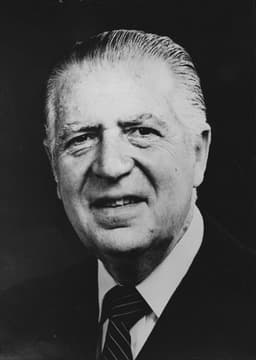
Fernando Belaunde Terry
Politician · Modern
54.4Total
Mingju
Politician · Modern
52.6Total
Basic Information
Born
1912
1635
Died
2002
1708
Era
Modern
Modern
Nationality
Peru
China
Occupation
Politician
Politician
Civilization
Western
Eastern
Score Comparison
Military (10%)
50.0
14.5
Political (20%)
68.0
68.0
Influence (20%)
53.3
51.8
Legacy (20%)
45.0
45.0
Leadership (15%)
68.0
72.0
Strategy (15%)
44.1
59.5
TOTAL
54.4
52.6
Fernando Belaunde Terry — Complete Timeline
1963 AD
Elected President of PeruPolitical Action◆ Major
Fernando Bela
ElectionCivilian Rule
Impact: nationalconstructive
1968 AD
Overthrown by military coupPolitical Action
General Juan Velasco Alvarado led a military coup that overthrew President Bela
CoupOverthrowMilitary
Impact: nationaldestructive
Exiled to the United StatesPolitical Action
After being overthrown, Bela
ExilePersonal
Impact: nationaltragic
1980 AD
Re-elected President of PeruPolitical Action
After 12 years of military rule, Bela
ElectionReturn to Democracy
Impact: nationalconstructive
1981 AD
Initiated the Marginal Forest Highway projectReform◆ Major
Belaúnde Terry launched the Marginal Forest Highway (Carretera Marginal de la Selva) project, a major infrastructure initiative to integrate the Amazon region into the national economy. The project aimed to promote colonization and development but faced environmental and social criticism.
InfrastructureDevelopmentAmazon
Impact: nationalconstructive
Mingju — Complete Timeline
1677 AD
Appointed Grand SecretaryPolitical Action◆ Major
Mingju was appointed Grand Secretary of the Qing Empire, serving under the Kangxi Emperor. He became a key figure in the central government, overseeing administrative reforms and military logistics during the early Qing period.
AppointmentGovernmentKangxi Era
Impact: national
1681 AD
Led Suppression of the Revolt of the Three FeudatoriesWar◆ Major
Mingju played a key role in planning and coordinating the Qing military campaign to suppress the Revolt of the Three Feudatories, a rebellion by southern warlords. The campaign succeeded in 1681, consolidating Qing control over southern China.
RebellionMilitary CampaignQing Consolidation
Impact: national
1688 AD
Dismissed from OfficePolitical Action◆ Major
Mingju was dismissed from his position as Grand Secretary following accusations of corruption and factionalism. His removal was part of the Kangxi Emperor's efforts to curb the power of influential officials and reduce bureaucratic corruption.
PurgeCorruptionDownfall
Impact: nationaldestructive
Expert Analysis
Origins
Fernando Belaunde Terry was born on October 7, 1912, in Lima, Peru, into a politically active family. His father was a diplomat and his uncle a former president. He studied architecture at the University of Texas at Austin, graduating in 1935. His background in architecture shaped his focus on infrastructure and national development.
Mingju (1636-1708) was born into a Manchu noble family of the Nara clan. He entered the imperial court as a young man, serving as a guard before rising through bureaucratic ranks. His family's status and his own intelligence allowed him to become a close confidant of the Kangxi Emperor.
Rise to Power
Belaunde's political career began in 1945 when he was elected to the Peruvian Congress. He founded the Popular Action party in 1956 and ran for president in 1962, but the election was annulled. In 1963, he won the presidency with 39.1% of the vote, ending a period of military rule. His first term (1963-1968) focused on infrastructure projects, including the Marginal Forest Highway. However, he was overthrown by a military coup led by General Juan Velasco Alvarado on October 3, 1968, after a dispute over a contract with the International Petroleum Company.
Mingju rose to power through his service to the Kangxi Emperor. He was appointed Grand Secretary in 1677, becoming one of the highest-ranking officials in the Qing government. He gained influence by supporting the emperor during the Revolt of the Three Feudatories (1673-1681), where he helped coordinate military strategy. His political acumen and loyalty earned him the emperor's trust.
Leadership & Governance
Belaunde's leadership was characterized by a democratic, reformist approach. He promoted agrarian reform, expanded education, and launched infrastructure projects like the Marginal Forest Highway to integrate the Amazon region. However, his government faced economic difficulties, including inflation and foreign debt. Politically, he scored 68.0, reflecting his commitment to democracy but limited effectiveness.
Mingju governed as a powerful grand secretary, managing the Qing bureaucracy. He was instrumental in the suppression of the Three Feudatories, demonstrating strategic thinking (score 59.5). However, he became involved in factional politics and was accused of corruption. The Kangxi Emperor dismissed him in 1688, citing his accumulation of wealth and power. Mingju's leadership score of 72.0 reflects his administrative capability, but his legacy is tainted by corruption.
Triumph & Tragedy
Belaunde's greatest triumph was his return to the presidency in 1980 after 12 years of military rule. He oversaw a peaceful transition to democracy and continued infrastructure projects. However, his second term was marred by economic crisis, hyperinflation, and the rise of the Shining Path insurgency. His failure to control the economy and violence led to his approval rating dropping to 18% by 1985.
Mingju's triumph was his role in defeating the Three Feudatories, which secured Qing control over southern China. He also helped consolidate the empire's administrative systems. His tragedy was his fall from power due to corruption and factionalism. His dismissal ended his career and led to a period of disgrace.
Character & Destiny
Belaunde was an idealist, focused on long-term infrastructure and democracy but often naive about political realities. His architectural background influenced his vision but also made him prioritize projects over fiscal discipline. His scores: Military 50.0 (moderate, as he was not a military leader), Political 68.0, Strategy 44.1 (reflecting his lack of strategic economic management).
Mingju was pragmatic and ambitious, skilled in navigating court politics. His strategic score of 59.5 indicates competence in military planning. However, his greed and factionalism led to his downfall. The Kangxi Emperor valued loyalty and efficiency, and Mingju's corruption violated those principles.
Legacy
Belaunde's legacy is mixed. He is remembered as a democrat who restored civilian rule in 1980, but his economic policies contributed to the crisis of the 1980s. The Marginal Forest Highway remains incomplete but symbolizes his vision of national integration. His political score of 68.0 and legacy score of 45.0 reflect his impact.
Mingju's legacy is primarily as a capable but corrupt official. He is not as well-known as other Qing figures. His role in the suppression of the Three Feudatories is noted, but his corruption overshadows his achievements. He scored 45.0 in legacy, similar to Belaunde.
Conclusion
Fernando Belaunde Terry had a slightly greater overall impact, with a total score of 54.4 vs Mingju's 52.6. Belaunde's commitment to democracy and infrastructure had lasting effects on Peru's political development, even if his economic management was flawed. Mingju's contributions to Qing stability were significant but his corruption limited his positive legacy. Belaunde's influence on modern Peru's democratic institutions outweighs Mingju's administrative role. Thus, Belaunde is the more impactful figure.
Rankings
🥇
Fernando Belaunde TerryLeader
Mil: 50.0Pol: 68.0Inf: 53.3
54.4
🥈
Mingju
Mil: 14.5Pol: 68.0Inf: 51.8
52.6
+1.8 behind
How This Comparison Works
Algorithm
Each figure is scored on 6 dimensions (0—100 scale) based on structured historical data: Military (10%), Political (20%), Influence (20%), Legacy (20%), Leadership (15%), Strategy (15%). The weighted total produces the final ranking.
Data Sources
Scores are computed from structured sub-indicators in the database. Scale factors adjust for era (Ancient ×0.85, Modern ×1.0) and civilization size (Eastern ×1.05, Other ×0.80) to account for differences in population and military scale.
Maximum 3 Figures
Comparisons are limited to 2—3 figures to ensure readability and statistical meaningfulness.
Error Margins
±5 points per dimension — Sub-scores are derived from historical records with inherent uncertainty. Two figures within 5 points on a dimension should be considered roughly equivalent in that area.
Total Score Accuracy
±3 points overall — The weighted combination of 6 dimensions produces a total score with approximately ±3 points of uncertainty. Differences of less than 3 points are not statistically significant— the figures are effectively tied.
Known Limitations
- Historical records are incomplete and uneven across civilizations
- Figures from oral-tradition societies may be underrepresented
- Occupation labels can misclassify multi-role figures
- Scores measure capability and impact, not moral character
- Quantitative scoring is a comparison tool, not absolute truth
Capability Radar
Military (10%) — Battles & Warfare
Battles
30
54
Win Rate
32
56
Expansion
32
59
Political (20%) — Governance & Reform
Reform
60
55
Diplomacy
55
60
Economy
50
50
Influence (20%) — Cultural & Global Reach
Cultural
35
30
Global
25
20
Legacy (20%) — Historical Impact
Historical
40
40
Longevity
30
30
Leadership (15%) — Power & Stability
Tenure
65
65
Stability
40
55
Strategy (15%) — Tactics & Innovation
Strategy
40
60
Tactics
42
62
Reform
46
64
Similar Comparisons
Comments & Discussion
No comments yet. Be the first to share your thoughts!