Loading...
Francisco Macias Nguema vs Napoleon Bonaparte
Napoleon Bonaparte leads by 16.7 pts · 2 figures compared
…
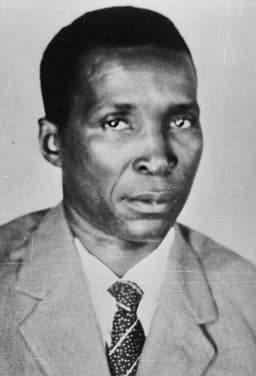
Francisco Macias Nguema
Politician · Modern
54.2Total

Napoleon Bonaparte
General · Modern
70.9Total
Basic Information
Born
1924
1769
Died
—
1821
Era
Modern
Modern
Nationality
Equatorial Guinea
France
Occupation
Politician
General
Civilization
Other
Western
Score Comparison
Military (10%)
50.0
94.0
Political (20%)
68.0
72.0
Influence (20%)
60.0
40.0
Legacy (20%)
40.8
80.0
Leadership (15%)
62.9
78.0
Strategy (15%)
43.3
90.0
TOTAL
54.2
70.9
Francisco Macias Nguema — Complete Timeline
1968 AD
Became First President of Equatorial GuineaPolitical Action◆ Major
Francisco Macias Nguema was elected as the first president of Equatorial Guinea upon its independence from Spain. He quickly consolidated power, establishing a one-party state and eliminating political opponents.
IndependenceFirst PresidentAuthoritarianism
Impact: national
1972 AD
Declared Himself President for LifePolitical Action
Macias Nguema declared himself President for Life, centralizing all power in his hands. He initiated a reign of terror, ordering the execution of thousands of political opponents, intellectuals, and perceived enemies.
DictatorshipRepressionHuman Rights Abuses
Impact: nationaldestructive
1979 AD
Overthrown and ExecutedPolitical Action
Macias Nguema was overthrown in a coup led by his nephew Teodoro Obiang Nguema Mbasogo. He was captured, tried for crimes including genocide and treason, and executed by firing squad. His regime had caused the death of an estimated 50,000 people.
CoupExecutionEnd of Tyranny
Impact: nationaltragic
Napoleon Bonaparte — Complete Timeline
1799 AD
Coup of 18 BrumaireOther◆ Major
Napoleon Bonaparte, with support from his brother Lucien and key political figures, overthrew the Directory in a bloodless coup. He established the Consulate with himself as First Consul, effectively becoming the ruler of France. This event ended the French Revolution's most unstable period.
French RevolutionCoupRise to Power
Impact: regional
1804 AD
Promulgation of the Napoleonic CodeOther◆ Major
Napoleon enacted the Civil Code of the French, known as the Napoleonic Code, a comprehensive set of laws that replaced the fragmented feudal legal systems. The code established legal equality, protected property rights, and secularized law. It became the basis for legal systems in many European and world countries.
Legal ReformNapoleonic CodeCivil Law
Impact: globalconstructive
1805 AD
Battle of AusterlitzWar◆ Major
Napoleon's Grande Arm
Napoleonic WarsBattleDecisive Victory
Impact: global
1812 AD
Invasion of RussiaWar◆ Major
Napoleon led the Grande Arm
Napoleonic WarsInvasionDisaster
Impact: globaldestructive
1815 AD
Battle of WaterlooWar◆ Major
Napoleon's French army was defeated by the combined forces of the Duke of Wellington's Anglo-Allied army and Gebhard Leberecht von Bl
Napoleonic WarsBattleFinal Defeat
Impact: globaldestructive
Expert Analysis
francisco-macias-nguema-vs-napoleon-bonaparte
# The Emperor and the Tyrant: Two Paths to Absolute Power
On a June morning in 1815, Napoleon Bonaparte stood on a muddy field near Waterloo, watching his Imperial Guard march into certain death. The man who had once crowned himself Emperor of Europe was about to taste final defeat. One hundred and sixty-four years later, on another continent, Francisco Macías Nguema fled into the jungles of Equatorial Guinea, his reign of terror collapsing as his own nephew turned against him. Both men seized absolute power. Both fell from grace. But the chasm between them reveals something profound about how ambition meets opportunity, and how character shapes destiny.
Origins
Napoleon was born in 1769 on the rugged island of Corsica, a place that had only recently become French. His family was minor nobility, poor enough to hunger for advancement but privileged enough to send him to military school. There, the short, intense boy with a thick accent endured the mockery of wealthy classmates. That humiliation forged something—a burning will to prove himself, a mind that devoured history and strategy, and a conviction that greatness was his birthright.
Macías Nguema arrived in 1924 in the village of Nsegayong, deep in the forests of Spanish Guinea. His father was a witch doctor, his people the Fang ethnic group. Under Spanish colonial rule, he learned to navigate a world of white administrators and Catholic missionaries, eventually becoming a clerk and later a mayor. Where Napoleon had been shaped by the Enlightenment and the French Revolution, Macías was shaped by colonial humiliation and the sudden, bewildering gift of independence.
Rise to Power
Napoleon’s ascent was a masterpiece of timing and talent. The French Revolution had shattered the old order, and by 1793, at age twenty-four, he had already distinguished himself at the Siege of Toulon. He understood artillery, but more importantly, he understood men. In 1796, he married Joséphine de Beauharnais and took command of a starving, mutinous army in Italy. Within months, he had turned those ragged soldiers into a conquering force, winning battles with dazzling speed and rewarding his men with plunder. By 1799, he was First Consul of France.
Macías Nguema’s rise was quieter but no less calculated. In 1968, Spain granted independence to Equatorial Guinea, and Macías, a former civil servant with a gift for fiery speeches, was elected president. He was not a military genius. He was a politician who understood fear. Within four years, in 1972, he declared himself President for Life. He banned opposition parties, shut down newspapers, and expelled foreigners. Where Napoleon had conquered nations, Macías conquered his own people.
Leadership and Governance
Napoleon governed as he fought—with relentless energy and a vision of order. He reformed French law into the Napoleonic Code, a system that enshrined equality before the law, protected property, and secularized the state. He built roads, founded banks, and established lycées to educate a new elite. His rule was authoritarian but rational. He believed in merit, promoting officers based on ability, not birth. Yet his brilliance came with a fatal flaw: he could not stop. Each victory demanded another, and the empire grew too vast for one man to hold.
Macías governed through terror. He murdered his political rivals, including members of his own cabinet. He banned fishing and farming, forcing villagers into labor camps. He ordered the execution of anyone who could read or write, seeing educated citizens as threats. By 1974, an estimated one-third of Equatorial Guinea’s population had fled or been killed. There was no code, no vision, only paranoia and the cult of a single man. His score for political leadership—69.3—reflects a cunning that kept him in power for eleven years, but his military score of 30.2 reveals the truth: he was no strategist, only a butcher.
Triumph and Tragedy
Napoleon’s greatest moment was Austerlitz in 1805, where he destroyed the combined armies of Russia and Austria in a battle still studied in military academies. His tragedy was Russia in 1812—a catastrophic invasion that cost half a million lives and broke his army. He was exiled to Elba, escaped, and returned for one hundred days before Waterloo ended everything. His scores—94 for military genius, 93 for strategy—tell of a man who could win any battle but could not win the war against his own ambition.
Macías Nguema had no Austerlitz. His triumph was simply surviving, year after year, as the bodies piled up. His tragedy came in 1979, when his nephew, Teodoro Obiang, led a coup. Macías was captured, tried for genocide, and executed. He left behind a country in ruins, a population reduced by a third, and a legacy of pure horror. His influence score of 73.5 is a chilling testament to how much damage one man can do.
Character and Destiny
Napoleon believed he was a force of nature. “Impossible is a word to be found only in the dictionary of fools,” he once said. His confidence was his engine and his undoing. He could not delegate, could not compromise, could not rest. He died in 1821 on Saint Helena, a prisoner of the British, still dreaming of glory.
Macías believed he was a god. He changed his name to include “Nguema,” a Fang term for a powerful spirit. He banned the word “intellectual” and forced citizens to chant his name in church. His paranoia consumed him, and in the end, he was betrayed by his own blood. He died not on a distant island but in a prison courtyard, executed by the nephew he had trusted.
Legacy
Napoleon’s legacy is written across Europe—in law codes, in city streets, in the very idea of the modern state. He is remembered as a brilliant general and a flawed ruler, a man who spread revolutionary ideals and then crushed them under his crown. His scores—82 for influence, 78 for legacy—reflect a figure who shaped the world, for better and worse.
Macías Nguema is remembered as a warning. His name appears in textbooks as an example of post-colonial tyranny, a man who turned independence into a death sentence. His legacy is measured in absence—the people who were never born, the villages that vanished, the culture that was silenced. His total score of 61.6 is not a measure of greatness but of damage.
Conclusion
Napoleon and Macías both rose from obscurity to absolute power. Both fell because they could not control what they had unleashed. But Napoleon’s story is one of genius corrupted by ambition; Macías’s is one of mediocrity armed with a gun. One conquered Europe; the other destroyed a country. One left a legacy that still shapes law and war; the other left a scar on a small African nation. In the end, the difference is not in the power they seized but in what they chose to do with it. Napoleon built an empire. Macías built a grave. History remembers both, but it does not judge them equally.
Rankings
🥇
Napoleon BonaparteLeader
Mil: 94.0Pol: 72.0Inf: 40.0
70.9
🥈
Francisco Macias Nguema
Mil: 50.0Pol: 68.0Inf: 60.0
54.2
+16.7 behind
How This Comparison Works
Algorithm
Each figure is scored on 6 dimensions (0—100 scale) based on structured historical data: Military (10%), Political (20%), Influence (20%), Legacy (20%), Leadership (15%), Strategy (15%). The weighted total produces the final ranking.
Data Sources
Scores are computed from structured sub-indicators in the database. Scale factors adjust for era (Ancient ×0.85, Modern ×1.0) and civilization size (Eastern ×1.05, Other ×0.80) to account for differences in population and military scale.
Maximum 3 Figures
Comparisons are limited to 2—3 figures to ensure readability and statistical meaningfulness.
Error Margins
±5 points per dimension — Sub-scores are derived from historical records with inherent uncertainty. Two figures within 5 points on a dimension should be considered roughly equivalent in that area.
Total Score Accuracy
±3 points overall — The weighted combination of 6 dimensions produces a total score with approximately ±3 points of uncertainty. Differences of less than 3 points are not statistically significant— the figures are effectively tied.
Known Limitations
- Historical records are incomplete and uneven across civilizations
- Figures from oral-tradition societies may be underrepresented
- Occupation labels can misclassify multi-role figures
- Scores measure capability and impact, not moral character
- Quantitative scoring is a comparison tool, not absolute truth
Capability Radar
Military (10%) — Battles & Warfare
Battles
21
95
Win Rate
27
90
Expansion
30
95
Political (20%) — Governance & Reform
Reform
0
95
Diplomacy
0
80
Economy
0
85
Influence (20%) — Cultural & Global Reach
Cultural
0
85
Global
0
90
Legacy (20%) — Historical Impact
Historical
5
95
Longevity
0
90
Leadership (15%) — Power & Stability
Tenure
11
85
Stability
0
70
Strategy (15%) — Tactics & Innovation
Strategy
28
95
Tactics
32
98
Reform
37
92
Similar Comparisons
Comments & Discussion
**历史真话人**6/17/2026
别拿殖民地的孩子去比欧洲的皇帝。马西亚斯该死,但拿破仑手上也沾满了海地和西班牙的鲜血。关键区别?拿破仑有书、有地图、有欧洲知识界给他擦屁股;马西亚斯只有丛林里的巫术和西班牙殖民者的残羹剩饭。你们所谓的“遗泽”,不过是胜者的自吹自擂罢了。
**The Grand Strategist**6/17/2026
Comparing Macías to Napoleon is like comparing a rabid dog to a lion. Napoleon actually understood what he was doing—his reforms still shape Europe’s legal systems today. Macías just butchered his own people out of paranoia, destroying a country that had no real army. One built a legacy; the other left a crater. There’s no “chasm” here—it’s a clear hierarchy of historical significance.
**追忆古典**6/17/2026
拿破仑是历史的飓风,马西亚斯不过是一阵恶臭的气流。前者重写了整个大陆的版图,后者只懂挥舞砍刀。你把拿破仑的法典和学府,跟一个翻白眼自封“唯一奇迹”之人的荒唐统治相提并论?小巴拉斯和大陆封锁的教训,你们根本没看懂。
Chronicler83426/17/2026
You’re underselling Macías’s terror. He turned his country into a killing farm, executing every educated person he could find. Napoleon fought wars with rules—Macías literally had no state, just a cult of fear. But here’s the real point: Napoleon’s ambition consumed Europe; Macías’s only consumed Equatorial Guinea. One was a global tragedy, the other a local one. Still a tragedy, though.
Chronicler36456/17/2026
Statistically, this comparison collapses. Napoleon governed 70 million Europeans and fought battles with 600,000 men; Macías ruled over 300,000 people and killed maybe 50,000. That’s a massacre, not a conquest. The data doesn’t lie: one expanded his empire through logistics and strategy, the other just emptied his prisons. You’re romanticizing two entirely different orders of magnitude.