Loading...
Frederick II of Hohenstaufen vs Napoleon Bonaparte
Napoleon Bonaparte leads by 11.6 pts · 2 figures compared
…
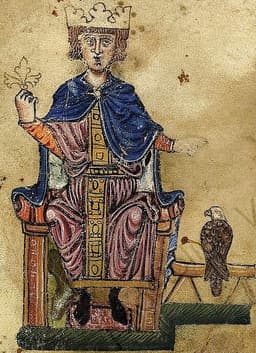
Frederick II of Hohenstaufen
Emperor · Medieval
59.3Total

Napoleon Bonaparte
General · Modern
70.9Total
Basic Information
Born
1194
1769
Died
1250
1821
Era
Medieval
Modern
Nationality
Holy Roman Empire
France
Occupation
Emperor
General
Civilization
Western
Western
Score Comparison
Military (10%)
40.0
94.0
Political (20%)
72.0
72.0
Influence (20%)
72.0
40.0
Legacy (20%)
52.0
80.0
Leadership (15%)
53.2
78.0
Strategy (15%)
55.0
90.0
TOTAL
59.3
70.9
Frederick II of Hohenstaufen — Complete Timeline
1220 AD
Coronation as Holy Roman EmperorPolitical Action◆ Major
Frederick II was crowned Holy Roman Emperor by Pope Honorius III in Rome. This coronation confirmed his authority over Germany and Italy, but also set the stage for a long conflict with the papacy over imperial power in Italy.
CoronationHoly Roman EmpirePapacy
Impact: global
1229 AD
Sixth Crusade and Treaty of JaffaWar◆ Major
Frederick II led the Sixth Crusade, negotiating the Treaty of Jaffa with Sultan al-Kamil. Through diplomacy, he regained control of Jerusalem, Bethlehem, and Nazareth without battle, but was excommunicated by the Pope for negotiating with Muslims.
CrusadeDiplomacyJerusalemExcommunication
Impact: globalconstructive
1231 AD
Promulgation of the Constitutions of MelfiReform◆ Major
Frederick II issued the Constitutions of Melfi, a comprehensive legal code for the Kingdom of Sicily. This code centralized royal authority, reformed the administration, and established a modern state based on Roman law.
LawReformSicily
Impact: regionalconstructive
1237 AD
Conflict with the Lombard LeagueWar◆ Major
Frederick II defeated the Lombard League at the Battle of Cortenuova, aiming to assert imperial control over northern Italy. His victory was followed by harsh reprisals, which alienated many Italian cities and strengthened papal opposition.
BattleItalyLombard League
Impact: regionaldestructive
1245 AD
Excommunication by Pope Innocent IV at the Council of LyonPolitical Action◆ Major
Pope Innocent IV declared Frederick II deposed at the First Council of Lyon, accusing him of heresy, sacrilege, and tyranny. This excommunication intensified the conflict between the Empire and the Papacy, leading to a war of propaganda.
ExcommunicationPapacyConflict
Impact: globaldestructive
1250 AD
Death and end of the Hohenstaufen dynastyOther◆ Major
Frederick II died of dysentery at Castel Fiorentino. His death marked the beginning of the end for the Hohenstaufen dynasty, as his sons were unable to maintain control, leading to the Great Interregnum in the Holy Roman Empire.
DeathHohenstaufenInterregnum
Impact: globaltragic
Napoleon Bonaparte — Complete Timeline
1799 AD
Coup of 18 BrumaireOther◆ Major
Napoleon Bonaparte, with support from his brother Lucien and key political figures, overthrew the Directory in a bloodless coup. He established the Consulate with himself as First Consul, effectively becoming the ruler of France. This event ended the French Revolution's most unstable period.
French RevolutionCoupRise to Power
Impact: regional
1804 AD
Promulgation of the Napoleonic CodeOther◆ Major
Napoleon enacted the Civil Code of the French, known as the Napoleonic Code, a comprehensive set of laws that replaced the fragmented feudal legal systems. The code established legal equality, protected property rights, and secularized law. It became the basis for legal systems in many European and world countries.
Legal ReformNapoleonic CodeCivil Law
Impact: globalconstructive
1805 AD
Battle of AusterlitzWar◆ Major
Napoleon's Grande Arm
Napoleonic WarsBattleDecisive Victory
Impact: global
1812 AD
Invasion of RussiaWar◆ Major
Napoleon led the Grande Arm
Napoleonic WarsInvasionDisaster
Impact: globaldestructive
1815 AD
Battle of WaterlooWar◆ Major
Napoleon's French army was defeated by the combined forces of the Duke of Wellington's Anglo-Allied army and Gebhard Leberecht von Bl
Napoleonic WarsBattleFinal Defeat
Impact: globaldestructive
Expert Analysis
frederick-ii-of-hohenstaufen-vs-napoleon-bonaparte
# The Emperor and the Conqueror: Two Visions of Power
On a December morning in 1805, Napoleon Bonaparte stood on a hill overlooking the frozen battlefield of Austerlitz, watching his Grand Army shred the combined forces of Russia and Austria. Six hundred years earlier, another emperor—Frederick II of Hohenstaufen—had stood on the walls of Jerusalem, not with a sword but with a treaty, having negotiated the Holy City back into Christian hands without a single casualty. Both men reshaped their worlds. Yet one built an empire that crumbled within a decade, while the other left a legacy that still echoes in law and diplomacy. What drove these two masters of power to such different ends?
Origins
Napoleon was born in 1769 on the island of Corsica, a remote outpost recently annexed by France. His family were minor nobles, proud and impoverished. He spoke Italian before French, and the sting of being an outsider never left him. France’s revolutionary chaos became his ladder: a young artillery officer with nothing to lose and everything to prove.
Frederick II, born in 1194, was the grandson of the legendary Barbarossa. His inheritance was a crown—but also a curse. Orphaned young, he grew up in the violent streets of Palermo, surrounded by the multicultural swirl of Norman Sicily. Where Napoleon learned ambition from poverty, Frederick learned cunning from survival. He absorbed Arabic, Greek, and Latin; he studied falconry, astronomy, and law. His world was not revolutionary France but the tangled web of papal power, crusading zeal, and feudal loyalty.
Rise to Power
Napoleon’s ascent was meteoric. At 24, he crushed a royalist uprising in Paris with a "whiff of grapeshot." At 26, he led a brilliant campaign in Italy, turning raw recruits into a conquering army. By 30, he was First Consul of France. The key event was the 1799 coup of 18 Brumaire—a gamble that paid off because France craved order after revolution’s bloodbath. His path was war, and war made him.
Frederick’s rise was slower, more tortuous. Crowned Holy Roman Emperor in 1220 by Pope Honorius III, he had to navigate the treacherous politics of Christendom. His great turning point came in 1229, during the Sixth Crusade. Unlike Napoleon, who fought for glory, Frederick negotiated. The Treaty of Jaffa gave Jerusalem back to Christians without a battle. It was a stunning diplomatic victory—but it also enraged the Pope, who saw it as a betrayal of crusading ideals. Frederick’s rise was not through battlefield brilliance but through a mind that saw negotiation as a form of warfare.
Leadership & Governance
Napoleon governed with the energy of a storm. He reformed France’s legal system with the Napoleonic Code, a rational, secular framework that abolished feudal privileges and established meritocracy. He centralized education, built roads, and stabilized the currency. But his governance was inseparable from his ambition: every reform served the war machine. His military genius—scoring 94.0 in strategy—was unmatched: he could read a battlefield like a chessboard, using speed, deception, and devastating artillery. Yet his political score of 75.0 reflects a fatal flaw: he could conquer but not consolidate.
Frederick II’s governance was quieter but deeper. In 1231, he issued the Constitutions of Melfi, a legal code for the Kingdom of Sicily that remains a landmark. It centralized royal power, curbed feudal lords, protected religious minorities (including Muslims and Jews), and established a professional bureaucracy. His court in Palermo was a laboratory of ideas: he patronized scholars, translated Arabic texts, and wrote a treatise on falconry. His military score of 34.6 is low, but his political score of 75.0 matches Napoleon’s. He understood that lasting power comes from institutions, not campaigns.
Triumph & Tragedy
Napoleon’s greatest moment was Austerlitz in 1805, where he destroyed a larger Russo-Austrian army and forced the Holy Roman Empire to dissolve. His tragedy was the 1812 invasion of Russia—a catastrophic overreach that cost half a million lives. Then came Waterloo in 1815, where his genius met the iron discipline of Wellington and Prussian reinforcements. He ended his days on Saint Helena, a prisoner of the British, dictating memoirs.
Frederick’s triumph was the Treaty of Jaffa—a peaceful recovery of Jerusalem that shocked Europe. His tragedy was the relentless war with the Papacy. In 1245, Pope Innocent IV excommunicated him at the Council of Lyon, declaring him deposed. The accusation—heresy, sacrilege, tyranny—was political, but it shattered his legitimacy. He spent his final years fighting a losing battle against papal propaganda and rebellious nobles. He died of dysentery in 1250 at Castel Fiorentino, and with him died the Hohenstaufen dynasty.
Character & Destiny
Napoleon was a creature of will. He believed he could bend history to his ambition. His personality—restless, arrogant, brilliant—drove him to conquer, but it also blinded him to limits. He could not share power, could not compromise, could not stop. His destiny was shaped by his refusal to accept any boundary.
Frederick was a creature of intellect. He saw power as a game of balance: between pope and emperor, Christian and Muslim, law and custom. His personality—curious, skeptical, aloof—allowed him to see the world in shades of gray. But his detachment also made him vulnerable. He had no popular base, no nationalist fervor to rally. When the Pope turned the Church against him, he had only his wits—and wits alone cannot hold an empire.
Legacy
Napoleon’s legacy is double-edged. He is remembered as a military genius and a tyrant, a reformer and a warmonger. The Napoleonic Code shaped modern law across Europe and beyond. His total score of 82.4 reflects his towering influence—but also his ultimate failure. France remembers him as a hero; Europe remembers him as the man who drowned a continent in blood.
Frederick II’s legacy is quieter but perhaps more profound. He is remembered as *Stupor Mundi*—the Wonder of the World. His Constitutions of Melfi influenced later legal systems. His model of religious tolerance and intellectual curiosity was centuries ahead of its time. Yet his total score of 65.7 reflects the fragility of his achievement: without a dynasty, without a nation, his empire dissolved.
Conclusion
Standing at their respective precipices—Napoleon at Austerlitz, Frederick at Jerusalem—both men glimpsed the same truth: that power is a fleeting gift. But they answered it differently. Napoleon tried to seize eternity by force, and it slipped through his fingers. Frederick tried to build eternity through institutions, and it outlasted his dynasty. In the end, the conqueror’s glory fades faster than the lawgiver’s code. Perhaps the real lesson is not about their differences, but about the choices that define all leaders: whether to bend the world to your will, or to leave it a better shape than you found it.
Rankings
🥇
Napoleon BonaparteLeader
Mil: 94.0Pol: 72.0Inf: 40.0
70.9
🥈
Frederick II of Hohenstaufen
Mil: 40.0Pol: 72.0Inf: 72.0
59.3
+11.6 behind
How This Comparison Works
Algorithm
Each figure is scored on 6 dimensions (0—100 scale) based on structured historical data: Military (10%), Political (20%), Influence (20%), Legacy (20%), Leadership (15%), Strategy (15%). The weighted total produces the final ranking.
Data Sources
Scores are computed from structured sub-indicators in the database. Scale factors adjust for era (Ancient ×0.85, Modern ×1.0) and civilization size (Eastern ×1.05, Other ×0.80) to account for differences in population and military scale.
Maximum 3 Figures
Comparisons are limited to 2—3 figures to ensure readability and statistical meaningfulness.
Error Margins
±5 points per dimension — Sub-scores are derived from historical records with inherent uncertainty. Two figures within 5 points on a dimension should be considered roughly equivalent in that area.
Total Score Accuracy
±3 points overall — The weighted combination of 6 dimensions produces a total score with approximately ±3 points of uncertainty. Differences of less than 3 points are not statistically significant— the figures are effectively tied.
Known Limitations
- Historical records are incomplete and uneven across civilizations
- Figures from oral-tradition societies may be underrepresented
- Occupation labels can misclassify multi-role figures
- Scores measure capability and impact, not moral character
- Quantitative scoring is a comparison tool, not absolute truth
Capability Radar
Military (10%) — Battles & Warfare
Battles
45
95
Win Rate
40
90
Expansion
50
95
Political (20%) — Governance & Reform
Reform
85
95
Diplomacy
80
80
Economy
75
85
Influence (20%) — Cultural & Global Reach
Cultural
75
85
Global
60
90
Legacy (20%) — Historical Impact
Historical
70
95
Longevity
65
90
Leadership (15%) — Power & Stability
Tenure
65
85
Stability
55
70
Strategy (15%) — Tactics & Innovation
Strategy
55
95
Tactics
60
98
Reform
70
92
Similar Comparisons
Comments & Discussion
HoopHistory6/17/2026
Frederick didn't earn his Jerusalem—he talked his way in while crusaders bled. Napoleon at Austerlitz crushed three armies in a day, rewriting warfare overnight. Frederick's "diplomatic" victory was a paper treaty that fell apart, but Napoleon's battlefield legacy gave us modern combined-arms tactics. Give me the man who wins with steel, not ink.
铁鹰守墓人6/17/2026
拿巴布的军事天才无可争议,但腓特烈二世的《梅尔菲宪章》才是真正超前——他建立了中央集权的官僚国家,比拿破仑的《民法典》早六百年。拿破仑的帝国十年崩塌,腓特烈的西西里王国却让神圣罗马帝国羡慕了半个世纪。谁更接近不朽的权力本质?
古典学人6/17/2026
拿破仑的《法国民法典》确实奠基了现代法律,但腓特烈二世的《特里卡梅农法令》奠定了第一个非宗教的世俗法律体系。别忘了,腓特烈是第一个建立国立大学的君主——那不勒斯大学比拿破仑的帝国大学早六百年。拿破仑复制了理性和秩序,腓特烈创造了它。
Historian2426/17/2026
Stop romanticizing Frederick's "multicultural" Palermo. He used Muslims as military slaves and tax farmers, then crusaded against them. Napoleon at least treated Jews as equals. Frederick's Constitution of Melfi kept serfdom intact; Napoleon's Code abolished feudalism everywhere he conquered. The Hohenstaufen was a brilliant medieval politician. Napoleon was a modern transformer. That's the real legacy gap.
Chronicler96356/17/2026
Check the numbers: Napoleon commanded 600,000 men at his peak, while Frederick II raised maybe 8,000 troops max. Yet Frederick ruled from Italy to Germany to Jerusalem without a single major military defeat. Napoleon's disaster in Russia lost a million men. Scale favors Napoleon, but efficiency—men controlled per square mile—leans strongly to Frederick. Context matters.