Loading...
Frederick III of Germany vs King Gojong of Korea
King Gojong of Korea leads by 12.3 pts · 2 figures compared
…

Frederick III of Germany
Emperor · Modern
40.5Total
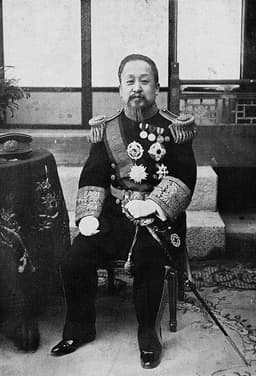
King Gojong of Korea
Emperor · Modern
52.8Total
Basic Information
Born
1831
1852
Died
1888
1919
Era
Modern
Modern
Nationality
Germany
Korea
Occupation
Emperor
Emperor
Civilization
Western
Eastern
Score Comparison
Military (10%)
21.2
50.0
Political (20%)
40.8
68.0
Influence (20%)
51.0
56.4
Legacy (20%)
40.0
48.3
Leadership (15%)
34.6
40.0
Strategy (15%)
43.7
54.6
TOTAL
40.5
52.8
Frederick III of Germany — Complete Timeline
1858 AD
Married Victoria, Princess Royal of the United KingdomPolitical Action
Frederick III married Victoria, the eldest daughter of Queen Victoria of the United Kingdom. The marriage was intended to strengthen Anglo-Prussian ties and influenced Frederick's liberal views, but also created tensions with Bismarck's conservative policies.
MarriageDiplomacyAnglo-Prussian Relations
Impact: regionalconstructive
1887 AD
Diagnosed with Throat CancerOther◆ Major
Frederick III was diagnosed with laryngeal cancer in 1887. Despite a tracheotomy and treatment, the cancer proved fatal. His illness and death prevented the implementation of his liberal-leaning policies, which might have altered Germany's political trajectory.
HealthCancerSuccession
Impact: nationaltragic
1888 AD
Reigned as German Emperor for 99 DaysPolitical Action◆ Major
Frederick III ascended the German throne on March 9, 1888, but died of throat cancer on June 15, 1888, after only 99 days. His brief reign, known as the Year of the Three Emperors, prevented any significant policy changes or reforms.
SuccessionDeathYear of Three Emperors
Impact: nationaltragic
King Gojong of Korea — Complete Timeline
1894 AD
Gabo ReformsReform◆ Major
Gojong's government implemented the Gabo Reforms, a series of modernization measures including the abolition of slavery, reform of the civil service exam, and adoption of a solar calendar. These reforms aimed to strengthen Korea against foreign encroachment.
ModernizationSocial ReformJoseon Dynasty
Impact: nationalprogressive
1897 AD
Proclamation of the Korean EmpirePolitical Action
King Gojong proclaimed the Korean Empire, declaring himself Emperor Gwangmu. This was an attempt to assert Korea's sovereignty and independence from foreign influence, particularly China and Japan, and to modernize the state.
Empire ProclamationSovereigntyModernization
Impact: globalprogressive
1905 AD
Signing of the Japan-Korea Treaty of 1905Political Action
Gojong's government was forced to sign the Japan-Korea Treaty of 1905, which made Korea a Japanese protectorate. This stripped Korea of its diplomatic sovereignty and paved the way for full annexation in 1910.
ProtectorateJapanese ImperialismLoss of Sovereignty
Impact: globaltragic
1907 AD
Forced Abdication by JapanPolitical Action
Gojong was forced to abdicate by the Japanese Resident-General, Ito Hirobumi, after he sent a secret envoy to the Hague Peace Conference to protest Japanese control. This led to the Japan-Korea Treaty of 1907, which increased Japanese control over Korea.
Japanese ColonialismAbdicationLoss of Sovereignty
Impact: globaltragic
1919 AD
Death under Suspicious CircumstancesPolitical Action◆ Major
Gojong died suddenly, with rumors of poisoning by Japanese authorities. His death sparked the March 1st Movement, a nationwide protest against Japanese rule, which became a pivotal event in the Korean independence movement.
DeathIndependence MovementJapanese Colonialism
Impact: nationaltragic
Expert Analysis
Origins
Frederick III was born on October 18, 1831, in Potsdam, Prussia, as the son of Prince William (later King William I of Prussia) and Princess Augusta of Saxe-Weimar-Eisenach. He was educated by liberal tutors and studied at the University of Bonn, where he was exposed to constitutional ideas. He married Victoria, Princess Royal of the United Kingdom, in 1858, which strengthened his liberal leanings. King Gojong was born on September 8, 1852, in Seoul, Korea, as the second son of Prince Heungseon. He was adopted into the royal family and became king at age 12 in 1864. His father, the Daewongun, acted as regent until 1873, shaping Gojong's early conservative education. Gojong later pursued modernization under pressure from Japan and Western powers.
Rise to Power
Frederick III became Crown Prince in 1861 after his father ascended the throne. He served as a commander in the Austro-Prussian War (1866) and Franco-Prussian War (1870-71), though his military role was limited. He was often sidelined by Chancellor Otto von Bismarck, who opposed his liberal views. He finally became German Emperor on March 9, 1888, after his father's death, but was already terminally ill with throat cancer. Gojong became king in 1864 under his father's regency. After the Daewongun's retirement in 1873, Gojong took direct rule. He faced the 1882 Imo Incident and 1894 Donghak Peasant Rebellion, which led to Chinese and Japanese intervention. In 1897, he proclaimed the Korean Empire, declaring himself Emperor Gwangmu to assert independence from China and Japan.
Leadership & Governance
Frederick III's leadership was largely theoretical due to his 99-day reign. He had liberal intentions, planning to appoint progressive ministers and reduce Bismarck's power, but his illness prevented action. His only significant act was dismissing the conservative Minister of Interior. In contrast, Gojong ruled for 43 years (1864-1907) and implemented the Gabo Reforms (1894-1896), which abolished slavery, reformed the civil service, and modernized the military. He also promoted industrialization and infrastructure, but his governance was undermined by factional infighting and Japanese interference. Gojong scored 68.0 in political leadership, while Frederick III scored only 40.8, reflecting the limited impact of his brief reign.
Triumph & Tragedy
Frederick III's greatest triumph was his symbolic role as a liberal hope for Germany, but his tragedy was his untimely death from throat cancer, which prevented any real change. His personal courage during his illness was notable, but his legacy is one of lost potential. Gojong's triumph was the proclamation of the Korean Empire in 1897, which temporarily elevated Korea's status. However, his tragedy was the loss of sovereignty to Japan: the Japan-Korea Treaty of 1905 made Korea a protectorate, and his forced abdication in 1907 after sending a secret envoy to the Hague Peace Conference. He died in 1919 under suspicious circumstances, possibly poisoned by Japanese agents. Gojong's military score of 50.0 reflects his inability to defend Korea, while Frederick III's military score of 21.2 shows his lack of military influence.
Character & Destiny
Frederick III was known for his liberal principles, honesty, and devotion to family, but his destiny was shaped by his fatal illness and Bismarck's dominance. He lacked the ruthlessness to challenge the establishment. Historian John C. G. Röhl described him as a "tragic figure" whose death sealed Germany's militaristic path. Gojong was more pragmatic and resilient, but indecisive and often manipulated by advisors. He tried to balance between reform and tradition, but his reliance on foreign powers (Russia, Japan) backfired. His character led to a mixed legacy: a monarch who sought independence but ultimately failed. Gojong's strategy score of 54.6 is higher than Frederick's 43.7, indicating better strategic maneuvering.
Legacy
Frederick III's legacy is minimal: his brief reign is remembered mainly for the "Three Emperors' Year" (1888) in Germany. His son Wilhelm II reversed his liberal policies, leading to World War I. Gojong's legacy is more profound: he is seen as a symbol of Korean resistance to Japanese colonialism. His death sparked the March 1st Movement in 1919, which strengthened the independence movement. The Korean Empire he proclaimed ended in 1910 with annexation, but his efforts inspired later leaders. Gojong's influence score of 56.4 is slightly higher than Frederick's 51.0, and his total score of 52.8 versus 40.5 reflects his greater impact.
Conclusion
King Gojong of Korea had a significantly greater impact than Frederick III of Germany. Gojong's 43-year reign, despite its failures, shaped modern Korean history and resistance to colonialism, while Frederick's 99-day rule produced no tangible change. Gojong's total score of 52.8 outperforms Frederick's 40.5 by 12.3 points, with advantages in military, political, influence, and strategy. Frederick III remains a historical footnote, a "what-if" of liberal reform in Germany, whereas Gojong's legacy continues to influence Korean national identity. The data clearly supports Gojong as the more consequential figure.
Rankings
🥇
King Gojong of KoreaLeader
Mil: 50.0Pol: 68.0Inf: 56.4
52.8
🥈
Frederick III of Germany
Mil: 21.2Pol: 40.8Inf: 51.0
40.5
+12.3 behind
How This Comparison Works
Algorithm
Each figure is scored on 6 dimensions (0—100 scale) based on structured historical data: Military (10%), Political (20%), Influence (20%), Legacy (20%), Leadership (15%), Strategy (15%). The weighted total produces the final ranking.
Data Sources
Scores are computed from structured sub-indicators in the database. Scale factors adjust for era (Ancient ×0.85, Modern ×1.0) and civilization size (Eastern ×1.05, Other ×0.80) to account for differences in population and military scale.
Maximum 3 Figures
Comparisons are limited to 2—3 figures to ensure readability and statistical meaningfulness.
Error Margins
±5 points per dimension — Sub-scores are derived from historical records with inherent uncertainty. Two figures within 5 points on a dimension should be considered roughly equivalent in that area.
Total Score Accuracy
±3 points overall — The weighted combination of 6 dimensions produces a total score with approximately ±3 points of uncertainty. Differences of less than 3 points are not statistically significant— the figures are effectively tied.
Known Limitations
- Historical records are incomplete and uneven across civilizations
- Figures from oral-tradition societies may be underrepresented
- Occupation labels can misclassify multi-role figures
- Scores measure capability and impact, not moral character
- Quantitative scoring is a comparison tool, not absolute truth
Capability Radar
Military (10%) — Battles & Warfare
Battles
10
5
Win Rate
10
5
Expansion
10
0
Political (20%) — Governance & Reform
Reform
30
40
Diplomacy
30
30
Economy
20
20
Influence (20%) — Cultural & Global Reach
Cultural
20
40
Global
15
30
Legacy (20%) — Historical Impact
Historical
25
50
Longevity
15
40
Leadership (15%) — Power & Stability
Tenure
5
60
Stability
15
15
Strategy (15%) — Tactics & Innovation
Strategy
20
5
Tactics
20
5
Reform
30
10
Similar Comparisons
Comments & Discussion
No comments yet. Be the first to share your thoughts!