Loading...
This comparison has not been analyzed yet.
One-time AI generation (~1 minute). Scores and timeline are already available below.
Gaafar Nimeiry vs Liamine Zeroual
Gaafar Nimeiry leads by 8.5 pts · 2 figures compared
…
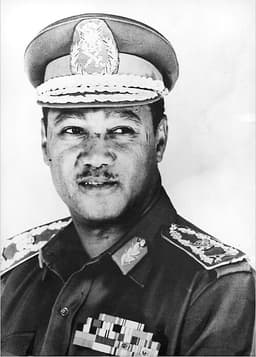
Gaafar Nimeiry
General · Modern
53.1Total

Liamine Zeroual
General · Modern
44.6Total
Basic Information
Born
1930
1941
Died
—
—
Era
Modern
Modern
Nationality
Sudan
Algeria
Occupation
General
General
Civilization
Other
Middle Eastern
Score Comparison
Military (10%)
45.0
22.6
Political (20%)
61.3
43.7
Influence (20%)
54.1
49.4
Legacy (20%)
42.5
40.0
Leadership (15%)
74.0
62.2
Strategy (15%)
41.7
41.0
TOTAL
53.1
44.6
Gaafar Nimeiry — Complete Timeline
1969 AD
1969 Sudanese coup d'étatPolitical Action◆ Major
Gaafar Nimeiry, then a colonel, led the Free Officers Movement in a bloodless coup that overthrew the civilian government of Prime Minister Mohamed Ahmed Mahgoub. Nimeiry established the Revolutionary Command Council (RCC) and declared Sudan a socialist state.
CoupMilitary RuleSocialism
Impact: national
1972 AD
Addis Ababa AgreementPolitical Action◆ Major
Nimeiry signed the Addis Ababa Agreement with the Anyanya rebel group, ending the First Sudanese Civil War (1955-1972). The agreement granted southern Sudan regional autonomy and ended 17 years of conflict, marking a major achievement in Nimeiry's early rule.
Peace AgreementCivil War EndAutonomy
Impact: nationalconstructive
1983 AD
Shift to IslamismReform◆ Major
Nimeiry abandoned his socialist policies and adopted Islamic Sharia law, imposing hudud punishments and dissolving the southern autonomy. This decision alienated the non-Muslim south and reignited civil war, leading to the formation of the Sudan People's Liberation Army (SPLA).
IslamizationShariaCivil War
Impact: nationaldestructive
1985 AD
1985 Sudanese coup d'étatPolitical Action◆ Major
Nimeiry was overthrown by a military coup led by General Abdel Rahman Swar al-Dahab while he was on a visit to the United States. The coup was triggered by widespread protests against economic hardship, corruption, and the ongoing civil war. Nimeiry went into exile in Egypt.
CoupRegime ChangeExile
Impact: national
Liamine Zeroual — Complete Timeline
1990 AD
Appointment as Minister of DefensePolitical Action◆ Major
Liamine Zeroual was appointed Minister of Defense by President Chadli Bendjedid in 1990. He oversaw the military during the early stages of the Algerian Civil War, which began after the 1991 election cancellation.
Algerian Civil WarMilitary
Impact: national
1994 AD
Election as President of AlgeriaPolitical Action◆ Major
Zeroual was elected President of Algeria in November 1994, succeeding the High State Council. His presidency focused on ending the civil war through a combination of military force and political dialogue with Islamist groups.
PresidencyCivil War
Impact: national
1996 AD
Institution of the 1996 Constitutional ReformsReform◆ Major
Zeroual oversaw a constitutional referendum in November 1996 that banned political parties based on religion and strengthened presidential powers. The reforms aimed to stabilize the political system but were criticized for limiting pluralism.
ConstitutionPolitical reform
Impact: national
1999 AD
Early Resignation from the PresidencyPolitical Action◆ Major
Zeroual resigned as president in January 1999, two years before his term ended, citing health reasons. He was succeeded by Abdelaziz Bouteflika after a controversial election. His early departure was seen as a step to allow a new leader to pursue peace.
ResignationTransition
Impact: national
This comparison has not been analyzed yet.
One-time AI generation (~1 minute). Scores and timeline are already available below.
Rankings
🥇
Gaafar NimeiryLeader
Mil: 45.0Pol: 61.3Inf: 54.1
53.1
🥈
Liamine Zeroual
Mil: 22.6Pol: 43.7Inf: 49.4
44.6
+8.5 behind
How This Comparison Works
Algorithm
Each figure is scored on 6 dimensions (0—100 scale) based on structured historical data: Military (10%), Political (20%), Influence (20%), Legacy (20%), Leadership (15%), Strategy (15%). The weighted total produces the final ranking.
Data Sources
Scores are computed from structured sub-indicators in the database. Scale factors adjust for era (Ancient ×0.85, Modern ×1.0) and civilization size (Eastern ×1.05, Other ×0.80) to account for differences in population and military scale.
Maximum 3 Figures
Comparisons are limited to 2—3 figures to ensure readability and statistical meaningfulness.
Error Margins
±5 points per dimension — Sub-scores are derived from historical records with inherent uncertainty. Two figures within 5 points on a dimension should be considered roughly equivalent in that area.
Total Score Accuracy
±3 points overall — The weighted combination of 6 dimensions produces a total score with approximately ±3 points of uncertainty. Differences of less than 3 points are not statistically significant— the figures are effectively tied.
Known Limitations
- Historical records are incomplete and uneven across civilizations
- Figures from oral-tradition societies may be underrepresented
- Occupation labels can misclassify multi-role figures
- Scores measure capability and impact, not moral character
- Quantitative scoring is a comparison tool, not absolute truth
Capability Radar
Military (10%) — Battles & Warfare
Battles
25
10
Win Rate
30
10
Expansion
20
5
Political (20%) — Governance & Reform
Reform
40
30
Diplomacy
45
35
Economy
30
25
Influence (20%) — Cultural & Global Reach
Cultural
30
15
Global
25
10
Legacy (20%) — Historical Impact
Historical
35
20
Longevity
20
10
Leadership (15%) — Power & Stability
Tenure
70
40
Stability
20
20
Strategy (15%) — Tactics & Innovation
Strategy
25
15
Tactics
20
15
Reform
30
20
Similar Comparisons
Comments & Discussion
No comments yet. Be the first to share your thoughts!