Loading...
Gaafar Nimeiry vs Liao Yaoxiang
Gaafar Nimeiry leads by 12.8 pts · 2 figures compared
…
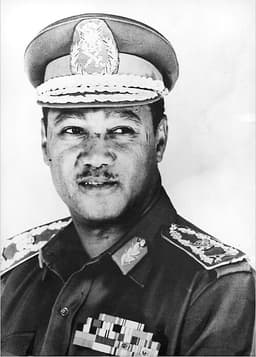
Gaafar Nimeiry
General · Modern
53.1Total

Liao Yaoxiang
General · Modern
40.3Total
Basic Information
Born
1930
1906
Died
—
1968
Era
Modern
Modern
Nationality
Sudan
China
Occupation
General
General
Civilization
Other
Eastern
Score Comparison
Military (10%)
45.0
45.0
Political (20%)
61.3
27.9
Influence (20%)
54.1
47.9
Legacy (20%)
42.5
39.2
Leadership (15%)
74.0
36.9
Strategy (15%)
41.7
43.3
TOTAL
53.1
40.3
Gaafar Nimeiry — Complete Timeline
1969 AD
1969 Sudanese coup d'étatPolitical Action◆ Major
Gaafar Nimeiry, then a colonel, led the Free Officers Movement in a bloodless coup that overthrew the civilian government of Prime Minister Mohamed Ahmed Mahgoub. Nimeiry established the Revolutionary Command Council (RCC) and declared Sudan a socialist state.
CoupMilitary RuleSocialism
Impact: national
1972 AD
Addis Ababa AgreementPolitical Action◆ Major
Nimeiry signed the Addis Ababa Agreement with the Anyanya rebel group, ending the First Sudanese Civil War (1955-1972). The agreement granted southern Sudan regional autonomy and ended 17 years of conflict, marking a major achievement in Nimeiry's early rule.
Peace AgreementCivil War EndAutonomy
Impact: nationalconstructive
1983 AD
Shift to IslamismReform◆ Major
Nimeiry abandoned his socialist policies and adopted Islamic Sharia law, imposing hudud punishments and dissolving the southern autonomy. This decision alienated the non-Muslim south and reignited civil war, leading to the formation of the Sudan People's Liberation Army (SPLA).
IslamizationShariaCivil War
Impact: nationaldestructive
1985 AD
1985 Sudanese coup d'étatPolitical Action◆ Major
Nimeiry was overthrown by a military coup led by General Abdel Rahman Swar al-Dahab while he was on a visit to the United States. The coup was triggered by widespread protests against economic hardship, corruption, and the ongoing civil war. Nimeiry went into exile in Egypt.
CoupRegime ChangeExile
Impact: national
Liao Yaoxiang — Complete Timeline
1925 AD
Graduated from the Whampoa Military AcademyOther◆ Major
Liao Yaoxiang graduated from the Whampoa Military Academy, a key training ground for KMT officers. He became a trusted commander under Chiang Kai-shek. His education shaped his military career in the Chinese Civil War.
EducationWhampoa
Impact: nationalconstructive
1948 AD
Commanded the KMT Forces in the Liaoxi-Shenyang CampaignWar
Liao Yaoxiang commanded the KMT's 9th Army Group in the Liaoxi-Shenyang Campaign. His forces were encircled and destroyed by the People's Liberation Army. The defeat was a decisive Communist victory in Manchuria, leading to the KMT's collapse in the northeast.
Chinese Civil WarDefeat
Impact: national
Captured by the CommunistsWar◆ Major
Liao Yaoxiang was captured by Communist forces after his army's defeat in the Liaoxi-Shenyang Campaign. He was imprisoned and later died in captivity. His capture symbolized the KMT's loss of Manchuria.
Chinese Civil WarCapture
Impact: national
Expert Analysis
Origins
Gaafar Nimeiry was born on January 1, 1930, in Wad Nubawi, Sudan. He came from a modest background; his father was a postal worker. Nimeiry attended the Sudanese Military College, graduating in 1952. He was influenced by the Free Officers Movement in Egypt and became involved in early military politics.
Liao Yaoxiang was born in 1903 in Hunan, China. He graduated from the Whampoa Military Academy (1926), a key training ground for KMT officers. He served under Chiang Kai-shek and participated in the Northern Expedition. His early career was shaped by the internal conflicts between the KMT and the Chinese Communist Party.
Rise to Power
Nimeiry rose to power through the 1969 Sudanese coup d'état on May 25, 1969. As a colonel, he led the Free Officers Movement in a bloodless coup that overthrew the civilian government of Prime Minister Mohamed Ahmed Mahgoub. He established the Revolutionary Command Council and became Prime Minister and later President. His early rule was marked by socialist policies and alignment with the Soviet Union.
Liao Yaoxiang rose through the ranks of the KMT military. He commanded the 9th Army Group during the Chinese Civil War. His most notable command was in the Liaoxi-Shenyang Campaign (September-October 1948), where his forces were encircled and destroyed by the People's Liberation Army (PLA). This defeat was a turning point in the civil war. Liao was captured by Communist forces and died in captivity in 1952.
Leadership & Governance
Nimeiry's leadership style was initially secular and socialist. He signed the Addis Ababa Agreement in 1972, ending the First Sudanese Civil War by granting autonomy to the South. However, in 1983, he shifted to Islamism, imposing Sharia law and dissolving southern autonomy, which reignited the civil war. His governance was characterized by political maneuvering, alternating between alliances with communists and Islamists. He scored 74.0 in leadership, reflecting his ability to maintain power for 16 years, but his strategic inconsistency scored 41.7.
Liao Yaoxiang's leadership was constrained by the broader KMT command. He was a competent field commander but lacked political influence. His strategy in the Liaoxi-Shenyang Campaign was criticized for being overly aggressive and poorly coordinated. He scored 36.9 in leadership and 43.3 in strategy. His political score of 27.9 reflects his limited role in KMT decision-making.
Triumph & Tragedy
Nimeiry's greatest success was the Addis Ababa Agreement, which brought peace for a decade. His failure was the imposition of Sharia law in 1983, which led to the Second Sudanese Civil War, resulting in hundreds of thousands of deaths. He was overthrown in 1985 while visiting the US, a humiliating end to his rule.
Liao Yaoxiang's triumph was his early military career, but his tragedy was the catastrophic defeat in the Liaoxi-Shenyang Campaign. His capture and death in captivity marked the end of his influence. He scored 45.0 in military, equal to Nimeiry, but his overall impact was limited.
Character & Destiny
Nimeiry was pragmatic but prone to drastic shifts. His decision to abandon socialism for Islamism was driven by a desire to consolidate power but backfired. He was resilient but lacked a consistent vision. His character led to a divided nation.
Liao Yaoxiang was a loyal KMT officer, but his fate was tied to the declining Nationalist regime. He was brave but inflexible, unable to adapt to the PLA's tactics. His destiny was sealed by the larger strategic failures of Chiang Kai-shek.
Legacy
Nimeiry's legacy is mixed. He is remembered for both the peace agreement and the civil war that followed. His influence score of 54.1 reflects his impact on Sudan's political trajectory. The Addis Ababa Agreement set a precedent for autonomy, but his Islamist shift left a lasting divide. He scored 42.5 in legacy.
Liao Yaoxiang's legacy is minor. He is remembered as a defeated KMT general. His influence score of 47.9 is slightly higher than his political score, but his legacy of 39.2 is low. He is not widely studied outside the context of the Chinese Civil War.
Conclusion
Gaafar Nimeiry had a greater impact than Liao Yaoxiang, as reflected in his total score of 53.1 versus 40.3. Despite his failures, Nimeiry's rule shaped Sudan for decades, while Liao Yaoxiang's defeat was a footnote in a larger conflict. Nimeiry's leadership score of 74.0 and political score of 61.3 demonstrate his ability to affect change, even if negative. Liao Yaoxiang's scores are uniformly lower, indicating limited influence. In the balance of historical impact, Nimeiry stands as a more significant figure.
Rankings
🥇
Gaafar NimeiryLeader
Mil: 45.0Pol: 61.3Inf: 54.1
53.1
🥈
Liao Yaoxiang
Mil: 45.0Pol: 27.9Inf: 47.9
40.3
+12.8 behind
How This Comparison Works
Algorithm
Each figure is scored on 6 dimensions (0—100 scale) based on structured historical data: Military (10%), Political (20%), Influence (20%), Legacy (20%), Leadership (15%), Strategy (15%). The weighted total produces the final ranking.
Data Sources
Scores are computed from structured sub-indicators in the database. Scale factors adjust for era (Ancient ×0.85, Modern ×1.0) and civilization size (Eastern ×1.05, Other ×0.80) to account for differences in population and military scale.
Maximum 3 Figures
Comparisons are limited to 2—3 figures to ensure readability and statistical meaningfulness.
Error Margins
±5 points per dimension — Sub-scores are derived from historical records with inherent uncertainty. Two figures within 5 points on a dimension should be considered roughly equivalent in that area.
Total Score Accuracy
±3 points overall — The weighted combination of 6 dimensions produces a total score with approximately ±3 points of uncertainty. Differences of less than 3 points are not statistically significant— the figures are effectively tied.
Known Limitations
- Historical records are incomplete and uneven across civilizations
- Figures from oral-tradition societies may be underrepresented
- Occupation labels can misclassify multi-role figures
- Scores measure capability and impact, not moral character
- Quantitative scoring is a comparison tool, not absolute truth
Capability Radar
Military (10%) — Battles & Warfare
Battles
25
35
Win Rate
30
20
Expansion
20
10
Political (20%) — Governance & Reform
Reform
40
10
Diplomacy
45
15
Economy
30
10
Influence (20%) — Cultural & Global Reach
Cultural
30
10
Global
25
5
Legacy (20%) — Historical Impact
Historical
35
15
Longevity
20
10
Leadership (15%) — Power & Stability
Tenure
70
20
Stability
20
10
Strategy (15%) — Tactics & Innovation
Strategy
25
30
Tactics
20
40
Reform
30
10
Similar Comparisons
Comments & Discussion
No comments yet. Be the first to share your thoughts!