Loading...
Ganapati Deva vs Napoleon Bonaparte
Napoleon Bonaparte leads by 12.2 pts · 2 figures compared
…
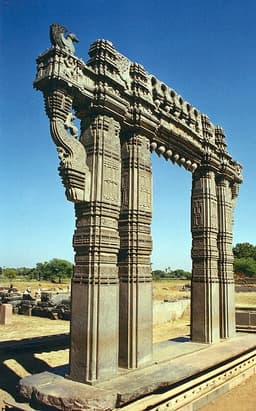
Ganapati Deva
Emperor · Medieval
58.7Total

Napoleon Bonaparte
General · Modern
70.9Total
Basic Information
Born
1199
1769
Died
1262
1821
Era
Medieval
Modern
Nationality
India
France
Occupation
Emperor
General
Civilization
Indian
Western
Score Comparison
Military (10%)
65.0
94.0
Political (20%)
53.8
72.0
Influence (20%)
59.0
40.0
Legacy (20%)
50.0
80.0
Leadership (15%)
72.0
78.0
Strategy (15%)
60.7
90.0
TOTAL
58.7
70.9
Ganapati Deva — Complete Timeline
1199 AD
Accession as Kakatiya rulerPolitical Action◆ Major
Ganapati Deva became the Kakatiya king, succeeding his father Mahadeva. He inherited a small kingdom and would expand it into a major power in the Deccan.
KakatiyaSuccessionExpansion
Impact: regionalconstructive
1220 AD
Construction of Warangal FortCultural◆ Major
Ganapati Deva commissioned the construction of the Warangal Fort, a massive stone fortification with four gates. The fort became the symbol of Kakatiya power and a center of administration.
KakatiyaFortArchitecture
Impact: regionalconstructive
1230 AD
Expansion of the Kakatiya kingdomWar◆ Major
Ganapati Deva led military campaigns that expanded the Kakatiya kingdom to include parts of modern Andhra Pradesh, Telangana, and Odisha. He defeated the Velanati Cholas and the Eastern Gangas, establishing Kakatiya supremacy.
KakatiyaExpansionMilitary
Impact: regionalconstructive
1240 AD
Patronage of trade and agricultureReform
Ganapati Deva implemented policies to promote trade and agriculture. He built irrigation tanks and encouraged the construction of temples, which boosted the economy and strengthened his rule.
KakatiyaTradeAgriculture
Impact: regionalconstructive
1262 AD
Death and succession by Rudrama DeviPolitical Action◆ Major
Ganapati Deva died, and his daughter Rudrama Devi succeeded him as the Kakatiya ruler. His death marked the end of his long reign, which had transformed the Kakatiya kingdom into a major power.
KakatiyaSuccessionDeath
Impact: regional
Napoleon Bonaparte — Complete Timeline
1799 AD
Coup of 18 BrumaireOther◆ Major
Napoleon Bonaparte, with support from his brother Lucien and key political figures, overthrew the Directory in a bloodless coup. He established the Consulate with himself as First Consul, effectively becoming the ruler of France. This event ended the French Revolution's most unstable period.
French RevolutionCoupRise to Power
Impact: regional
1804 AD
Promulgation of the Napoleonic CodeOther◆ Major
Napoleon enacted the Civil Code of the French, known as the Napoleonic Code, a comprehensive set of laws that replaced the fragmented feudal legal systems. The code established legal equality, protected property rights, and secularized law. It became the basis for legal systems in many European and world countries.
Legal ReformNapoleonic CodeCivil Law
Impact: globalconstructive
1805 AD
Battle of AusterlitzWar◆ Major
Napoleon's Grande Arm
Napoleonic WarsBattleDecisive Victory
Impact: global
1812 AD
Invasion of RussiaWar◆ Major
Napoleon led the Grande Arm
Napoleonic WarsInvasionDisaster
Impact: globaldestructive
1815 AD
Battle of WaterlooWar◆ Major
Napoleon's French army was defeated by the combined forces of the Duke of Wellington's Anglo-Allied army and Gebhard Leberecht von Bl
Napoleonic WarsBattleFinal Defeat
Impact: globaldestructive
Expert Analysis
ganapati-deva-vs-napoleon-bonaparte
# The Emperor and the Builder: Two Paths to Power in an Age of Turmoil
On a June morning in 1815, Napoleon Bonaparte watched his dreams shatter in the muddy fields of Waterloo, his Grande Armée reduced to a fleeing remnant. Four hundred years earlier and half a world away, another ruler faced a different kind of reckoning: Ganapati Deva, nearing the end of his sixty-three-year reign, could look out from the massive stone walls of Warangal Fort and see a kingdom he had transformed from a small principality into one of the Deccan’s greatest powers. One man’s story ends in exile and despair; the other’s ends with a daughter taking the throne and a dynasty continuing. What drove these two very different outcomes? The answer lies not just in their choices, but in the worlds they inhabited.
Origins
Napoleon Bonaparte was born in 1769 on the island of Corsica, a place that had only recently become French. His family was minor nobility, but in the rigid hierarchy of pre-revolutionary France, that meant little. He was short, intense, and spoke French with a thick Italian accent—a perpetual outsider who would spend his life trying to prove himself. His era was one of collapse: the old order of kings and aristocrats was crumbling, and the French Revolution had opened a door for men of talent, regardless of birth.
Ganapati Deva, born in 1199, inherited a different world. The Kakatiya kingdom was a small realm in the eastern Deccan, surrounded by more powerful neighbors. His father, Mahadeva, had died suddenly, leaving a boy king to rule in a land where legitimacy came from blood and divine favor, not revolutionary upheaval. There was no ladder for an ambitious outsider here; the path was narrow and traditional. Yet Ganapati Deva would prove that even within tradition, there is room for greatness.
Rise to Power
Napoleon’s ascent was a product of war and chaos. At twenty-four, he cleared the streets of Paris with a “whiff of grapeshot” during the Royalist uprising of 1795, earning the attention of the revolutionary government. By twenty-seven, he was commanding armies in Italy, winning battles that stunned Europe. His rise was meteoric, fueled by ambition and the vacuum left by a collapsing regime. He was not elected, not chosen by birth—he seized his moment.
Ganapati Deva’s rise was slower, more deliberate. He became king in 1199 as a child, inheriting a kingdom that barely stretched beyond the walls of Warangal. He spent his early years consolidating power, building alliances, and waiting. His first major act—the construction of the Warangal Fort, begun around 1220—was not a conquest but a statement. That fort, with its four massive gates and granite walls, would become the symbol of his reign, a fortress that said: *I am here to stay.*
Leadership & Governance
Napoleon ruled through brilliance and terror. His military genius was undeniable—he reorganized armies, pioneered new tactics, and won battles like Austerlitz in 1805 with a strategic audacity that left his enemies reeling. His political reforms were equally ambitious: the Napoleonic Code standardized French law, abolished feudal privileges, and spread the ideals of the Revolution across Europe. But his governance was also a dictatorship. He crowned himself emperor in 1804, silenced dissent, and placed family members on thrones from Spain to Poland. His leadership was a paradox: a liberator who became a tyrant.
Ganapati Deva ruled through patience and prosperity. His military campaigns, around 1230, expanded the Kakatiya kingdom to include parts of modern Andhra Pradesh, Telangana, and Odisha, but he was no Napoleon on the battlefield—his military score is modest compared to the Corsican’s. His true genius was political. He built irrigation tanks, encouraged trade, and fostered agriculture. He understood that a kingdom grows not through conquest alone, but through the welfare of its people. His daughter Rudrama Devi would later rule as a queen, a testament to his willingness to break tradition for the sake of stability.
Triumph & Tragedy
Napoleon’s greatest triumph was his empire at its height in 1811—a Europe that stretched from Spain to Poland, with his brothers on thrones and his code shaping laws. His tragedy was the invasion of Russia in 1812, where half a million men died in the snow. He never recovered. Waterloo was the final blow, and he died in 1821 on the remote island of Saint Helena, a prisoner of the British.
Ganapati Deva’s triumph was quieter but more lasting. He died in 1262, having ruled for sixty-three years, leaving behind a kingdom that was prosperous, fortified, and stable. His tragedy was not defeat but the knowledge that his dynasty would eventually fall—the Kakatiya kingdom would be destroyed by the Delhi Sultanate a century later. But for now, his daughter Rudrama Devi took the throne, and the line continued.
Character & Destiny
Napoleon was driven by an insatiable hunger for glory. “I am not a man,” he once said, “I am a thing.” He saw himself as an instrument of history, a force that could reshape the world. This belief made him unstoppable—and ultimately, isolated. He trusted no one, not even his own brothers. His downfall came because he could not stop.
Ganapati Deva was driven by a different ambition: to build something that would outlast him. He was a builder in the literal sense—the Warangal Fort still stands, a testament to his vision. He was also a builder of institutions, of trade routes, of a stable succession. His character was one of patience, not passion; of calculation, not conquest. He understood that power is not a sprint but a marathon.
Legacy
Napoleon’s legacy is written across the map of Europe. The Napoleonic Code influenced legal systems from Louisiana to Japan. His military tactics are still studied. But his legacy is also one of war, suffering, and the deaths of millions. He is remembered as both a genius and a monster.
Ganapati Deva’s legacy is more local but no less profound. He is remembered in Telangana and Andhra Pradesh as a great king who built irrigation tanks that still water fields, and a fort that still draws visitors. His reign is seen as a golden age of the Kakatiya dynasty. But outside India, he is largely unknown.
Conclusion
What separates these two rulers is not talent—both were extraordinary—but context and temperament. Napoleon lived in an age of revolution, where everything was possible and nothing was stable. He chose to ride that wave to its crest, and then to crash. Ganapati Deva lived in an age of tradition, where power was inherited and the goal was to preserve, not to conquer. He chose to build slowly, and his kingdom endured.
One man conquered Europe and lost it. Another built a fort and kept it. In the end, perhaps the builder’s path is the wiser one. But history, as always, remembers the conqueror more vividly.
Rankings
🥇
Napoleon BonaparteLeader
Mil: 94.0Pol: 72.0Inf: 40.0
70.9
🥈
Ganapati Deva
Mil: 65.0Pol: 53.8Inf: 59.0
58.7
+12.2 behind
How This Comparison Works
Algorithm
Each figure is scored on 6 dimensions (0—100 scale) based on structured historical data: Military (10%), Political (20%), Influence (20%), Legacy (20%), Leadership (15%), Strategy (15%). The weighted total produces the final ranking.
Data Sources
Scores are computed from structured sub-indicators in the database. Scale factors adjust for era (Ancient ×0.85, Modern ×1.0) and civilization size (Eastern ×1.05, Other ×0.80) to account for differences in population and military scale.
Maximum 3 Figures
Comparisons are limited to 2—3 figures to ensure readability and statistical meaningfulness.
Error Margins
±5 points per dimension — Sub-scores are derived from historical records with inherent uncertainty. Two figures within 5 points on a dimension should be considered roughly equivalent in that area.
Total Score Accuracy
±3 points overall — The weighted combination of 6 dimensions produces a total score with approximately ±3 points of uncertainty. Differences of less than 3 points are not statistically significant— the figures are effectively tied.
Known Limitations
- Historical records are incomplete and uneven across civilizations
- Figures from oral-tradition societies may be underrepresented
- Occupation labels can misclassify multi-role figures
- Scores measure capability and impact, not moral character
- Quantitative scoring is a comparison tool, not absolute truth
Capability Radar
Military (10%) — Battles & Warfare
Battles
65
95
Win Rate
70
90
Expansion
60
95
Political (20%) — Governance & Reform
Reform
65
95
Diplomacy
60
80
Economy
65
85
Influence (20%) — Cultural & Global Reach
Cultural
55
85
Global
40
90
Legacy (20%) — Historical Impact
Historical
55
95
Longevity
50
90
Leadership (15%) — Power & Stability
Tenure
70
85
Stability
60
70
Strategy (15%) — Tactics & Innovation
Strategy
65
95
Tactics
60
98
Reform
55
92
Similar Comparisons
Comments & Discussion
WarCog6/17/2026
For all Napoleon’s tactical genius—he won over 70 battles—his grand strategy was a gamble on personal glory. Ganapati Deva never fought a Waterloo; he fought droughts, built reservoirs, and consolidated trade routes to strengthen the Kakatiya economy. Napoleon conquered for himself; Ganapati built for state resilience. That’s why one ended up on Saint Helena and the other’s dynasty survived him. Generalship wins battles; statecraft outlasts empires.
兵史辩手6/17/2026
别把拿破仑跟甘纳帕蒂放一起比。拿破仑的辉煌背后是欧洲的白骨,他打的是国家破产的战争——滑铁卢前法国国库都空了。甘纳帕蒂修了瓦朗加尔的多座大型水库,保证德干十年丰歉不慌。一个把胜利当赌注,一个把基建当遗产。谁更有远见,答案不是明摆着吗?
BodyCountSkeptic6/17/2026
Sure, Napoleon has the massive casualty figures—anywhere from 1 to 3 million dead in his campaigns. Ganapati Deva’s wars are poorly recorded, but his 13th-century Deccan was hardly a paradise: he annexed several neighboring kingdoms, likely with heavy losses. We romanticize the "builder" because we lack body counts. If we had casualty lists for every siege of Warangal, would we still call him a sage ruler? Numbers matter; let’s not canonize a medieval king just because his paperwork is missing.
古史拾遗6/17/2026
请注意一个细节:甘纳帕蒂在位63年,而拿破仑只当了11年皇帝。这60年不是白捡的——甘纳帕蒂击败了契丹陀罗王朝和雅达瓦人的多次入侵,但史料偏偏漏了他治国中期的平稳积累。拿破仑的政变、法典、学院、中央银行全在十年内密集爆发,然后迅速燃烧殆尽。长跑和短跑比距离?不公平。
Revisionist_Edge6/17/2026
This comparison props up Ganapati Deva as a noble builder and Napoleon as a tragic overreacher, ignoring that Napoleon expanded the rights of Jews and abolished feudalism across Europe, while Ganapati ruled a hierarchical caste society that never questioned slavery or patriarchy. Let’s stop pretending a medieval monarch who built a fort is morally superior to a revolutionary emperor who changed a continent. Context is fine, but let’s name the actual values we’re weighing.
内亚视角6/17/2026
拿滑铁卢和瓦朗加尔对比其实误导人。拿破仑面对的是1815年欧洲列强的包围网,法国已经没有盟友;而甘纳帕蒂面对的是德干高原上分散的酋邦,敌人从未联合成统一力量。他之所以安定,一半是因为地理:高原隔绝、补给线长,邻居打不动持久战。拿破仑输在了