Loading...
Garcia I of Leon vs Napoleon Bonaparte
Napoleon Bonaparte leads by 31.3 pts · 2 figures compared
…
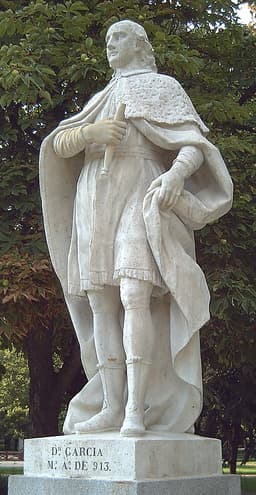
Garcia I of Leon
Emperor · Medieval
39.6Total

Napoleon Bonaparte
General · Modern
70.9Total
Basic Information
Born
871
1769
Died
914
1821
Era
Medieval
Modern
Nationality
Leon
France
Occupation
Emperor
General
Civilization
Western
Western
Score Comparison
Military (10%)
47.5
94.0
Political (20%)
27.9
72.0
Influence (20%)
46.3
40.0
Legacy (20%)
39.2
80.0
Leadership (15%)
38.1
78.0
Strategy (15%)
35.7
90.0
TOTAL
39.6
70.9
Garcia I of Leon — Complete Timeline
910 AD
First King of LeonPolitical Action◆ Major
Upon the deposition of his father Alfonso III, Garcia I became the first king of Leon, ruling the central portion of the divided Asturian kingdom. He established his court in the city of Leon, which became the capital of the new kingdom, marking the transition from Asturias to Leon as the dominant Christian power.
CoronationKingdom of LeonCapital
Impact: regionalconstructive
912 AD
Repopulation of the Duero ValleyReform◆ Major
Garcia I continued the repopulation of the Duero Valley, granting land and privileges to settlers from the north. He established fortified settlements at Roa, Osma, and San Esteban de Gormaz, strengthening the Leonese frontier against Muslim raids and consolidating control over the region.
RepopulationDuero ValleySettlement
Impact: regionalconstructive
914 AD
Death Without HeirPolitical Action◆ Major
Garcia I died without a legitimate heir, leading to a succession crisis. The throne passed to his brother Ordo
Succession CrisisDeathHeirless
Impact: nationaltragic
Napoleon Bonaparte — Complete Timeline
1799 AD
Coup of 18 BrumaireOther◆ Major
Napoleon Bonaparte, with support from his brother Lucien and key political figures, overthrew the Directory in a bloodless coup. He established the Consulate with himself as First Consul, effectively becoming the ruler of France. This event ended the French Revolution's most unstable period.
French RevolutionCoupRise to Power
Impact: regional
1804 AD
Promulgation of the Napoleonic CodeOther◆ Major
Napoleon enacted the Civil Code of the French, known as the Napoleonic Code, a comprehensive set of laws that replaced the fragmented feudal legal systems. The code established legal equality, protected property rights, and secularized law. It became the basis for legal systems in many European and world countries.
Legal ReformNapoleonic CodeCivil Law
Impact: globalconstructive
1805 AD
Battle of AusterlitzWar◆ Major
Napoleon's Grande Arm
Napoleonic WarsBattleDecisive Victory
Impact: global
1812 AD
Invasion of RussiaWar◆ Major
Napoleon led the Grande Arm
Napoleonic WarsInvasionDisaster
Impact: globaldestructive
1815 AD
Battle of WaterlooWar◆ Major
Napoleon's French army was defeated by the combined forces of the Duke of Wellington's Anglo-Allied army and Gebhard Leberecht von Bl
Napoleonic WarsBattleFinal Defeat
Impact: globaldestructive
Expert Analysis
garcia-i-of-leon-vs-napoleon-bonaparte
# The Emperor and the King: Two Paths of Power in a Fractured Europe
On a June morning in 1815, Napoleon Bonaparte stood on a muddy field near Waterloo, watching his Imperial Guard break for the first time in history. Less than a thousand years earlier, in the winter of 914, another ruler—Garcia I of León—died quietly in his bed, leaving behind a kingdom so new it had no name until he gave it one. One man shook the world and was crushed by it; the other barely disturbed the dust of his own valley. Yet both were kings, both were warriors, and both faced the same fundamental question: what does it mean to rule? Their answers could not have been more different.
Origins
Napoleon was born in 1769 on Corsica, an island that had just become French, into a minor noble family that spoke Italian at home. His world was one of revolution, ambition, and the collapse of old orders. The French Revolution erupted when he was twenty, and he rode its chaos like a wave. His education at military academies taught him artillery tactics and the Enlightenment ideals of meritocracy. He was short, intense, and driven by a hunger that came from being an outsider in his own nation.
Garcia I of León arrived in 871, in a Spain that was not yet Spain. The Christian kingdoms of the north were huddled against the mountains, fighting a centuries-long Reconquista against the Umayyad Caliphate. His father, Alfonso III, had been a great king of Asturias, but Garcia was born into a world of fragmented loyalties, scarce resources, and constant border raids. There were no artillery academies, no revolutionary manifestos—only the cold stone of a hill fort and the memory of Visigothic glory.
The difference in their eras is the difference between a cannon and a sword. Napoleon inherited a Europe of nations and ideologies; Garcia inherited a Europe of tribes and faiths.
Rise to Power
Napoleon’s ascent was a masterpiece of speed and calculation. In 1793, at age twenty-four, he retook Toulon from royalist rebels and British forces, earning his first star. By 1796, he commanded the Army of Italy and turned a starving, mutinous force into a conquering machine. His Italian campaign of 1796–1797 was not just a military triumph but a political one: he negotiated his own treaties, sent captured treasure to Paris, and became a hero. The coup of 18 Brumaire in 1799 made him First Consul at thirty. He crowned himself Emperor in 1804, taking the crown from the Pope’s hands and placing it on his own head.
Garcia’s rise was quieter and more constrained. In 910, his aging father Alfonso III was deposed by his own sons—Garcia and his brothers Ordoño and Fruela—in a palace intrigue that remains murky. The kingdom of Asturias split into three: Garcia took the central portion, which became León. He was not elected, not acclaimed by a revolutionary crowd; he was the eldest son of a king in a world where birthright was the only legitimate currency. His power came from blood, not brilliance.
Where Napoleon climbed a ladder of fire, Garcia inherited a chair of stone.
Leadership & Governance
Napoleon governed like a storm. He reorganized France into departments, centralized the bureaucracy, and created the Napoleonic Code—a legal system based on reason, equality before the law, and protection of property. He restored the Catholic Church but kept it under state control. He built roads, established the Bank of France, and filled his administration with talented men regardless of birth. His military genius was strategic: at Austerlitz in 1805, he destroyed a combined Russian and Austrian army with a feigned retreat and a devastating attack on the frozen lakes. He was a master of speed, deception, and the decisive blow.
Garcia governed like a farmer. His major recorded act was the repopulation of the Duero Valley, a vast, depopulated frontier zone between Christian and Muslim lands. He granted land and privileges to settlers from the north, creating a buffer of loyal peasants and soldiers. This was not Napoleonic ambition; it was survival. The Duero Valley was a no-man’s-land, and Garcia turned it into a kingdom. He had no code, no bureaucracy, no standing army—only oaths of fealty and the slow, patient work of filling empty fields.
Napoleon’s leadership score of 80 reflects his ability to inspire and organize; Garcia’s 36.5 reflects his obscurity. But Garcia was not a failure—he was a builder of foundations. Napoleon built a cathedral of glass; Garcia laid a single stone.
Triumph & Tragedy
Napoleon’s greatest triumph was the Empire of 1812, which stretched from Spain to Poland. His tragedy was the Russian campaign of that same year: 600,000 men marched east; fewer than 100,000 returned. He was exiled to Elba in 1814, escaped in 1815, and was defeated at Waterloo by the Duke of Wellington and Gebhard Leberecht von Blücher. His final exile on Saint Helena was a slow death of boredom and cancer.
Garcia’s triumph was the establishment of León as a kingdom that would survive for centuries. His tragedy was his death without an heir in 914. The throne passed to his brother Ordoño II, and Garcia’s line ended. He left no son, no dynasty, no legend. The kingdom he founded would be absorbed into Castile and then into Spain, and his name would fade into a footnote.
Napoleon’s fall was spectacular; Garcia’s was silent. One was a supernova, the other a candle guttering out.
Character & Destiny
Napoleon was restless, arrogant, and brilliant. He once said, “Impossible is a word to be found only in the dictionary of fools.” He believed he could bend the world to his will, and for a decade, he did. But his character was his destiny: his insatiable ambition drove him to overreach, and his refusal to compromise led to his downfall. He could not stop.
Garcia was cautious, dutiful, and obscure. He did what a king of his time was supposed to do: defend the borders, settle the land, and produce an heir. He failed in the last task, and that failure erased him. His character was not a driver of history but a passenger. He did not shape his era; his era shaped him.
Napoleon’s total score of 82.4 is a measure of a life that changed continents. Garcia’s 48.8 is a measure of a life that changed a valley. Both were kings, but one was a force of nature, the other a caretaker.
Legacy
Napoleon’s legacy is everywhere. The Napoleonic Code influenced civil law across Europe and the Americas. His military tactics are still studied in war colleges. His name is synonymous with ambition, genius, and hubris. He is remembered in statues, books, and films—a titan of history.
Garcia’s legacy is the Kingdom of León, which gave its name to a region of Spain and a province of Mexico. He is remembered only by specialists and local historians. His grave is unknown, his face unrecorded. He is a footnote in the story of the Reconquista.
But perhaps that is not a tragedy. Garcia did not seek immortality; he sought to keep his people alive through a harsh winter of history. Napoleon sought to conquer the world and lost everything. Which is the greater success?
Conclusion
Standing at Waterloo, Napoleon might have envied Garcia’s quiet death in bed. Sitting in his cold palace in León, Garcia might have envied Napoleon’s glory. But they were never meant to be compared. Napoleon was a modern man, forged in the fires of revolution, who believed that will could conquer all. Garcia was a medieval man, shaped by the cycles of harvest and raid, who knew that survival was victory enough.
History remembers the storm, not the soil. But the soil is what remains after the storm passes. Napoleon’s empire crumbled; Garcia’s kingdom endured, transformed, and became Spain. Perhaps the true measure of a ruler is not how high he rises, but what he leaves behind when he falls.
Rankings
🥇
Napoleon BonaparteLeader
Mil: 94.0Pol: 72.0Inf: 40.0
70.9
🥈
Garcia I of Leon
Mil: 47.5Pol: 27.9Inf: 46.3
39.6
+31.3 behind
How This Comparison Works
Algorithm
Each figure is scored on 6 dimensions (0—100 scale) based on structured historical data: Military (10%), Political (20%), Influence (20%), Legacy (20%), Leadership (15%), Strategy (15%). The weighted total produces the final ranking.
Data Sources
Scores are computed from structured sub-indicators in the database. Scale factors adjust for era (Ancient ×0.85, Modern ×1.0) and civilization size (Eastern ×1.05, Other ×0.80) to account for differences in population and military scale.
Maximum 3 Figures
Comparisons are limited to 2—3 figures to ensure readability and statistical meaningfulness.
Error Margins
±5 points per dimension — Sub-scores are derived from historical records with inherent uncertainty. Two figures within 5 points on a dimension should be considered roughly equivalent in that area.
Total Score Accuracy
±3 points overall — The weighted combination of 6 dimensions produces a total score with approximately ±3 points of uncertainty. Differences of less than 3 points are not statistically significant— the figures are effectively tied.
Known Limitations
- Historical records are incomplete and uneven across civilizations
- Figures from oral-tradition societies may be underrepresented
- Occupation labels can misclassify multi-role figures
- Scores measure capability and impact, not moral character
- Quantitative scoring is a comparison tool, not absolute truth
Capability Radar
Military (10%) — Battles & Warfare
Battles
20
95
Win Rate
25
90
Expansion
25
95
Political (20%) — Governance & Reform
Reform
20
95
Diplomacy
25
80
Economy
20
85
Influence (20%) — Cultural & Global Reach
Cultural
10
85
Global
5
90
Legacy (20%) — Historical Impact
Historical
20
95
Longevity
15
90
Leadership (15%) — Power & Stability
Tenure
30
85
Stability
15
70
Strategy (15%) — Tactics & Innovation
Strategy
20
95
Tactics
15
98
Reform
10
92
Similar Comparisons
Comments & Discussion
WATERLOO_WORM6/17/2026
Napoleon's genius was real, but Waterloo proved what Garcia understood: a kingdom built on personal glory is a house of cards. Napoleon's ambition stretched from Madrid to Moscow, yet he couldn't hold power for a decade. Garcia I, by contrast, consolidated León from a frontier outpost into a foundation that lasted centuries. Who's the better ruler? The one who dies in his own bed, not on St. Helena. Napoleon's artillery won battles; Garcia's patience won a kingdom.
骑兵之矛6/17/2026
拿破仑的军事才能光芒万丈,但加西亚一世才是真正的幸存者。想想看:皇帝在莱比锡损失了六万大军,而莱昂国王用区区数百骑士就保住了基督教在伊比利亚的据点。拿破仑把法国送上世界之巅又摔下来,加西亚却默默把边疆小王国变成了卡斯蒂利亚的雏形。谁更懂统治?答案不言自明。
SCEPTIC_CANON6/17/2026
The comparison is ahistorical. Napoleon commanded armies of 500,000 across continents; Garcia I barely ruled a territory the size of modern Wales. One reshaped Europe's legal codes with the Napoleonic Code, the other left barely a dozen charters. This analysis romanticizes obscurity. Garcia was a local warlord in a messy Reconquista; Napoleon was a global force. The only shared trait? Both were men. Let's not pretend a footnote king rivals the man who still haunts European politics.
竹林史官6/17/2026
抛开军事细节,我要说拿破仑输在了一个简单的地方:他没看懂加西亚式的权力。皇帝把一切押在战场胜利上,结果滑铁卢一次失利就终结了一切。加西亚却懂得,真正的王权来自土地、教堂和农民的支持。他在埃斯洛尼亚河谷修了六座修道院,把信仰变成了政权的根基。拿破仑建了凯旋门,可凯旋门挡不住冬天。莱昂的教堂至今还在。
BRONZE_AGE_BARD6/17/2026
You people forget: Garcia I was a king when kings actually mattered—before gunpowder, before nationalism. Napoleon ruled a nation; Garcia ruled a people. In 914, loyalty was personal, not ideological. Garcia faced the Caliphate's might with a spear and a cross, while Napoleon hid behind marshals and conscripts. Give me the man who slept with his sword every night, not the one who slept in a palace of his own making. That's a real comparison.