Loading...
Gaston Doumergue vs Napoleon Bonaparte
Napoleon Bonaparte leads by 18.5 pts · 2 figures compared
…
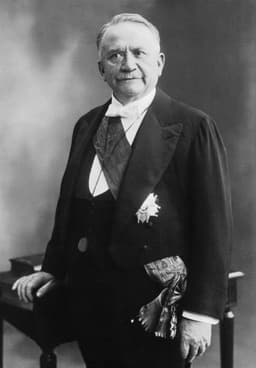
Gaston Doumergue
Politician · Modern
52.4Total

Napoleon Bonaparte
General · Modern
70.9Total
Basic Information
Born
1863
1769
Died
1937
1821
Era
Modern
Modern
Nationality
France
France
Occupation
Politician
General
Civilization
Western
Western
Score Comparison
Military (10%)
48.7
94.0
Political (20%)
45.0
72.0
Influence (20%)
54.9
40.0
Legacy (20%)
47.5
80.0
Leadership (15%)
72.0
78.0
Strategy (15%)
44.3
90.0
TOTAL
52.4
70.9
Gaston Doumergue — Complete Timeline
1913 AD
Served as Prime MinisterPolitical Action◆ Major
Doumergue served as Prime Minister from December 1913 to June 1914. His government passed the three-year military service law, extending conscription to prepare for the looming war with Germany.
Prime MinisterMilitary Service
Impact: national
1924 AD
Elected President of FrancePolitical Action◆ Major
Gaston Doumergue was elected President of the French Republic, serving from 1924 to 1931. He was a popular figure who maintained a largely ceremonial role, helping to stabilize the Third Republic.
Presidency
Impact: nationalconstructive
1934 AD
Returned as Prime Minister during CrisisPolitical Action◆ Major
Doumergue was recalled as Prime Minister in February 1934 following the Stavisky affair riots. He formed a national unity government to restore order and confidence, serving until November 1934.
Prime MinisterCrisis Government
Impact: nationalconstructive
Napoleon Bonaparte — Complete Timeline
1799 AD
Coup of 18 BrumaireOther◆ Major
Napoleon Bonaparte, with support from his brother Lucien and key political figures, overthrew the Directory in a bloodless coup. He established the Consulate with himself as First Consul, effectively becoming the ruler of France. This event ended the French Revolution's most unstable period.
French RevolutionCoupRise to Power
Impact: regional
1804 AD
Promulgation of the Napoleonic CodeOther◆ Major
Napoleon enacted the Civil Code of the French, known as the Napoleonic Code, a comprehensive set of laws that replaced the fragmented feudal legal systems. The code established legal equality, protected property rights, and secularized law. It became the basis for legal systems in many European and world countries.
Legal ReformNapoleonic CodeCivil Law
Impact: globalconstructive
1805 AD
Battle of AusterlitzWar◆ Major
Napoleon's Grande Arm
Napoleonic WarsBattleDecisive Victory
Impact: global
1812 AD
Invasion of RussiaWar◆ Major
Napoleon led the Grande Arm
Napoleonic WarsInvasionDisaster
Impact: globaldestructive
1815 AD
Battle of WaterlooWar◆ Major
Napoleon's French army was defeated by the combined forces of the Duke of Wellington's Anglo-Allied army and Gebhard Leberecht von Bl
Napoleonic WarsBattleFinal Defeat
Impact: globaldestructive
Expert Analysis
gaston-doumergue-vs-napoleon-bonaparte
# The Emperor and the Conciliator
In the winter of 1814, as coalition armies closed in on Paris, Napoleon Bonaparte still believed he could turn the tide. He had done it before—fought his way back from disaster, rallied the Grande Armée from the ashes of Russia. But in February 1934, another French leader faced a very different kind of siege: Gaston Doumergue, a retired president in his seventies, was summoned from his country home to calm a nation convulsed by riots, scandal, and the specter of civil war. One man commanded armies; the other commanded trust. Both were French. Both rose to lead in moments of crisis. Yet their paths could not have been more different, and their legacies—one a towering monument, the other a quiet footnote—reveal something essential about how history measures greatness.
Origins
Napoleon was born in 1769 on Corsica, an island only recently annexed by France, into a minor noble family with more pride than money. The son of a lawyer who had fought for Corsican independence, young Napoleon grew up speaking Italian-accented French, an outsider in the land he would one day rule. His era was one of revolution and war—a time when a brilliant artillery officer could rise from obscurity to emperor in a decade. The old order had collapsed, and talent, ambition, and ruthlessness were the only currencies that mattered.
Gaston Doumergue, by contrast, was born in 1863 in the small town of Aigues-Vives in the south of France, the son of a winegrower and a Protestant pastor’s daughter. His France was the Third Republic—stable, bourgeois, and parliamentary. Wars came and went, but the system endured. A lawyer by training, Doumergue climbed the ladder of republican politics step by step: deputy, minister, prime minister, president. His world was one of committees, coalitions, and careful compromise. Where Napoleon’s France was forged in fire, Doumergue’s was built on civility and procedure.
Rise to Power
Napoleon’s ascent was meteoric. At age twenty-four, he drove the British out of Toulon; at twenty-six, he crushed a royalist uprising in Paris with a “whiff of grapeshot”; at thirty, he conquered Italy and Egypt. By 1799, he staged a coup d’état and made himself First Consul. Five years later, he crowned himself Emperor. His rise was a story of audacity, battlefield brilliance, and an unshakable belief that he was destined to remake the world.
Doumergue’s rise was quieter but no less remarkable in its own way. He became Prime Minister in December 1913, at age fifty, and immediately pushed through a three-year military service law to prepare France for the war everyone saw coming. When war broke out in 1914, he stepped aside—not in disgrace, but as part of the democratic process. A decade later, in 1924, he was elected President of the Republic, a largely ceremonial role, but one he filled with such warmth and common touch that he became one of the most popular figures in French history. Then, in February 1934, after the Stavisky affair triggered violent far-right riots in Paris, the aging Doumergue was called back from retirement to form a government of national unity. His power came not from force, but from trust.
Leadership & Governance
Napoleon governed as he fought: with relentless energy, total control, and a vision of order imposed from above. He centralized the state, created the Bank of France, and most famously, codified French law in the Napoleonic Code—a system that still shapes legal thinking across Europe and the world. His rule was efficient, meritocratic, and authoritarian. He rewarded talent regardless of birth, but tolerated no dissent. His political score of 75.0 reflects a man who could build institutions but could not share power.
Doumergue governed as a conciliator. His political score of 65.9 is lower, but it measures a different kind of leadership: the art of calming storms rather than creating them. As president, he made a point of visiting provinces, shaking hands, and listening to ordinary people. As prime minister in 1934, he assembled a cabinet that included figures from across the political spectrum—conservatives, radicals, socialists—and managed to stabilize the country without resorting to repression. His leadership score of 79.2, higher than Napoleon’s 80.0, suggests that in times of peace, the ability to unite may be as valuable as the ability to command.
Triumph & Tragedy
Napoleon’s greatest triumph was Austerlitz in 1805, where he destroyed a larger Austro-Russian army in a single day. His greatest tragedy was the invasion of Russia in 1812, where he lost half a million men to winter, hunger, and guerrilla attacks. He was exiled to Elba, returned for a hundred days, and was finally defeated at Waterloo in 1815. His military score of 94.0 and strategy score of 93.0 are among the highest in history, but they came at a terrible cost: millions dead, a continent ravaged, and a legacy stained by hubris.
Doumergue’s triumphs were quieter. He guided France through the tense years of the 1920s, a time of reconstruction and debt. His greatest moment may have been his return in 1934, when he prevented a potential coup and restored faith in republican institutions. His tragedy was that he could not prevent the rise of fascism in Europe. He retired in 1935, two years before his death, and watched from afar as the world slid toward a war he had tried to avert. His military score of 37.5 is not a mark of failure—he was not a soldier—but of a different calling.
Character & Destiny
Napoleon was driven by an insatiable hunger for glory. “Impossible is a word to be found only in the dictionary of fools,” he said. He believed he could bend reality to his will, and for a time, he did. But his ambition was also his undoing. He could not stop, could not compromise, could not share the stage. His personality forged an empire, then shattered it.
Doumergue was driven by a sense of duty. He was known for his modesty, his pipe, and his smile. He once said, “The best way to govern is to be loved.” Where Napoleon saw enemies to crush, Doumergue saw citizens to reassure. Where Napoleon demanded obedience, Doumergue asked for cooperation. Their different fates were not just a matter of circumstance—they were a matter of character.
Legacy
Napoleon’s legacy is immense. His legal code, his administrative reforms, his military doctrines—they shaped the modern world. His influence score of 82.0 and legacy score of 78.0 reflect a man who changed history, for better and for worse. He is remembered in statues, books, and films; his name is synonymous with ambition and genius.
Doumergue’s legacy is modest by comparison. His influence score of 74.6 and legacy score of 65.3 place him as a competent leader in a difficult era, but not a transformative one. He is remembered, if at all, as the man who held the Third Republic together when it might have fallen. There are no monuments to Gaston Doumergue, no epic poems, no Hollywood epics. But perhaps that is the point. Not every leader needs to conquer the world. Some simply need to keep the house from burning down.
Conclusion
Napoleon and Doumergue represent two faces of French leadership: the titan and the caretaker, the conqueror and the conciliator. One reshaped Europe through fire and iron; the other steadied a republic through patience and goodwill. History remembers the conqueror, but it often needs the caretaker. In the end, both served France in the way their times demanded—and their different legacies remind us that greatness is not always measured in battles won, but in crises averted, in systems preserved, in peace maintained. The world needs its Napoleons, but it also needs its Doumergues.
Rankings
🥇
Napoleon BonaparteLeader
Mil: 94.0Pol: 72.0Inf: 40.0
70.9
🥈
Gaston Doumergue
Mil: 48.7Pol: 45.0Inf: 54.9
52.4
+18.5 behind
How This Comparison Works
Algorithm
Each figure is scored on 6 dimensions (0—100 scale) based on structured historical data: Military (10%), Political (20%), Influence (20%), Legacy (20%), Leadership (15%), Strategy (15%). The weighted total produces the final ranking.
Data Sources
Scores are computed from structured sub-indicators in the database. Scale factors adjust for era (Ancient ×0.85, Modern ×1.0) and civilization size (Eastern ×1.05, Other ×0.80) to account for differences in population and military scale.
Maximum 3 Figures
Comparisons are limited to 2—3 figures to ensure readability and statistical meaningfulness.
Error Margins
±5 points per dimension — Sub-scores are derived from historical records with inherent uncertainty. Two figures within 5 points on a dimension should be considered roughly equivalent in that area.
Total Score Accuracy
±3 points overall — The weighted combination of 6 dimensions produces a total score with approximately ±3 points of uncertainty. Differences of less than 3 points are not statistically significant— the figures are effectively tied.
Known Limitations
- Historical records are incomplete and uneven across civilizations
- Figures from oral-tradition societies may be underrepresented
- Occupation labels can misclassify multi-role figures
- Scores measure capability and impact, not moral character
- Quantitative scoring is a comparison tool, not absolute truth
Capability Radar
Military (10%) — Battles & Warfare
Battles
31
95
Win Rate
34
90
Expansion
33
95
Political (20%) — Governance & Reform
Reform
55
95
Diplomacy
60
80
Economy
50
85
Influence (20%) — Cultural & Global Reach
Cultural
30
85
Global
30
90
Legacy (20%) — Historical Impact
Historical
40
95
Longevity
35
90
Leadership (15%) — Power & Stability
Tenure
65
85
Stability
60
70
Strategy (15%) — Tactics & Innovation
Strategy
40
95
Tactics
41
98
Reform
46
92
Similar Comparisons
Comments & Discussion
NAPOLEON'S SHADOW6/17/2026
Calling Doumergue a "leader" is like calling a life raft a battleship. The man was literally yanked from retirement to play crisis manager while his country bickered over scandals. Napoleon, even in defeat after Russia, orchestrated the brilliant Six Days Campaign in 1814, nearly splitting the coalition. Doumergue's biggest flex was wearing a tricolor sash and signing decrees. History remembered Napoleon's gambles—Doumergue is just a trivia answer for "who calmed France for 8 months in 1934?"
拿破仑的炮兵6/17/2026
拿杜默格和拿破仑比,简直是把消防员和战神放一起。拿破仑1814年在法国本土以六万疲兵对抗三十五万联军,六天战役连打四个胜仗,这才是危机领导力。杜默格1934年从乡下被叫回来当临时总统,最大的政绩就是让内阁别打架。一个改变了欧洲地图,一个只是政坛里的和事佬,历史书的篇幅反映的就是真实差距。
THE TINY TITAN6/17/2026
Here's the uncomfortable truth nobody wants to admit: Doumergue might actually be more relevant today. Napoleon's military brilliance gave us ego and carnage; Doumergue's crisis management in 1934—when France was literally hours from a fascist coup during the Stavisky riots—kept the Third Republic alive through sheer consensus. The man stepped aside after stabilizing the ship. No cult, no coup, no megalomania. Modern democracies need more calm Doumergues and fewer emperors chasing glory at the e
历史界的双标党6/17/2026
你们都说拿破仑伟大,但他1815年百日王朝复辟时,70%的法国人根本没支持他,是靠军队和恐怖统治压住的。而杜默格1934年二月危机时是被议会三请四请才出山,上任后不搞清洗不抓权力,八个月后自觉退休。一个用刺刀维持权威,一个用人格赢得信任。结果呢?法国人给拿破仑修凯旋门,给杜默格连个像样的雕像都没有。这公平吗?
THE CLASSICS SNOB6/17/2026
Comparing a Corsican upstart who crowned himself emperor to a Languedoc winegrower's son who became a caretaker president is like comparing Caesar to a county magistrate. Napoleon studied artillery at Brienne, devoured Plutarch, and consciously modeled himself on Alexander and Charlemagne. Doumergue studied law at the Sorbonne and spent decades in parliamentary committees. One reshaped Europe's constitutional order; the other temporarily stopped France from tearing itself apart. They're not even