Loading...
Gaston Eyskens vs Napoleon Bonaparte
Napoleon Bonaparte leads by 17.8 pts · 2 figures compared
…
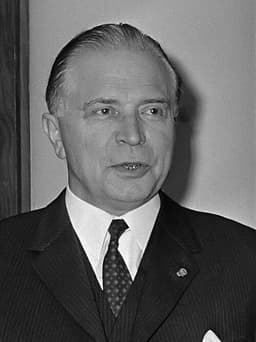
Gaston Eyskens
Politician · Modern
53.1Total

Napoleon Bonaparte
General · Modern
70.9Total
Basic Information
Born
1905
1769
Died
1988
1821
Era
Modern
Modern
Nationality
Belgium
France
Occupation
Politician
General
Civilization
Western
Western
Score Comparison
Military (10%)
50.0
94.0
Political (20%)
55.0
72.0
Influence (20%)
54.1
40.0
Legacy (20%)
45.0
80.0
Leadership (15%)
72.0
78.0
Strategy (15%)
42.9
90.0
TOTAL
53.1
70.9
Gaston Eyskens — Complete Timeline
1968 AD
Prime Minister of Belgium (first term)Political Action◆ Major
Gaston Eyskens became Prime Minister of Belgium for the first time, leading a coalition government. His tenure focused on economic policy and the ongoing linguistic conflict between Flemish and French-speaking communities.
Prime MinisterBelgian Politics
Impact: national
1970 AD
State reform of 1970Reform
Under Prime Minister Gaston Eyskens, Belgium enacted a major state reform that created three cultural communities (Flemish, French, German) and three regions (Flanders, Wallonia, Brussels). This was the first step in the federalization of Belgium.
State ReformFederalizationBelgium
Impact: nationalconstructive
1972 AD
Prime Minister of Belgium (second term)Political Action
Gaston Eyskens served a second term as Prime Minister, continuing to manage the linguistic tensions and economic challenges. His government fell over the issue of the Fourons commune, a symbol of the Flemish-Walloon conflict.
Prime MinisterBelgian Politics
Impact: national
Napoleon Bonaparte — Complete Timeline
1799 AD
Coup of 18 BrumaireOther◆ Major
Napoleon Bonaparte, with support from his brother Lucien and key political figures, overthrew the Directory in a bloodless coup. He established the Consulate with himself as First Consul, effectively becoming the ruler of France. This event ended the French Revolution's most unstable period.
French RevolutionCoupRise to Power
Impact: regional
1804 AD
Promulgation of the Napoleonic CodeOther◆ Major
Napoleon enacted the Civil Code of the French, known as the Napoleonic Code, a comprehensive set of laws that replaced the fragmented feudal legal systems. The code established legal equality, protected property rights, and secularized law. It became the basis for legal systems in many European and world countries.
Legal ReformNapoleonic CodeCivil Law
Impact: globalconstructive
1805 AD
Battle of AusterlitzWar◆ Major
Napoleon's Grande Arm
Napoleonic WarsBattleDecisive Victory
Impact: global
1812 AD
Invasion of RussiaWar◆ Major
Napoleon led the Grande Arm
Napoleonic WarsInvasionDisaster
Impact: globaldestructive
1815 AD
Battle of WaterlooWar◆ Major
Napoleon's French army was defeated by the combined forces of the Duke of Wellington's Anglo-Allied army and Gebhard Leberecht von Bl
Napoleonic WarsBattleFinal Defeat
Impact: globaldestructive
Expert Analysis
gaston-eyskens-vs-napoleon-bonaparte
# The Emperor and the Architect
On a June morning in 1815, Napoleon Bonaparte watched his Imperial Guard march into the murderous crossfire at Waterloo, their blue coats soaked by Belgian rain. One hundred and fifty-three years later, another man stood in a government building not far from that same battlefield, signing papers that would reshape Belgium not through cannon fire, but through clauses and compromises. The contrast could hardly be starker: one man who sought to conquer a continent, another who sought to hold a small country together. Yet both were products of their time, driven by forces that reveal much about the nature of power, ambition, and the paths history offers to those who seek to shape it.
Origins
Napoleon was born in 1769 on the island of Corsica, a place recently annexed by France, into a minor noble family of modest means. His childhood was marked by the tension between Corsican identity and French rule, a wound that never fully healed. He spoke Italian before French, and his accent would mark him as an outsider in Parisian salons. The French Revolution, erupting when he was twenty, shattered the old order and opened doors that birth alone could never have unlocked. It was a world where talent and ruthlessness could carry a man from obscurity to empire.
Gaston Eyskens arrived in 1905 in a very different Europe—industrialized, bureaucratized, and already scarred by national rivalries. Born in Lier, Flanders, he grew up in a Belgium still recovering from the First World War, a country where the fault line between Dutch-speaking Flemings and French-speaking Walloons ran through every institution. Where Napoleon’s world was one of revolutionary upheaval, Eyskens’ was one of constitutional negotiation. His father had been a teacher; his own path led through economics and academia, not military academies. The tools of his trade were budgets, coalition agreements, and the careful management of linguistic grievances.
Rise to Power
Napoleon’s ascent was explosive. In 1793, at age twenty-four, he drove the British out of Toulon with a brilliant artillery plan. By 1796, he commanded the Army of Italy and turned a ragtag force into a conquering army, winning a dozen battles in a year. The Directory, France’s corrupt and unpopular government, gave him command not out of trust but out of desperation. He repaid them by seizing power in the coup of 1799, becoming First Consul at thirty. His rise was a masterclass in seizing opportunity: every defeat of a rival, every political vacuum, every moment of public fear became a ladder.
Eyskens’ path was slower, steadier, and far less dramatic. He entered politics after a career as an economics professor, serving as a minister in several post-war governments before becoming Prime Minister for the first time in 1949. His rise was not a coup but a series of coalitions, compromises, and patient negotiations. Where Napoleon conquered, Eyskens convinced. Where Napoleon commanded armies, Eyskens chaired committees. The difference was not merely personal—it was structural. In a stable parliamentary democracy, power comes not from glory but from trust, and trust must be earned over decades.
Leadership & Governance
Napoleon governed with a will of iron and a mind of breathtaking clarity. He reformed French law into the Napoleonic Code, standardizing justice across a fragmented nation. He centralized education, created the Bank of France, and built roads and canals that bound his empire together. His military genius—scoring 93 in strategy and 94 in military command—was matched by a political intelligence that understood how to appeal to ambition, fear, and self-interest. He made nobles from commoners, gave soldiers lands and titles, and created a meritocracy that the old regime could never have imagined. Yet his governance was ultimately autocratic. He crowned himself emperor in 1804, silencing dissent and concentrating power in his own hands.
Eyskens governed in a very different key. His political score of 69 and leadership score of 79 reflect a man who worked within constraints, not above them. As Prime Minister four times between 1949 and 1973, he presided over Belgium’s post-war economic reconstruction, managing the transition from coal and steel to services and trade. His greatest achievement came in 1970 with the state reform that created three cultural communities—Flemish, French, and German—laying the foundation for Belgium’s transformation from a unitary state to a federal one. It was not glamorous work. It required endless meetings, careful wording, and the patience to satisfy Flemish nationalists, Walloon socialists, and Brussels liberals. But it kept a country together that many thought would split apart.
Triumph & Tragedy
Napoleon’s triumph was Austerlitz in 1805, where he destroyed the combined armies of Austria and Russia in a single day, cementing his control over Europe. His tragedy was Moscow in 1812—the disastrous invasion of Russia that cost half a million lives and shattered his Grand Army. The retreat through the snow, the Cossack attacks, the frozen corpses lining the road: it was a catastrophe from which he never recovered. Exiled to Elba, he returned for a hundred days only to meet final defeat at Waterloo in 1815. He died in 1821 on the remote island of Saint Helena, a prisoner of the British, abandoned by all but a few loyal followers.
Eyskens’ triumph was quieter but no less real: the 1970 state reform that preserved Belgian unity while acknowledging its linguistic divisions. It was a masterstroke of federalism, creating a framework that allowed Flemings and Walloons to govern their own cultural affairs while remaining part of a single state. His tragedy was that the reform did not go far enough. The linguistic tensions continued, and later governments would need to push federalization further. Eyskens spent his final years watching his careful compromises unravel into new crises, his work never fully complete.
Character & Destiny
Napoleon was driven by an insatiable hunger for glory. “I live only for posterity,” he once said, and he meant it. His ambition was boundless, his energy inexhaustible, his confidence absolute. But these same qualities led to his downfall. He could not stop. He could not share power. He could not accept that even genius has limits. His character was his destiny: the same will that carried him to the top of the world drove him off the cliff.
Eyskens was a man of a different temper. Patient, methodical, and deeply aware of constraints, he understood that politics is the art of the possible. “Governing is choosing,” he said, but the choices he faced were never between glory and ruin—only between better and worse compromises. His character suited his destiny: a small country, a divided people, a world where survival depended not on conquest but on accommodation.
Legacy
Napoleon’s legacy is monumental. His Napoleonic Code influenced legal systems across Europe and the world. His campaigns are still studied in military academies. His name is synonymous with ambition, genius, and tragic hubris. He scored 82 in influence and 78 in legacy—scores that reflect a man who changed the course of history, for better and for worse.
Eyskens’ legacy is more modest but no less significant. He is remembered as the architect of Belgian federalism, the man who found a way for Flemings and Walloons to live together. His influence score of 75 and legacy score of 62 reflect a leader who worked within history rather than trying to bend it to his will. Today, Belgium remains a federal state, and every Belgian who speaks their own language in their own community lives within the framework Eyskens helped build.
Conclusion
One man conquered Europe and died in exile. Another governed a small country and died in peace. Napoleon Bonaparte and Gaston Eyskens lived in the same civilization but in different worlds—one of revolution and empire, the other of democracy and compromise. Their lives remind us that history offers many paths to significance. Some are paved with glory, others with patience. Both require courage, but of very different kinds. And both leave their marks, whether on the map of a continent or in the quiet structure of a constitution that keeps a nation whole.
Rankings
🥇
Napoleon BonaparteLeader
Mil: 94.0Pol: 72.0Inf: 40.0
70.9
🥈
Gaston Eyskens
Mil: 50.0Pol: 55.0Inf: 54.1
53.1
+17.8 behind
How This Comparison Works
Algorithm
Each figure is scored on 6 dimensions (0—100 scale) based on structured historical data: Military (10%), Political (20%), Influence (20%), Legacy (20%), Leadership (15%), Strategy (15%). The weighted total produces the final ranking.
Data Sources
Scores are computed from structured sub-indicators in the database. Scale factors adjust for era (Ancient ×0.85, Modern ×1.0) and civilization size (Eastern ×1.05, Other ×0.80) to account for differences in population and military scale.
Maximum 3 Figures
Comparisons are limited to 2—3 figures to ensure readability and statistical meaningfulness.
Error Margins
±5 points per dimension — Sub-scores are derived from historical records with inherent uncertainty. Two figures within 5 points on a dimension should be considered roughly equivalent in that area.
Total Score Accuracy
±3 points overall — The weighted combination of 6 dimensions produces a total score with approximately ±3 points of uncertainty. Differences of less than 3 points are not statistically significant— the figures are effectively tied.
Known Limitations
- Historical records are incomplete and uneven across civilizations
- Figures from oral-tradition societies may be underrepresented
- Occupation labels can misclassify multi-role figures
- Scores measure capability and impact, not moral character
- Quantitative scoring is a comparison tool, not absolute truth
Capability Radar
Military (10%) — Battles & Warfare
Battles
31
95
Win Rate
32
90
Expansion
33
95
Political (20%) — Governance & Reform
Reform
65
95
Diplomacy
60
80
Economy
75
85
Influence (20%) — Cultural & Global Reach
Cultural
30
85
Global
35
90
Legacy (20%) — Historical Impact
Historical
40
95
Longevity
30
90
Leadership (15%) — Power & Stability
Tenure
70
85
Stability
55
70
Strategy (15%) — Tactics & Innovation
Strategy
40
95
Tactics
40
98
Reform
45
92
Similar Comparisons
Comments & Discussion
No comments yet. Be the first to share your thoughts!