Loading...
Gautamiputra Satakarni vs Philip II of Macedon
Philip II of Macedon leads by 12.7 pts · 2 figures compared
…

Gautamiputra Satakarni
Emperor · Ancient
61.2Total
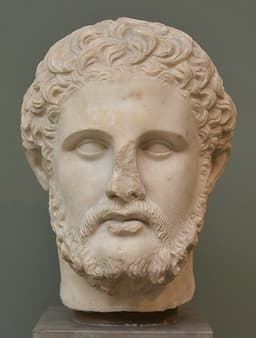
Philip II of Macedon
Emperor · Ancient
73.9Total
Basic Information
Born
78
-382
Died
102
-336
Era
Ancient
Ancient
Nationality
India
Macedon
Occupation
Emperor
Emperor
Civilization
Indian
Western
Score Comparison
Military (10%)
67.3
65.0
Political (20%)
72.0
76.0
Influence (20%)
57.2
75.0
Legacy (20%)
50.0
70.0
Leadership (15%)
72.0
78.0
Strategy (15%)
60.7
80.3
TOTAL
61.2
73.9
Gautamiputra Satakarni — Complete Timeline
85 AD
Revived Hindu Rule in the DeccanPolitical Action
Gautamiputra Satakarni reestablished Brahmanical Hindu authority in the Deccan after centuries of foreign rule by Indo-Greeks and Shakas. He performed Vedic sacrifices and took the title 'Ekabrahmana' (unique Brahmin), symbolizing the restoration of Hindu kingship.
Hindu RevivalKingship
Impact: regionalconstructive
90 AD
Defeated the Western KshatrapasWar◆ Major
Gautamiputra Satakarni defeated the Western Kshatrapa ruler Nahapana, reconquering territories in Gujarat, Malwa, and the Konkan coast. This victory restored Satavahana control over western India and opened trade routes to the Arabian Sea.
ConquestSatavahana Expansion
Impact: regional
Issued the Nasik PrasastiCultural
Gautamiputra Satakarni commissioned a royal inscription at the Nasik caves, recording his conquests and titles. The inscription describes him as 'destroyer of the Shakas, Yavanas, and Pahlavas' and provides key historical evidence of his reign.
InscriptionPropaganda
Impact: regional
95 AD
Expanded the Satavahana EmpireWar◆ Major
Gautamiputra Satakarni extended Satavahana rule from the Krishna River in the south to the Narmada River in the north, and from the Arabian Sea to the Bay of Bengal. This made the Satavahana Empire the largest in the Deccan during his reign.
Territorial ExpansionEmpire
Impact: regional
Philip II of Macedon — Complete Timeline
359 BC
Reforms of the Macedonian ArmyReform◆ Major
Philip II reorganized the Macedonian army, introducing the sarissa (long pike) and the phalanx formation. He also improved cavalry tactics and logistics, creating a professional, disciplined force that was superior to Greek hoplite armies.
MacedonMilitary ReformPhalanx
Impact: regionalconstructive
338 BC
Battle of ChaeroneaWar
Philip II led the Macedonian army to a decisive victory over the combined forces of Athens and Thebes at Chaeronea. The battle ended Greek independence and established Macedonian hegemony over Greece. Philip's son Alexander commanded the cavalry on the left wing.
MacedonGreeceBattle
Impact: regionaldestructive
337 BC
Formation of the League of CorinthPolitical Action◆ Major
Philip II established the League of Corinth, a federation of Greek states under Macedonian leadership. The league declared war on Persia and appointed Philip as its commander-in-chief, laying the groundwork for Alexander's later invasion.
MacedonGreeceAlliance
Impact: regionalconstructive
336 BC
Assassination at AegaePolitical Action◆ Major
Philip II was assassinated by his bodyguard Pausanias at the wedding of his daughter Cleopatra in Aegae. The motive remains unclear, but his death led to the immediate succession of his son Alexander the Great, who continued his plans for the Persian invasion.
MacedonAssassinationSuccession
Impact: regionaltragic
Expert Analysis
Origins
Gautamiputra Satakarni (c. 100–130 CE) was born into the Satavahana dynasty, which ruled the Deccan plateau after the decline of the Mauryan Empire. His father was likely Satakarni II, and the family belonged to the Brahmanical tradition. Little is known of his early life, but he was trained in statecraft and military arts from a young age. The Satavahanas had long contended with foreign powers, including Indo-Greeks and Shakas, who had established rule in western India.
Philip II (382–336 BCE) was born in Pella, the capital of Macedon, as the youngest son of King Amyntas III. He spent his youth as a hostage in Thebes, where he studied under the renowned general Epaminondas, absorbing military innovations and Greek politics. Upon returning to a chaotic Macedon, he seized the throne in 359 BCE after his brother Perdiccas III died in battle. Philip inherited a kingdom on the brink of collapse, with hostile neighbors and internal strife.
Rise to Power
Gautamiputra Satakarni ascended the Satavahana throne likely in the early 2nd century CE, during a period of Shaka dominance under Nahapana. His first major campaign was against the Western Kshatrapas, a Shaka dynasty controlling Gujarat, Malwa, and the Konkan. He defeated Nahapana around 125 CE, reconquering vast territories and issuing coins and inscriptions to legitimize his rule. The Nasik Prasasti (inscription) records his titles and conquests, describing him as "destroyer of the Shakas, Yavanas (Indo-Greeks), and Pahlavas (Parthians)." This victory reestablished Brahmanical authority and expanded the Satavahana empire from the Krishna to the Narmada rivers.
Philip II rose to power by first securing Macedon's borders. He defeated the Illyrians in 358 BCE, then annexed the mineral-rich region of Pangaeum. He turned his attention to the Greek city-states, exploiting their rivalries. The Sacred War (355–346 BCE) gave him an opportunity to intervene in central Greece, and he emerged as a key arbiter. His decisive victory at the Battle of Chaeronea (338 BCE) over Athens and Thebes ended Greek independence. He then imposed the League of Corinth, a federation of Greek states under Macedonian hegemony, and declared war on Persia, unifying Greece for the first time under a single leader.
Leadership & Governance
Gautamiputra Satakarni ruled as a traditional Hindu monarch, reviving Brahmanical rituals and patronizing Vedic sacrifices. He styled himself as a protector of the four varnas (social classes) and performed the ashvamedha (horse sacrifice) to assert imperial sovereignty. His governance relied on a feudal system of local rulers (amatyas) who paid tribute and provided troops. He maintained control through military campaigns and strategic marriages. His Nasik inscription emphasizes his role as a restorer of order and dharma after foreign rule.
Philip II was a practical and innovative leader who centralized Macedonian power. He reformed the army, introducing the sarissa (a 6-meter pike) and the phalanx formation, combined with elite cavalry. He also created a professional standing army with logistics and siege capabilities. Politically, he used diplomacy, marriage alliances, and military force to bind Greek states to Macedon. The League of Corinth gave him a veneer of legitimacy while ensuring his control over foreign policy and military. He also founded new cities and promoted infrastructure to integrate his realm.
Triumph & Tragedy
Gautamiputra Satakarni's greatest triumph was defeating Nahapana and reclaiming lost Satavahana territories, reviving Hindu rule in the Deccan. He issued coins that circulated widely, indicating economic prosperity. His tragedy is that his empire did not long outlast him; after his death, the Satavahanas gradually declined, facing pressure from the Abhiras and other regional powers. His legacy in the Deccan is strong, but his empire fragmented within a century.
Philip II's greatest triumph was the unification of Greece and the creation of a military machine that his son Alexander would use to conquer the Persian Empire. His reforms set the stage for the Hellenistic age. His tragedy was his assassination in 336 BCE at the wedding of his daughter Cleopatra, likely due to personal and political rivalries. He never saw his dream of invading Persia fulfilled, and his death plunged Macedon into a brief crisis before Alexander secured the throne.
Character & Destiny
Gautamiputra Satakarni is portrayed in inscriptions as a pious and just ruler, a restorer of dharma. He likely combined Brahmanical orthodoxy with pragmatic military leadership. His character led him to focus on consolidating power through religious legitimacy and military expansion. However, his reliance on feudal structures may have limited the empire's longevity.
Philip II was a shrewd and ambitious strategist, known for his diplomacy and ruthlessness. He was also a skilled propagandist who used the Panhellenic ideal to unite Greeks. His character—calculating, bold, and patient—allowed him to overcome numerous setbacks, including early defeats and political isolation. His fate—assassination at the peak of his power—reflects the volatile nature of Macedonian court politics and the personal enmities he accumulated.
Legacy
Gautamiputra Satakarni's legacy is as a champion of Hindu revival and a unifier of the Deccan. He is remembered in Indian history as a great emperor who restored indigenous rule. The Satavahana period saw economic prosperity, trade with Rome, and cultural achievements, including the construction of Buddhist stupas and caves. His influence on later Deccan kingdoms, such as the Chalukyas and Rashtrakutas, is evident in their imperial rhetoric.
Philip II's legacy is immense: he transformed Macedon from a backwater into a Mediterranean power, created the army that Alexander used to conquer the Persian Empire, and inaugurated the Hellenistic period. His military reforms influenced warfare for centuries. The League of Corinth set a precedent for Greek political unity. Philip's son Alexander overshadowed him, but without Philip's foundations, Alexander's achievements would have been impossible. In terms of lasting impact, Philip's military and political innovations reshaped the ancient world.
Conclusion
Both rulers were formidable, but Philip II's impact was far greater. His military reforms (scoring 80.3 in strategy) and political unification of Greece (political score 76.0) created the conditions for the spread of Hellenistic civilization across three continents. Gautamiputra Satakarni's revival of Hindu rule was significant regionally, but his empire was relatively short-lived and did not fundamentally alter the course of world history. Philip's total score of 73.9 versus Gautamiputra's 61.2 reflects this difference. While both were skilled leaders, Philip II had a more profound and enduring influence on the world.
Rankings
🥇
Philip II of MacedonLeader
Mil: 65.0Pol: 76.0Inf: 75.0
73.9
🥈
Gautamiputra Satakarni
Mil: 67.3Pol: 72.0Inf: 57.2
61.2
+12.7 behind
How This Comparison Works
Algorithm
Each figure is scored on 6 dimensions (0—100 scale) based on structured historical data: Military (10%), Political (20%), Influence (20%), Legacy (20%), Leadership (15%), Strategy (15%). The weighted total produces the final ranking.
Data Sources
Scores are computed from structured sub-indicators in the database. Scale factors adjust for era (Ancient ×0.85, Modern ×1.0) and civilization size (Eastern ×1.05, Other ×0.80) to account for differences in population and military scale.
Maximum 3 Figures
Comparisons are limited to 2—3 figures to ensure readability and statistical meaningfulness.
Error Margins
±5 points per dimension — Sub-scores are derived from historical records with inherent uncertainty. Two figures within 5 points on a dimension should be considered roughly equivalent in that area.
Total Score Accuracy
±3 points overall — The weighted combination of 6 dimensions produces a total score with approximately ±3 points of uncertainty. Differences of less than 3 points are not statistically significant— the figures are effectively tied.
Known Limitations
- Historical records are incomplete and uneven across civilizations
- Figures from oral-tradition societies may be underrepresented
- Occupation labels can misclassify multi-role figures
- Scores measure capability and impact, not moral character
- Quantitative scoring is a comparison tool, not absolute truth
Capability Radar
Military (10%) — Battles & Warfare
Battles
65
85
Win Rate
70
90
Expansion
70
85
Political (20%) — Governance & Reform
Reform
70
90
Diplomacy
65
92
Economy
70
80
Influence (20%) — Cultural & Global Reach
Cultural
60
80
Global
45
80
Legacy (20%) — Historical Impact
Historical
65
85
Longevity
55
85
Leadership (15%) — Power & Stability
Tenure
75
75
Stability
70
70
Strategy (15%) — Tactics & Innovation
Strategy
65
92
Tactics
60
88
Reform
55
95
Similar Comparisons
Comments & Discussion
No comments yet. Be the first to share your thoughts!