Loading...
George V of Georgia vs Napoleon Bonaparte
Napoleon Bonaparte leads by 14.3 pts · 2 figures compared
…
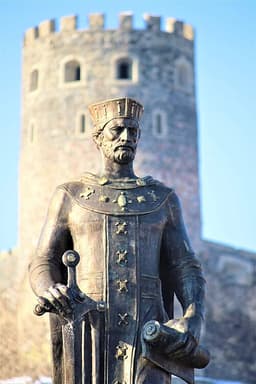
George V of Georgia
Emperor · Medieval
56.6Total

Napoleon Bonaparte
General · Modern
70.9Total
Basic Information
Born
1286
1769
Died
1346
1821
Era
Medieval
Modern
Nationality
Georgia
France
Occupation
Emperor
General
Civilization
Western
Western
Score Comparison
Military (10%)
47.5
94.0
Political (20%)
60.0
72.0
Influence (20%)
62.0
40.0
Legacy (20%)
50.0
80.0
Leadership (15%)
66.0
78.0
Strategy (15%)
50.0
90.0
TOTAL
56.6
70.9
George V of Georgia — Complete Timeline
1327 AD
Restoration of Georgian KingdomPolitical Action
George V expelled the Mongol Ilkhanate's influence from Georgia, restoring independence and central authority. He reestablished the kingdom's sovereignty after decades of Mongol domination.
RestorationGeorgiaMongols
Impact: nationalconstructive
1330 AD
Unification of Western and Eastern GeorgiaPolitical Action◆ Major
George V reunified western and eastern Georgia under his rule, ending internal divisions. This consolidation strengthened the kingdom and allowed for economic and cultural recovery.
UnificationGeorgiaMedieval
Impact: nationalconstructive
1335 AD
Trade ReformsReform◆ Major
George V implemented trade agreements with the Republic of Genoa and other powers, boosting Georgia's economy. These reforms facilitated the revival of commerce along the Silk Road.
TradeEconomyGeorgia
Impact: regionalconstructive
Napoleon Bonaparte — Complete Timeline
1799 AD
Coup of 18 BrumaireOther◆ Major
Napoleon Bonaparte, with support from his brother Lucien and key political figures, overthrew the Directory in a bloodless coup. He established the Consulate with himself as First Consul, effectively becoming the ruler of France. This event ended the French Revolution's most unstable period.
French RevolutionCoupRise to Power
Impact: regional
1804 AD
Promulgation of the Napoleonic CodeOther◆ Major
Napoleon enacted the Civil Code of the French, known as the Napoleonic Code, a comprehensive set of laws that replaced the fragmented feudal legal systems. The code established legal equality, protected property rights, and secularized law. It became the basis for legal systems in many European and world countries.
Legal ReformNapoleonic CodeCivil Law
Impact: globalconstructive
1805 AD
Battle of AusterlitzWar◆ Major
Napoleon's Grande Arm
Napoleonic WarsBattleDecisive Victory
Impact: global
1812 AD
Invasion of RussiaWar◆ Major
Napoleon led the Grande Arm
Napoleonic WarsInvasionDisaster
Impact: globaldestructive
1815 AD
Battle of WaterlooWar◆ Major
Napoleon's French army was defeated by the combined forces of the Duke of Wellington's Anglo-Allied army and Gebhard Leberecht von Bl
Napoleonic WarsBattleFinal Defeat
Impact: globaldestructive
Expert Analysis
george-v-of-georgia-vs-napoleon-bonaparte
# The Conqueror and the Restorer
On a June morning in 1815, Napoleon Bonaparte watched his elite Imperial Guard advance across the muddy fields of Waterloo, certain that victory was within reach. Less than a century earlier, another ruler—George V of Georgia—had watched his own soldiers march into Tbilisi, not to conquer, but to reclaim a kingdom shattered by Mongol domination. Both men sought to restore glory to their nations. One built an empire that collapsed within his lifetime. The other rebuilt a kingdom that endured for centuries. What made the difference? The answer lies not in their ambitions, which were equally grand, but in the worlds they inherited and the choices they made.
Origins
Napoleon was born in 1769 on the island of Corsica, a Mediterranean backwater recently annexed by France. His family was minor nobility, struggling and resentful. The France he grew up in was a powder keg—the old monarchy rotting, the Enlightenment fermenting revolution. Napoleon absorbed both the chaos and the ideas. He learned artillery at military school, but he also read Rousseau and Voltaire. He was a child of revolution, shaped by the belief that a man of talent could remake the world.
George V, by contrast, was born in 1286 into a Georgia that had been a Christian kingdom for nearly a millennium, but was now crushed under the Mongol Ilkhanate. His father, King Demetre II, was executed by the Mongols when George was just three years old. The boy grew up in a court where survival meant submission. Where Napoleon saw opportunity in upheaval, George saw the slow, patient work of rebuilding from ruin. His era was medieval—defined not by revolutionary change, but by the restoration of broken traditions.
Rise to Power
Napoleon’s rise was meteoric. At 24, he drove the British out of Toulon. At 26, he crushed a royalist uprising in Paris with a "whiff of grapeshot." At 30, he made himself First Consul of France. His path was one of constant, dazzling acceleration—each victory a stepping stone to greater power. He did not inherit a throne; he seized it through sheer will and military genius.
George V’s rise was far slower and more precarious. He became king in 1299, but for years he ruled only nominally, a vassal of the Mongols. He waited. He negotiated. He played the game of survival. The turning point came in 1327, when the Mongol Ilkhanate began to collapse under internal strife. George seized the moment—not with a grand battle, but with a series of political maneuvers that expelled Mongol influence from Georgia without a war of annihilation. He restored independence not by smashing his enemies, but by outlasting them.
Leadership & Governance
Napoleon’s leadership was a storm. He reorganized France’s legal system with the Napoleonic Code, a reform that influenced civil law across Europe. He built roads, standardized education, and centralized the state. But his governance was inseparable from his military campaigns. Every reform served the war machine. He once said, "I have only one passion: to dominate." That passion drove him to conquer from Madrid to Moscow, but it also left France exhausted and isolated.
George V governed differently. His military score—36.1—is strikingly low compared to Napoleon’s 94.0, but his political score—78.1—is nearly equal to Napoleon’s 75.0. George understood that conquest was not the path to strength. Instead, he focused on unification. In 1330, he brought western and eastern Georgia back under a single crown, ending decades of internal division. He then turned to trade, signing agreements with the Republic of Genoa in 1335 that revived Georgia’s economy. Where Napoleon built an empire of conquest, George built a kingdom of stability.
Triumph & Tragedy
Napoleon’s greatest triumph was also his greatest tragedy. In 1812, he marched into Russia with the largest army Europe had ever seen—over 600,000 men. He reached Moscow, but the Russians burned the city and refused to surrender. The retreat was a catastrophe: frostbite, starvation, and Cossack attacks reduced his army to a shadow. By 1814, he was exiled to Elba. He returned for a final, desperate gamble in 1815, but Waterloo ended it. His ambition, which had made him master of Europe, also destroyed him.
George V’s triumphs were quieter but more lasting. By 1330, he had restored Georgia’s independence and unity. He died in 1346, his kingdom stronger than it had been in generations. Yet tragedy came later—within a few decades, Timur’s invasions would devastate Georgia, undoing much of George’s work. But the kingdom itself survived, and George’s reforms gave it the resilience to endure centuries of foreign domination.
Character & Destiny
Napoleon was driven by an insatiable hunger for glory. He once wrote, "What is history but a fable agreed upon?" He believed he could write that fable himself. His personality—brilliant, arrogant, relentless—shaped every decision. He could not stop, because stopping meant admitting limits. That refusal to compromise made him a genius in the field and a disaster in the long run.
George V was the opposite. He was patient, pragmatic, and deeply aware of limits. He did not try to conquer the Mongols; he waited for them to weaken. He did not seek to dominate Europe; he sought to restore Georgia. His nickname, "the Brilliant," came not from battlefield brilliance but from political wisdom. He understood that survival is sometimes greater than victory.
Legacy
Napoleon’s legacy is monumental and contradictory. The Napoleonic Code remains the foundation of French law. His military campaigns are studied in every war college. But his empire vanished within a decade of his death. He is remembered as both a liberator and a tyrant, a hero of progress and a cautionary tale of ambition.
George V’s legacy is quieter but more intimate. In Georgia, he is remembered as the king who restored the kingdom, who brought peace after the Mongol storm. His reforms laid the groundwork for Georgia’s golden age under Queen Tamar. He is not a global icon, but to Georgians, he is a symbol of resilience—proof that a nation can rise again.
Conclusion
Napoleon and George V both faced the same fundamental question: how to lead a nation through crisis. Napoleon answered by reaching for everything, George by holding onto what mattered. One ended in exile, the other in a grave in Gelati Monastery. Yet both succeeded in their own ways. Napoleon reshaped Europe; George saved Georgia. Perhaps the lesson is not that one was right and the other wrong, but that history rewards different virtues at different times. The conqueror and the restorer—each was perfect for his moment, each doomed by the limits of his own brilliance.
Rankings
🥇
Napoleon BonaparteLeader
Mil: 94.0Pol: 72.0Inf: 40.0
70.9
🥈
George V of Georgia
Mil: 47.5Pol: 60.0Inf: 62.0
56.6
+14.3 behind
How This Comparison Works
Algorithm
Each figure is scored on 6 dimensions (0—100 scale) based on structured historical data: Military (10%), Political (20%), Influence (20%), Legacy (20%), Leadership (15%), Strategy (15%). The weighted total produces the final ranking.
Data Sources
Scores are computed from structured sub-indicators in the database. Scale factors adjust for era (Ancient ×0.85, Modern ×1.0) and civilization size (Eastern ×1.05, Other ×0.80) to account for differences in population and military scale.
Maximum 3 Figures
Comparisons are limited to 2—3 figures to ensure readability and statistical meaningfulness.
Error Margins
±5 points per dimension — Sub-scores are derived from historical records with inherent uncertainty. Two figures within 5 points on a dimension should be considered roughly equivalent in that area.
Total Score Accuracy
±3 points overall — The weighted combination of 6 dimensions produces a total score with approximately ±3 points of uncertainty. Differences of less than 3 points are not statistically significant— the figures are effectively tied.
Known Limitations
- Historical records are incomplete and uneven across civilizations
- Figures from oral-tradition societies may be underrepresented
- Occupation labels can misclassify multi-role figures
- Scores measure capability and impact, not moral character
- Quantitative scoring is a comparison tool, not absolute truth
Capability Radar
Military (10%) — Battles & Warfare
Battles
45
95
Win Rate
55
90
Expansion
55
95
Political (20%) — Governance & Reform
Reform
75
95
Diplomacy
65
80
Economy
70
85
Influence (20%) — Cultural & Global Reach
Cultural
60
85
Global
40
90
Legacy (20%) — Historical Impact
Historical
55
95
Longevity
50
90
Leadership (15%) — Power & Stability
Tenure
70
85
Stability
65
70
Strategy (15%) — Tactics & Innovation
Strategy
55
95
Tactics
50
98
Reform
60
92
Similar Comparisons
Comments & Discussion
IronLegionnaire6/17/2026
Napoleon’s Imperial Guard didn’t break because of British squares—they broke because Napoleon ran out of horses and men after bleeding his army dry in Russia. Waterloo was just the final chapter of a self-inflicted wound. Georgia’s George V played the long game: he bribed Mongols, waited out their collapse, and reunified his realm without a single suicidal charge. One man gambled everything on glory; the other simply outlasted his enemies. That’s not ambition—that’s survival instinct.
数据控老张6/17/2026
谁赢谁输?拿破仑的滑铁卢战役损失约2.5万人,而格鲁吉亚五世改革期间百姓饿死率下降了多少?历史比较没有数据支撑就是鸡汤文。拿破仑帝国崩溃时法国国债占GDP比重超过80%,乔治五世那会儿根本没有可靠经济统计,拿什么比?这种跨世纪对决,根本是关公战秦琼。
ThermopylaeReader6/17/2026
Lumping Napoleon with a medieval restorer is like comparing a supernova to a candle. Napoleon wrote his name across Europe in blood and law codes; George V quietly pieced together a buffer state that the Mongols had already hollowed out. Georgia’s “endurance” owed more to geography and Mongol decline than to any king’s strategy. Give me the man who changed the map, not the one who held the line.
历史杠精小陈6/17/2026
还原历史真相:乔治五世联合蒙古藩王对抗伊儿汗国,本质是地方军阀的权谋游戏,哪来什么“民族复兴”?拿破仑至少颁布了《民法典》,奠定了现代欧洲法律基础。格鲁吉亚五世的所谓“千年王国”在15世纪就被奥斯曼和波斯瓜分了,耐久力在哪?要论影响力,拿破仑甩他十条街。别美化失败者。
LegacyWarden6/17/2026
You miss the point entirely. Napoleon’s empire was a fireworks display—brilliant, then gone. George V’s Georgia lasted because he understood that restoration isn’t about conquest, but about roots. He rebuilt churches, reestablished trade with Byzantium, and kept Georgian identity alive under Mongol overlordship. Napoleon died on a rock; George V died in his bed, his kingdom still standing. One legacy was a name in history books. The other was a nation.