Loading...
Georges Clemenceau vs Napoleon Bonaparte
Napoleon Bonaparte leads by 7.1 pts · 2 figures compared
…
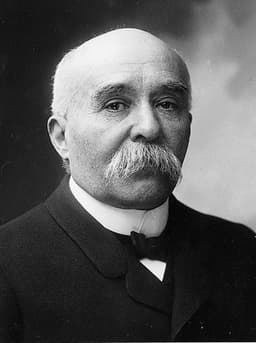
Georges Clemenceau
Politician · Modern
63.8Total

Napoleon Bonaparte
General · Modern
70.9Total
Basic Information
Born
1841
1769
Died
1929
1821
Era
Modern
Modern
Nationality
France
France
Occupation
Politician
General
Civilization
Western
Western
Score Comparison
Military (10%)
49.1
94.0
Political (20%)
70.3
72.0
Influence (20%)
65.0
40.0
Legacy (20%)
65.0
80.0
Leadership (15%)
78.0
78.0
Strategy (15%)
41.4
90.0
TOTAL
63.8
70.9
Georges Clemenceau — Complete Timeline
1917 AD
Became Prime Minister of France for the second timePolitical Action◆ Major
Clemenceau was appointed premier during a critical phase of World War I, after the failure of the Nivelle Offensive and mutinies in the French army. He formed a war government and vowed to pursue the war to victory, restoring morale and discipline.
World War ILeadershipWar Government
Impact: global
Suppressed the French army mutinies of 1917Political Action◆ Major
Clemenceau took a hard line against mutineers, ordering arrests and courts-martial. He also improved soldiers' conditions and leave. His actions restored order in the French army, allowing it to continue fighting effectively for the remainder of the war.
World War IMutinyDiscipline
Impact: nationaldestructive
1919 AD
Played a leading role in the Paris Peace ConferencePolitical Action◆ Major
Clemenceau chaired the Paris Peace Conference and was a key figure in drafting the Treaty of Versailles. He insisted on harsh terms for Germany, including reparations, territorial losses, and military restrictions, to ensure French security.
World War IPeace TreatyVersailles
Impact: global
1920 AD
Resigned as Prime MinisterPolitical Action
Clemenceau lost the presidential election to Paul Deschanel and subsequently resigned as prime minister. His departure marked the end of his wartime leadership. He retired from politics, having achieved his goal of victory and a punitive peace.
ResignationPoliticsPost-War
Impact: national
Napoleon Bonaparte — Complete Timeline
1799 AD
Coup of 18 BrumaireOther◆ Major
Napoleon Bonaparte, with support from his brother Lucien and key political figures, overthrew the Directory in a bloodless coup. He established the Consulate with himself as First Consul, effectively becoming the ruler of France. This event ended the French Revolution's most unstable period.
French RevolutionCoupRise to Power
Impact: regional
1804 AD
Promulgation of the Napoleonic CodeOther◆ Major
Napoleon enacted the Civil Code of the French, known as the Napoleonic Code, a comprehensive set of laws that replaced the fragmented feudal legal systems. The code established legal equality, protected property rights, and secularized law. It became the basis for legal systems in many European and world countries.
Legal ReformNapoleonic CodeCivil Law
Impact: globalconstructive
1805 AD
Battle of AusterlitzWar◆ Major
Napoleon's Grande Arm
Napoleonic WarsBattleDecisive Victory
Impact: global
1812 AD
Invasion of RussiaWar◆ Major
Napoleon led the Grande Arm
Napoleonic WarsInvasionDisaster
Impact: globaldestructive
1815 AD
Battle of WaterlooWar◆ Major
Napoleon's French army was defeated by the combined forces of the Duke of Wellington's Anglo-Allied army and Gebhard Leberecht von Bl
Napoleonic WarsBattleFinal Defeat
Impact: globaldestructive
Expert Analysis
georges-clemenceau-vs-napoleon-bonaparte
# The Conqueror and the Tiger: Two French Visions of Power
In the winter of 1919, an old man with a bristling white mustache sat in the Hall of Mirrors at Versailles, the very room where, forty-eight years earlier, the German Empire had been proclaimed after France's humiliation. Now, Georges Clemenceau, aged seventy-eight, was dictating terms to a defeated Germany. He could not have missed the irony: the same hall had witnessed Napoleon's greatest triumphs, and now it hosted the final act of a war that had consumed a generation. What drove a man who conquered continents to die in exile, and a man who never led an army to preside over France's greatest victory? The answer lies not in their shared nationality, but in their radically different relationships with time, power, and the limits of human ambition.
Origins
Napoleon Bonaparte was born in 1769 on the island of Corsica, a land of vendetta and clan loyalty, newly annexed by France. His family were minor nobles of Italian descent, and young Napoleon grew up speaking Corsican Italian, not French. This outsider status would define him: he was a man who had to prove himself, who saw the world as something to be conquered rather than inherited. The French Revolution, erupting when he was twenty, shattered the old order and created a vacuum that a brilliant artillery officer could fill. His education at the military academy of Brienne taught him mathematics and strategy, but his real schooling came from reading Rousseau and Plutarch—dreaming of being Caesar in an age that had just killed its king.
Georges Clemenceau, born in 1841 in the Vendée region, came from a very different world. His father was a country doctor and a republican activist who had been imprisoned by Napoleon III. Clemenceau grew up in the shadow of defeat—the fall of the Second Empire in 1870, the German occupation of Paris, the bloody suppression of the Paris Commune. Where Napoleon saw a world to be remade, Clemenceau saw a world to be defended. He studied medicine in Paris, but his true passion was politics, honed in the radical salons of Montmartre and the American exile where he taught French and observed democracy in action. His nickname, "The Tiger," came not from predatory ambition but from tenacity—he was a man who never surrendered.
Rise to Power
Napoleon's ascent was meteoric, almost supernatural. In 1793, at age twenty-four, he drove the British fleet from Toulon and became a brigadier general. By 1796, he commanded the Army of Italy, where his lightning campaigns forced Austria to sue for peace. The Italian campaign was not merely military genius—it was a political performance. He wrote bulletins that made him a hero, looted art treasures to send back to Paris, and cultivated an aura of invincibility. The Egyptian campaign of 1798 was a gamble that failed strategically but succeeded mythically: the Battle of the Pyramids, the Sphinx, the discovery of the Rosetta Stone—all became part of the Napoleon legend. By 1799, he returned to a France desperate for order and staged the coup of 18 Brumaire, becoming First Consul at age thirty. In five years, he had gone from obscure officer to master of France.
Clemenceau's rise was a marathon, not a sprint. He entered politics in 1871 as a radical deputy, voting against the peace treaty with Germany—a stance that made him a hero to the revanchist right but a pariah to the moderate center. He spent decades in the wilderness, editing newspapers, fighting duels, and making enemies with his sharp tongue. His first term as prime minister in 1906 lasted only three years and was marked by labor strikes and social unrest. He was sixty-five years old when, in 1917, with the French army mutinying and the nation on the brink of collapse, President Raymond Poincaré reluctantly called him back. "The Tiger" was not young, not charming, not beloved—but he was exactly what a dying nation needed.
Leadership & Governance
Napoleon ruled as a military genius who believed that force could solve any problem. His Napoleonic Code, enacted in 1804, standardized French law, abolished feudalism, and established meritocracy—but it also restricted women's rights and reestablished slavery in the colonies. He was a reformer who centralized education, built roads and canals, and created the Bank of France—but every reform served his ambition. His military strategy was revolutionary: he used speed, massed artillery, and the corps system to defeat larger armies. At Austerlitz in 1805, he destroyed the Third Coalition in a single day. But his governance had a fatal flaw: he could not stop. Every victory demanded another war, every treaty was a truce, every ally became an enemy. "I love power as an artist," he once said. But artists know when to stop; Napoleon did not.
Clemenceau governed as a politician who understood the art of the possible. As prime minister during the Great War, he did not command armies—he commanded a nation. When the French army mutinied in 1917, he did not execute thousands as the Germans might have; he visited the front lines, promised better food and leave, and dismissed incompetent generals. He visited the trenches, smoking his perpetual cigarette, listening to soldiers who called him "the Old Man." His strategy was simple: hold the line, trust the Allies, and wait for the Americans. He told the Chamber of Deputies, "I wage war." Nothing else mattered. He suppressed defeatists, censored newspapers, and arrested politicians who advocated peace—but he did so openly, with parliamentary approval, in a democracy under siege.
Triumph & Tragedy
Napoleon's greatest moment was Austerlitz, where the sun rose over the frozen battlefield and he crushed the combined armies of Austria and Russia. His greatest tragedy was the invasion of Russia in 1812. He marched six hundred thousand men into the vastness of the Russian winter; fewer than forty thousand returned. The Grande Armée did not die in battle—it starved, froze, and dissolved into a rabble of desperate men. Napoleon's mistake was not tactical but psychological: he could not conceive of an enemy that would not fight, a space that could not be conquered, a winter that did not respect his genius. Exiled to Elba in 1814, he returned for the Hundred Days, only to meet final defeat at Waterloo in 1815, where the rain, the mud, and the Prussian arrival turned his last gamble into a rout. He died in 1821 on Saint Helena, a British prisoner, dictating his memoirs to justify his life.
Clemenceau's triumph was the Armistice of November 11, 1918. He stood in the railway carriage at Compiègne and watched the German delegation sign the surrender. France had survived—but at a cost of 1.4 million dead, entire regions devastated, a generation crippled. His tragedy came at the Paris Peace Conference of 1919, where he demanded a harsh peace to guarantee French security. He wanted the Rhineland separated from Germany, permanent demilitarization, and reparations that would cripple the German economy. He got only a fraction of what he wanted—President Wilson's idealism and Lloyd George's pragmatism diluted his demands. "The Tiger" was called a warmonger, a revanchist, a man of the past. He lost the presidential election in 1920 and resigned, bitter and vindicated. He died in 1929, watching the Germany he had tried to contain rise again.
Character & Destiny
Napoleon was a creature of infinite ambition and terrible loneliness. He could charm men and women alike, but he trusted no one. His marriages to Josephine and Marie Louise were political, his siblings were appointed kings, his marshals were bought with titles and treasure. He believed that "impossible is a word to be found only in the dictionary of fools"—and for a time, he was right. But his character was his destiny: he could not share power, could not delegate, could not stop. He once said, "There is no such thing as accident; it is fate misnamed." But his fate was self-made, a spiral of conquest that consumed everything it touched.
Clemenceau was a man of fierce independence and profound pessimism. He was a duellist who fought fourteen duels, a journalist who attacked everyone, a politician who made enemies of allies. He loved France but distrusted Frenchmen. He believed that democracy was fragile, that war was inevitable, and that only the strong survived. He once said, "War is a series of catastrophes that ends in a victory." He did not dream of glory; he fought for survival. His character was also his destiny: he was the right man for the worst moment, a tiger who could only exist in a cage.
Legacy
Napoleon's legacy is a paradox. He is remembered as a military genius who reshaped Europe, a lawgiver who created the modern state, and a tyrant who drowned the continent in blood. The Napoleonic Code influences legal systems from Louisiana to Japan. His campaigns are studied in every military academy. But he also demonstrated the limits of power—that a single man, no matter how brilliant, cannot conquer a continent or defeat time itself. His final words were "France, Army, Head of the Army, Josephine"—a man still dreaming of what he had lost.
Clemenceau's legacy is quieter but no less profound. He is remembered as the father of victory, the man who saved France in its darkest hour. The Treaty of Versailles that he shaped is blamed for the rise of Hitler and World War II—but Clemenceau knew that it was not enough. He warned that "a treaty is only a scrap of paper if the will to enforce it is lacking." He left behind no code, no empire, no dynasty—only a memory of stubborn courage. When he died, his will instructed that his funeral be simple: no speeches, no military honors, just a plain hearse to the cemetery. "I wish to be buried at the side of my father," he wrote, "in the earth of my native country."
Conclusion
Two Frenchmen, two centuries, two visions of power. Napoleon believed that the world could be remade by force; Clemenceau knew that it could only be defended by endurance. Napoleon conquered Europe and lost everything; Clemenceau saved France and gained nothing but history's respect. Perhaps the difference is not in their genius but in their understanding of time. Napoleon lived in the eternal present of the battlefield, where every moment demanded victory. Clemenceau lived in the long shadow of history, where victory is never final and peace is always temporary. The conqueror built an empire that collapsed within a generation; the politician preserved a republic that endures to this day. In the end, the Tiger's legacy may be the more lasting: not the glory of conquest, but the courage to survive.
Rankings
🥇
Napoleon BonaparteLeader
Mil: 94.0Pol: 72.0Inf: 40.0
70.9
🥈
Georges Clemenceau
Mil: 49.1Pol: 70.3Inf: 65.0
63.8
+7.1 behind
How This Comparison Works
Algorithm
Each figure is scored on 6 dimensions (0—100 scale) based on structured historical data: Military (10%), Political (20%), Influence (20%), Legacy (20%), Leadership (15%), Strategy (15%). The weighted total produces the final ranking.
Data Sources
Scores are computed from structured sub-indicators in the database. Scale factors adjust for era (Ancient ×0.85, Modern ×1.0) and civilization size (Eastern ×1.05, Other ×0.80) to account for differences in population and military scale.
Maximum 3 Figures
Comparisons are limited to 2—3 figures to ensure readability and statistical meaningfulness.
Error Margins
±5 points per dimension — Sub-scores are derived from historical records with inherent uncertainty. Two figures within 5 points on a dimension should be considered roughly equivalent in that area.
Total Score Accuracy
±3 points overall — The weighted combination of 6 dimensions produces a total score with approximately ±3 points of uncertainty. Differences of less than 3 points are not statistically significant— the figures are effectively tied.
Known Limitations
- Historical records are incomplete and uneven across civilizations
- Figures from oral-tradition societies may be underrepresented
- Occupation labels can misclassify multi-role figures
- Scores measure capability and impact, not moral character
- Quantitative scoring is a comparison tool, not absolute truth
Capability Radar
Military (10%) — Battles & Warfare
Battles
30
95
Win Rate
32
90
Expansion
34
95
Political (20%) — Governance & Reform
Reform
80
95
Diplomacy
90
80
Economy
70
85
Influence (20%) — Cultural & Global Reach
Cultural
60
85
Global
80
90
Legacy (20%) — Historical Impact
Historical
85
95
Longevity
70
90
Leadership (15%) — Power & Stability
Tenure
85
85
Stability
75
70
Strategy (15%) — Tactics & Innovation
Strategy
35
95
Tactics
38
98
Reform
46
92
Similar Comparisons
Comments & Discussion
Tiger's Ghost6/17/2026
Clemenceau won where Napoleon failed: he actually finished the job. Napoleon's 1814 abdication came after a coalition of all Europe ganged up on him; Clemenceau faced the same coalition but this time France was on top. The old Tiger understood modern total war—mobilizing a nation's entire economy and morale—while Napoleon still thought in terms of pitched battles and dynastic glory. Napoleon's ego cost him everything; Clemenceau had no throne to lose, only a country to save.
数据将军6/17/2026
别被拿破仑的光环骗了。他所谓的"辉煌战绩"本质就是数据注水:滑铁卢时他号称有七万大军,实际能打的不到五万,其余都是临时拉来的新兵。相反,克莱蒙梭能把法国从1917年的兵变中拉回来靠的是实打实的数据管理——他计算过每一条铁路线能运多少炮弹,知道每个兵工厂的日产量。拿破仑的统计数字是为了写进回忆录,克莱蒙梭的数字是为了打赢战争。
Classics Grad6/17/2026
Both men understood the classical playbook, but only one knew when to stop. Napoleon saw himself as Caesar crossing the Rubicon—his invasion of Russia was pure Alexandrian hubris, chasing glory beyond reason. Clemenceau read his Thucydides better: he knew Athens lost not because they lacked power, but because they couldn't leave the table when they were ahead. 1919 wasn't about conquest; it was about securing what France had already bled for. The Tiger wasn't a conqueror; he was a defensive real
历史迷途者6/17/2026
最讽刺的是:拿破仑死了百年后,克莱蒙梭继承的是拿破仑的噩梦军国主义。拿破仑在1805年奥斯特里茨贏得漂亮,但那是为个人野心服务的战争;克莱蒙梭面对的是无意义的堑壕绞肉机,却坚持要"打到最后一颗子弹"。两人都是将法国推向前台的赌徒,只不过一个赌的是皇冠,一个赌的是共和国。差别?拿破仑输了,克莱蒙梭赢了,如此而已。
The Iron Censor6/17/2026
Revisionists love to paint Clemenceau as a bloodthirsty geriatric, but at least he never sold off French territory like Napoleon did with Louisiana. Napoleon traded away over 800,000 square miles for pennies to fund European wars—that's economic malpractice disguised as strategy. Clemenceau, by contrast, fought tooth and nail for Alsace-Lorraine, territories actually connected to French soil. One man understood geography as asset; the other treated it as currency. I know which vision served Fran