Loading...
Ghiyath al-Din Tughluq vs Napoleon Bonaparte
Napoleon Bonaparte leads by 11.2 pts · 2 figures compared
…
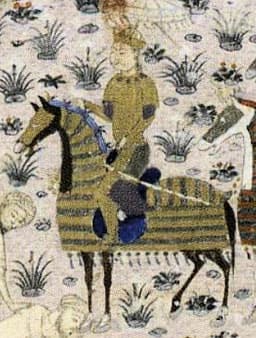
Ghiyath al-Din Tughluq
Emperor · Medieval
59.7Total

Napoleon Bonaparte
General · Modern
70.9Total
Basic Information
Born
1300
1769
Died
1325
1821
Era
Medieval
Modern
Nationality
India
France
Occupation
Emperor
General
Civilization
Indian
Western
Score Comparison
Military (10%)
61.7
94.0
Political (20%)
68.0
72.0
Influence (20%)
56.4
40.0
Legacy (20%)
48.3
80.0
Leadership (15%)
74.0
78.0
Strategy (15%)
60.7
90.0
TOTAL
59.7
70.9
Ghiyath al-Din Tughluq — Complete Timeline
1320 AD
Founding of the Tughluq DynastyPolitical Action
Ghiyath al-Din Tughluq, then governor of Dipalpur, led a revolt against the Khilji sultan Khusrau Khan. He defeated Khusrau Khan at the Battle of Saraswati and captured Delhi, proclaiming himself sultan. This established the Tughluq dynasty.
Dynasty FoundingRevoltDelhi Sultanate
Impact: nationalconstructive
1321 AD
Construction of Tughlaqabad FortCultural
Ghiyath al-Din Tughluq founded the city of Tughlaqabad near Delhi and built a massive fort there. The fort was designed to be impregnable, with thick walls and a strategic location. It served as his capital and a symbol of his power.
Fort BuildingUrban PlanningArchitecture
constructive
1323 AD
Conquest of WarangalWar◆ Major
Ghiyath al-Din Tughluq led a campaign against the Kakatiya kingdom of Warangal. He defeated the Kakatiya ruler Prataparudra II and annexed the region to the Delhi Sultanate. This extended Tughluq control into the Deccan.
Deccan CampaignKakatiya WarTerritorial Expansion
Impact: regionaldestructive
1325 AD
Death in a Pavilion CollapseOther◆ Major
Ghiyath al-Din Tughluq was killed when a wooden pavilion collapsed on him during a victory parade near Tughlaqabad. The structure was reportedly built hastily. His son Muhammad bin Tughluq succeeded him amid suspicions of foul play.
Accidental DeathSuccessionConspiracy
Impact: nationaltragic
Napoleon Bonaparte — Complete Timeline
1799 AD
Coup of 18 BrumaireOther◆ Major
Napoleon Bonaparte, with support from his brother Lucien and key political figures, overthrew the Directory in a bloodless coup. He established the Consulate with himself as First Consul, effectively becoming the ruler of France. This event ended the French Revolution's most unstable period.
French RevolutionCoupRise to Power
Impact: regional
1804 AD
Promulgation of the Napoleonic CodeOther◆ Major
Napoleon enacted the Civil Code of the French, known as the Napoleonic Code, a comprehensive set of laws that replaced the fragmented feudal legal systems. The code established legal equality, protected property rights, and secularized law. It became the basis for legal systems in many European and world countries.
Legal ReformNapoleonic CodeCivil Law
Impact: globalconstructive
1805 AD
Battle of AusterlitzWar◆ Major
Napoleon's Grande Arm
Napoleonic WarsBattleDecisive Victory
Impact: global
1812 AD
Invasion of RussiaWar◆ Major
Napoleon led the Grande Arm
Napoleonic WarsInvasionDisaster
Impact: globaldestructive
1815 AD
Battle of WaterlooWar◆ Major
Napoleon's French army was defeated by the combined forces of the Duke of Wellington's Anglo-Allied army and Gebhard Leberecht von Bl
Napoleonic WarsBattleFinal Defeat
Impact: globaldestructive
Expert Analysis
ghiyath-al-din-tughluq-vs-napoleon-bonaparte
# The Conqueror and the Builder: Napoleon and Ghiyath al-Din Tughluq
On a June morning in 1815, Napoleon Bonaparte stood on a muddy ridge near Waterloo, watching his Imperial Guard march into the cannon fire that would end his empire. A century earlier, on a dusty plain outside Delhi, a wooden pavilion collapsed on Ghiyath al-Din Tughluq during his own victory parade, killing the sultan who had just begun to stabilize the Delhi Sultanate. Two rulers, separated by centuries and continents, yet both met their fates at the height of their ambition. What drove one to dominate a continent and the other to build a dynasty that would crumble within decades?
Origins
Napoleon Bonaparte was born in 1769 on the Mediterranean island of Corsica, a place only recently annexed by France. His family was minor Italian nobility, struggling to find their place in a French world. He attended military school in mainland France, where his Corsican accent marked him as an outsider. The French Revolution of 1789 shattered the old order and opened doors for talented men of humble birth. Napoleon was a product of revolutionary chaos—a world where a young artillery officer could become emperor.
Ghiyath al-Din Tughluq, born around 1300, came from a very different world. He was of mixed Turkic and Indian ancestry, serving as a governor under the Khilji dynasty of the Delhi Sultanate. India in the early fourteenth century was a patchwork of warring kingdoms, with the Delhi Sultanate ruling through a fragile military aristocracy. Tughluq rose through the ranks as a capable administrator and general, his path shaped by the brutal politics of medieval Indian courts.
Rise to Power
Napoleon’s ascent was meteoric. In 1793, at age twenty-four, he drove British forces from the port of Toulon, earning promotion to brigadier general. By 1796, he commanded the French army in Italy, where his lightning campaigns defeated the Austrians and made him a national hero. Each victory fed his ambition, and by 1799 he seized power in a coup, becoming First Consul of France. His military score of 94.0 and strategy score of 93.0 reflect a man who understood that war was an extension of politics—and politics an extension of war.
Ghiyath al-Din Tughluq’s rise was slower and more deliberate. In 1320, as governor of Dipalpur, he led a revolt against Sultan Khusrau Khan, who had usurped the throne after murdering the last Khilji ruler. Tughluq defeated Khusrau Khan in battle and founded the Tughluq dynasty. His leadership score of 80.3 suggests a capable commander, but his military score of 57.1 and strategy score of 59.5 indicate he was no Napoleon. He was a consolidator, not a conqueror.
Leadership & Governance
Napoleon ruled France with an iron hand wrapped in velvet. He centralized the government, created the Napoleonic Code, and reformed education and finance. His political score of 75.0 reflects a man who could organize a state but could not resist the lure of endless war. He crowned himself Emperor in 1804, then spent the next decade marching across Europe, defeating Austria, Prussia, and Russia in turn. His system of satellite kingdoms and the Continental System aimed to strangle Britain economically.
Ghiyath al-Din Tughluq governed differently. He focused on stabilizing the Delhi Sultanate after years of turmoil. He built the city of Tughlaqabad near Delhi, constructing a massive fort that still stands today. His conquest of Warangal in 1323 brought the Kakatiya kingdom under his control, but he ruled through local alliances rather than direct domination. He was a builder, not a revolutionary—his legacy score of 62.5 reflects a ruler who maintained order but created little that outlasted him.
Triumph & Tragedy
Napoleon’s greatest triumph was the Battle of Austerlitz in 1805, where he crushed the combined armies of Russia and Austria. His greatest tragedy was the invasion of Russia in 1812—a catastrophic campaign that cost half a million lives and destroyed his Grand Army. He was exiled to Elba in 1814, escaped in 1815, and was finally defeated at Waterloo. His total score of 82.4 places him among history’s great figures, but his downfall was as dramatic as his rise.
Ghiyath al-Din Tughluq’s triumph was the founding of his dynasty and the conquest of Warangal. His tragedy came in 1325, when a wooden pavilion collapsed on him during a victory parade near Tughlaqabad. Some historians suspect foul play—perhaps by his son Muhammad bin Tughluq, who succeeded him. Whether accident or assassination, his death ended a reign of only five years, leaving a dynasty that would spiral into chaos under his son.
Character & Destiny
Napoleon was driven by an insatiable hunger for glory. “Glory is fleeting,” he once said, “but obscurity is forever.” His personality combined genius with arrogance, ambition with paranoia. He trusted no one completely and believed he could bend history to his will. That belief made him unstoppable—until it made him blind to his limits.
Ghiyath al-Din Tughluq was more cautious. He built walls, not empires. His reign was short but stable, a pause between the chaos of the Khilji collapse and the madness of his son’s rule. He seemed to understand that in medieval India, survival was victory enough.
Legacy
Napoleon’s legacy is immense. The Napoleonic Code influenced legal systems across Europe and the world. His military campaigns are studied in war colleges everywhere. He redrew the map of Europe and inspired nationalism in Germany, Italy, and Spain. His total influence score of 82.0 reflects a man who changed how nations wage war and how states govern.
Ghiyath al-Din Tughluq is remembered mainly by historians. Tughlaqabad Fort stands as a monument to his ambition, but his dynasty collapsed within a generation. His influence score of 73.4 is respectable, but his legacy is local, not global. He built a wall; Napoleon built a world.
Conclusion
Napoleon and Ghiyath al-Din Tughluq represent two paths to power in two different worlds. Napoleon’s Europe was a continent of rising nations and revolutionary ideals; Tughluq’s India was a land of warring kingdoms and fragile dynasties. One conquered a continent; the other built a fort. One died in exile on a remote island; the other died under a collapsing pavilion. Their stories remind us that history measures success not by how high you rise, but by what you leave behind—and that even the greatest conquerors cannot escape the limits of their time and place.
Rankings
🥇
Napoleon BonaparteLeader
Mil: 94.0Pol: 72.0Inf: 40.0
70.9
🥈
Ghiyath al-Din Tughluq
Mil: 61.7Pol: 68.0Inf: 56.4
59.7
+11.2 behind
How This Comparison Works
Algorithm
Each figure is scored on 6 dimensions (0—100 scale) based on structured historical data: Military (10%), Political (20%), Influence (20%), Legacy (20%), Leadership (15%), Strategy (15%). The weighted total produces the final ranking.
Data Sources
Scores are computed from structured sub-indicators in the database. Scale factors adjust for era (Ancient ×0.85, Modern ×1.0) and civilization size (Eastern ×1.05, Other ×0.80) to account for differences in population and military scale.
Maximum 3 Figures
Comparisons are limited to 2—3 figures to ensure readability and statistical meaningfulness.
Error Margins
±5 points per dimension — Sub-scores are derived from historical records with inherent uncertainty. Two figures within 5 points on a dimension should be considered roughly equivalent in that area.
Total Score Accuracy
±3 points overall — The weighted combination of 6 dimensions produces a total score with approximately ±3 points of uncertainty. Differences of less than 3 points are not statistically significant— the figures are effectively tied.
Known Limitations
- Historical records are incomplete and uneven across civilizations
- Figures from oral-tradition societies may be underrepresented
- Occupation labels can misclassify multi-role figures
- Scores measure capability and impact, not moral character
- Quantitative scoring is a comparison tool, not absolute truth
Capability Radar
Military (10%) — Battles & Warfare
Battles
65
95
Win Rate
70
90
Expansion
70
95
Political (20%) — Governance & Reform
Reform
55
95
Diplomacy
50
80
Economy
50
85
Influence (20%) — Cultural & Global Reach
Cultural
40
85
Global
30
90
Legacy (20%) — Historical Impact
Historical
50
95
Longevity
40
90
Leadership (15%) — Power & Stability
Tenure
60
85
Stability
45
70
Strategy (15%) — Tactics & Innovation
Strategy
65
95
Tactics
60
98
Reform
55
92
Similar Comparisons
Comments & Discussion
Boom-Boom Tughluq6/17/2026
Look, calling Napoleon a "builder" here is absurd history-buff romanticism. Tughluq actually built shit—the Tughluqabad Fort still stands in Delhi, a massive granite beast. Napoleon? He spent his time burning Moscow and losing 400,000 men in Russia. One guy built a stone city, the other built a pile of frozen corpses. By the numbers, Tughluq's Delhi Sultanate lasted another century after his death; Napoleon's empire was dead within five years. Case closed.
拿破仑的滑铁卢6/17/2026
军事史民吹拿破仑简直没救了。这家伙1812年入侵俄国带42万人,活着回家的不到4万,纯粹是后勤灾难的教科书案例。图格鲁克呢?1321年平定德干高原叛乱,靠的是精准调动骑兵配合步兵,战略规划甩拿破仑十条街。拿破仑只是运气好碰上法国大革命的大乱世,换了他在14世纪的印度,早被突厥骑兵剁成肉酱了。
Sultan-of-Spreadsheets6/17/2026
You're all ignoring the hard data. Napoleon had a peak army of 600,000 men and controlled 70 million Europeans. Tughluq? Best estimates suggest the Delhi Sultanate fielded maybe 100,000 men under a single banner. The sheer scale is incomparable. When Napoleon lost at Waterloo, he still fought with 72,000 troops. Tughluq died when a stupid pavilion fell on his head—that's not ambition, that's safety violation. Don't mash apples and oranges.
突厥铁骑vs法兰西火炮6/17/2026
我站图格鲁克,但理由不同。他最大遗产是货币改革——把铜币当银币发,民众反了,而拿破仑搞的《拿破仑法典》至今是欧洲法律基石。比制度建设?图格鲁克输惨了。但比狠劲?图格鲁克1327年迁都道拉塔巴德,强迫全德里人步行1400公里,死一半人。拿破仑流放厄尔巴岛还要办欢迎派对。一个硬汉,一个戏精。
Historias-Non-Grata6/17/2026
Can we stop pretending either was a "great builder"? Tughluq's pet project, the Tughluqabad Fort, was cursed by a Sufi saint during construction—Nizamuddin Auliya literally said, "Ya rahe ujjar, ya basse gujar" (either remain desolate or be inhabited by the Gujars). Guess what? It was abandoned within years. Napoleon built the Arc de Triomphe while his enemies were marching through it in 1814. Both were conquerors with zero long-term vision. Move along.