Loading...
Gitanas Nauseda vs Napoleon Bonaparte
Napoleon Bonaparte leads by 24.4 pts · 2 figures compared
…
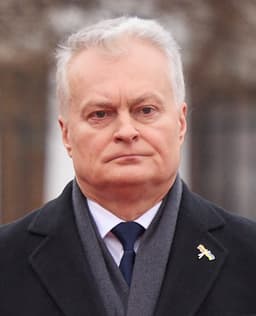
Gitanas Nauseda
Politician · Modern
46.5Total

Napoleon Bonaparte
General · Modern
70.9Total
Basic Information
Born
1964
1769
Died
—
1821
Era
Modern
Modern
Nationality
Lithuania
France
Occupation
Politician
General
Civilization
Western
Western
Score Comparison
Military (10%)
13.5
94.0
Political (20%)
68.0
72.0
Influence (20%)
51.0
40.0
Legacy (20%)
37.5
80.0
Leadership (15%)
64.0
78.0
Strategy (15%)
31.8
90.0
TOTAL
46.5
70.9
Gitanas Nauseda — Complete Timeline
2019 AD
Elected President of LithuaniaPolitical Action◆ Major
Nauseda won the Lithuanian presidential election as an independent candidate, defeating Ingrida
ElectionPresidentIndependent
Impact: nationalconstructive
2020 AD
Strong Stance on Belarus and RussiaPolitical Action◆ Major
Nauseda condemned the Belarusian government's crackdown on protesters after the disputed 2020 election. He supported EU sanctions against Belarus and provided support to Belarusian opposition figures.
BelarusHuman RightsForeign Policy
Impact: regionalconstructive
2022 AD
Support for Ukraine During Russian InvasionPolitical Action◆ Major
Nauseda was a vocal supporter of Ukraine after Russia's full-scale invasion. He advocated for NATO's eastern flank reinforcement and Lithuania provided military aid to Ukraine.
UkraineNATOSecurity
Impact: globalconstructive
2024 AD
Re-elected President of LithuaniaPolitical Action◆ Major
Nauseda won re-election in the 2024 Lithuanian presidential election, defeating Prime Minister Ingrida
ElectionRe-electionPresident
Impact: nationalconstructive
Napoleon Bonaparte — Complete Timeline
1799 AD
Coup of 18 BrumaireOther◆ Major
Napoleon Bonaparte, with support from his brother Lucien and key political figures, overthrew the Directory in a bloodless coup. He established the Consulate with himself as First Consul, effectively becoming the ruler of France. This event ended the French Revolution's most unstable period.
French RevolutionCoupRise to Power
Impact: regional
1804 AD
Promulgation of the Napoleonic CodeOther◆ Major
Napoleon enacted the Civil Code of the French, known as the Napoleonic Code, a comprehensive set of laws that replaced the fragmented feudal legal systems. The code established legal equality, protected property rights, and secularized law. It became the basis for legal systems in many European and world countries.
Legal ReformNapoleonic CodeCivil Law
Impact: globalconstructive
1805 AD
Battle of AusterlitzWar◆ Major
Napoleon's Grande Arm
Napoleonic WarsBattleDecisive Victory
Impact: global
1812 AD
Invasion of RussiaWar◆ Major
Napoleon led the Grande Arm
Napoleonic WarsInvasionDisaster
Impact: globaldestructive
1815 AD
Battle of WaterlooWar◆ Major
Napoleon's French army was defeated by the combined forces of the Duke of Wellington's Anglo-Allied army and Gebhard Leberecht von Bl
Napoleonic WarsBattleFinal Defeat
Impact: globaldestructive
Expert Analysis
gitanas-nauseda-vs-napoleon-bonaparte
# The Emperor and the Economist: Two Paths to Power in a Dangerous Europe
On a June evening in 1815, Napoleon Bonaparte watched his empire crumble in the mud of Waterloo, his dreams of continental domination shattered by a coalition of European powers. Two centuries later, on a spring day in 2024, Gitanas Nausėda stood in Vilnius, accepting congratulations on his re-election as President of Lithuania—a small nation that Napoleon himself had once marched through on his way to Moscow. These two men, separated by 155 years and an ocean of circumstance, both rose to lead their nations in times of existential threat. Yet one ended his life a prisoner on a remote Atlantic island, while the other continues to guide his country through the treacherous currents of modern geopolitics. What explains the difference? The answer lies not merely in their talents, but in the worlds that shaped them.
Origins
Napoleon Bonaparte was born in 1769 on the island of Corsica, a Mediterranean rock that had only become French the year before. His family belonged to the minor nobility, but they were poor, proud, and resentful of French domination. Young Napoleon spoke Italian-accented French and carried the chip of a provincial outsider. The French Revolution, which erupted when he was twenty, shattered the old order and opened paths that would have been unthinkable under the monarchy. A brilliant artillery officer could now become emperor—if he had the ambition and the ruthlessness.
Gitanas Nausėda was born in 1964 in Klaipėda, a port city on the Baltic Sea that had been part of Germany, then the Soviet Union, and finally independent Lithuania. His father was an engineer, his mother a teacher—solid, educated, Soviet professionals. Unlike Napoleon, Nausėda grew up in a world where individual ambition was suspect and political power was held by a distant, oppressive state. He studied economics, earned a doctorate, and worked as a bank economist. When Lithuania regained independence in 1990, he was twenty-six—old enough to remember Soviet repression, young enough to build a new future. His path to power would not be through conquest, but through consensus.
Rise to Power
Napoleon’s ascent was a blaze of gunpowder and glory. He first distinguished himself at the Siege of Toulon in 1793, where his artillery tactics drove out British forces. By 1796, at twenty-six, he was commanding the French Army of Italy, where he won a series of stunning victories against the Austrians. In 1799, he staged a coup d’état and made himself First Consul. By 1804, he crowned himself Emperor of the French. His rise was built on military genius, personal charisma, and the chaos of revolutionary France, which demanded heroes.
Nausėda’s rise was quieter, but no less strategic. He entered politics in 2019 as an independent candidate—a deliberate choice in a country weary of party bickering. His campaign focused on economic expertise, social welfare, and a steady hand in foreign policy. He won the runoff against Ingrida Šimonytė with 66% of the vote, a landslide that reflected not passion but trust. Where Napoleon seized power, Nausėda was invited to hold it.
Leadership & Governance
As ruler, Napoleon was a force of nature. He reformed French law with the Napoleonic Code, which established equality before the law and secular authority. He reorganized education, built roads, and stabilized the currency. But his governance was inseparable from his wars. He conquered most of Europe, installed his brothers as kings, and redrew borders at will. His military score of 94 reflects his tactical brilliance—Austerlitz in 1805 remains a masterpiece of encirclement and deception. Yet his political score of 75 hints at his weakness: he could win battles but could not secure lasting peace.
Nausėda governs in a completely different key. As president of a parliamentary republic, his powers are limited—he commands no army, proposes no laws. His influence comes from moral authority and diplomatic skill. He condemned Belarus’s crackdown on protesters in 2020, supported Ukraine after Russia’s 2022 invasion, and advocated for NATO’s eastern flank. His leadership score of 77 reflects steady competence rather than brilliance. He does not reshape the world; he defends his small piece of it.
Triumph & Tragedy
Napoleon’s greatest triumph was the Empire at its height in 1810, when he controlled most of Europe and married an Austrian princess. His greatest tragedy was the invasion of Russia in 1812, where 600,000 men marched east and only 100,000 returned. The disaster broke his aura of invincibility. Exiled to Elba in 1814, he escaped and ruled for a Hundred Days, only to be crushed at Waterloo in 1815. His final years were spent on Saint Helena, dictating memoirs and dying slowly of stomach cancer.
Nausėda’s triumphs are quieter but more durable. His strong stance on Belarus and Russia has made Lithuania a voice of moral clarity in Europe. His re-election in 2024, again defeating Šimonytė, confirmed popular trust in his steady hand. His tragedy, if it comes, may be the tragedy of all small states: that history’s great powers may decide his country’s fate regardless of his efforts.
Character & Destiny
Napoleon’s character was his destiny. His ambition was limitless, his confidence absolute, his energy inexhaustible. “Impossible is a word to be found only in the dictionary of fools,” he said. This drive built an empire—and destroyed it. He could not stop, could not compromise, could not share power. His personality was a weapon that eventually turned on its wielder.
Nausėda’s character is more measured. He is an economist, not a warrior; a consensus-builder, not a conqueror. His speeches emphasize stability, European unity, and democratic values. He does not seek to dominate, only to protect. In a world of nuclear weapons and NATO alliances, this is not cowardice but realism. The age of conquering emperors is over; the age of prudent presidents has begun.
Legacy
Napoleon’s legacy is colossal. The Napoleonic Code influenced legal systems across Europe and the Americas. His military campaigns are still studied in war colleges. He reshaped nationalism, inspired revolutions, and left a shadow that stretches to the present. His legacy score of 78 reflects both his achievements and his costs: millions dead, borders redrawn, a continent scarred.
Nausėda’s legacy is still being written. His score of 51 reflects his relative youth and the modest scale of his office. But history may judge him kindly. In an era of rising authoritarianism, he has defended democracy. In a region threatened by Russian revanchism, he has kept Lithuania safe. He may not be remembered as a great conqueror—but that is precisely the point.
Conclusion
Napoleon and Nausėda are products of their times as much as their talents. One lived in an age of empires, when a single man could reshape continents with cannon and cavalry. The other lives in an age of institutions, when power is diffused through alliances, treaties, and elections. The Corsican’s ambition led him to a lonely island grave; the Lithuanian’s prudence may lead his country to a secure future. Both paths are valid responses to the worlds they inherited. But as we watch Nausėda stand firm against Russian aggression, we might recall Napoleon’s own words: “There are only two forces that unite men—fear and interest.” In the end, the emperor relied on fear; the economist, on interest. History has yet to decide which force endures longer.
Rankings
🥇
Napoleon BonaparteLeader
Mil: 94.0Pol: 72.0Inf: 40.0
70.9
🥈
Gitanas Nauseda
Mil: 13.5Pol: 68.0Inf: 51.0
46.5
+24.4 behind
How This Comparison Works
Algorithm
Each figure is scored on 6 dimensions (0—100 scale) based on structured historical data: Military (10%), Political (20%), Influence (20%), Legacy (20%), Leadership (15%), Strategy (15%). The weighted total produces the final ranking.
Data Sources
Scores are computed from structured sub-indicators in the database. Scale factors adjust for era (Ancient ×0.85, Modern ×1.0) and civilization size (Eastern ×1.05, Other ×0.80) to account for differences in population and military scale.
Maximum 3 Figures
Comparisons are limited to 2—3 figures to ensure readability and statistical meaningfulness.
Error Margins
±5 points per dimension — Sub-scores are derived from historical records with inherent uncertainty. Two figures within 5 points on a dimension should be considered roughly equivalent in that area.
Total Score Accuracy
±3 points overall — The weighted combination of 6 dimensions produces a total score with approximately ±3 points of uncertainty. Differences of less than 3 points are not statistically significant— the figures are effectively tied.
Known Limitations
- Historical records are incomplete and uneven across civilizations
- Figures from oral-tradition societies may be underrepresented
- Occupation labels can misclassify multi-role figures
- Scores measure capability and impact, not moral character
- Quantitative scoring is a comparison tool, not absolute truth
Capability Radar
Military (10%) — Battles & Warfare
Battles
21
95
Win Rate
26
90
Expansion
25
95
Political (20%) — Governance & Reform
Reform
40
95
Diplomacy
55
80
Economy
50
85
Influence (20%) — Cultural & Global Reach
Cultural
20
85
Global
25
90
Legacy (20%) — Historical Impact
Historical
20
95
Longevity
15
90
Leadership (15%) — Power & Stability
Tenure
30
85
Stability
45
70
Strategy (15%) — Tactics & Innovation
Strategy
34
95
Tactics
33
98
Reform
35
92
Similar Comparisons
Comments & Discussion
No comments yet. Be the first to share your thoughts!