Loading...
Gligorov Kiro vs Napoleon Bonaparte
Napoleon Bonaparte leads by 18.5 pts · 2 figures compared
…
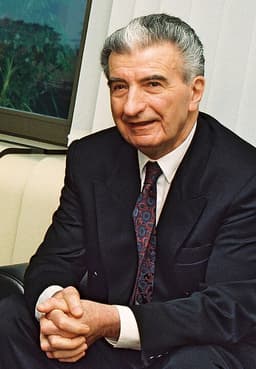
Gligorov Kiro
Politician · Modern
52.4Total

Napoleon Bonaparte
General · Modern
70.9Total
Basic Information
Born
1917
1769
Died
2012
1821
Era
Modern
Modern
Nationality
North Macedonia
France
Occupation
Politician
General
Civilization
Western
Western
Score Comparison
Military (10%)
49.1
94.0
Political (20%)
61.3
72.0
Influence (20%)
52.5
40.0
Legacy (20%)
45.0
80.0
Leadership (15%)
65.0
78.0
Strategy (15%)
41.7
90.0
TOTAL
52.4
70.9
Gligorov Kiro — Complete Timeline
1991 AD
Independence referendum and election as first presidentPolitical Action
Gligorov led Macedonia through a peaceful independence referendum from Yugoslavia in September 1991. He was elected as the first president of independent Macedonia in January 1991, overseeing the country's transition to sovereignty.
IndependenceReferendumPresidency
Impact: nationalconstructive
1995 AD
Assassination attemptPolitical Action◆ Major
Gligorov survived an assassination attempt in Skopje on October 3, 1995, when a car bomb exploded near his motorcade. He was seriously injured but recovered, while his driver was killed. The perpetrators were never identified.
Assassination attemptViolenceSurvival
Impact: nationaltragic
2001 AD
Presidency during the 2001 insurgencyWar◆ Major
Gligorov served as president during the 2001 insurgency by Albanian rebels, which threatened Macedonia's stability. He supported the Ohrid Framework Agreement in August 2001, which ended the conflict and granted greater rights to ethnic Albanians.
InsurgencyPeace agreementEthnic conflict
Impact: nationalconstructive
Napoleon Bonaparte — Complete Timeline
1799 AD
Coup of 18 BrumaireOther◆ Major
Napoleon Bonaparte, with support from his brother Lucien and key political figures, overthrew the Directory in a bloodless coup. He established the Consulate with himself as First Consul, effectively becoming the ruler of France. This event ended the French Revolution's most unstable period.
French RevolutionCoupRise to Power
Impact: regional
1804 AD
Promulgation of the Napoleonic CodeOther◆ Major
Napoleon enacted the Civil Code of the French, known as the Napoleonic Code, a comprehensive set of laws that replaced the fragmented feudal legal systems. The code established legal equality, protected property rights, and secularized law. It became the basis for legal systems in many European and world countries.
Legal ReformNapoleonic CodeCivil Law
Impact: globalconstructive
1805 AD
Battle of AusterlitzWar◆ Major
Napoleon's Grande Arm
Napoleonic WarsBattleDecisive Victory
Impact: global
1812 AD
Invasion of RussiaWar◆ Major
Napoleon led the Grande Arm
Napoleonic WarsInvasionDisaster
Impact: globaldestructive
1815 AD
Battle of WaterlooWar◆ Major
Napoleon's French army was defeated by the combined forces of the Duke of Wellington's Anglo-Allied army and Gebhard Leberecht von Bl
Napoleonic WarsBattleFinal Defeat
Impact: globaldestructive
Expert Analysis
gligorov-kiro-vs-napoleon-bonaparte
# The Emperor and the Peacemaker
On a crisp October morning in 1995, a car bomb tore through the streets of Skopje, killing the driver of Kiro Gligorov and leaving the president himself scarred but alive. A century and a half earlier, on a June evening in 1815, Napoleon Bonaparte watched his Imperial Guard dissolve into the mud of Waterloo, his dream of European dominion ending in cannon smoke and despair. One man built an empire that shook the world; the other built a nation that barely existed on any map. What drove these two figures—one a conqueror of continents, the other a quiet survivor of history’s storms—to such radically different destinies? The answer lies not in the size of their ambitions, but in the nature of their times and the choices they made.
Origins
Napoleon Bonaparte was born in 1769 on the island of Corsica, a rugged land only recently annexed by France. His family was minor nobility, but poor enough that young Napoleon studied on a royal scholarship at military academies in Brienne and Paris. He emerged in the 1780s as a artillery officer, a profession for men who understood mathematics and timing—skills he would later wield like a scepter. The French Revolution, which erupted in 1789, shattered the old order and opened paths for talent over birth. Napoleon was a product of this chaos: ambitious, brilliant, and utterly ruthless.
Kiro Gligorov was born in 1917 in Štip, a town then part of the Kingdom of Serbia, later Yugoslavia. His father was a lawyer, and young Kiro studied law in Belgrade, graduating in 1938. Unlike Napoleon, Gligorov did not inherit a tradition of empire; he inherited a tradition of survival. His homeland—Macedonia—had been carved up by empires for centuries: Ottoman, Bulgarian, Serbian, Greek. By the time Gligorov entered politics after World War II, Yugoslavia was a federation under Josip Broz Tito, and Macedonia was one of its six republics. Gligorov learned to navigate not battlefields, but bureaucracies.
Rise to Power
Napoleon’s ascent was meteoric and violent. At 24, he drove the British out of Toulon in 1793, earning promotion to brigadier general. By 1796, at 26, he commanded the Army of Italy, where he defeated larger Austrian forces through speed and audacity. His 1798 Egyptian campaign was a strategic failure but a propaganda triumph—he brought scholars and scientists to study the pyramids, cementing his image as a man of both sword and mind. In 1799, he returned to a France mired in corruption and military stalemate, and seized power in a coup d’état. By 1804, he crowned himself Emperor of the French. He was 35.
Gligorov rose slowly, through committees and compromises. He served in Tito’s government as finance minister and later as president of the Yugoslav Assembly. When Yugoslavia began to fracture in the late 1980s, Gligorov emerged not as a general, but as a conciliator. In 1991, as Croatia and Slovenia declared independence, Gligorov called a referendum in Macedonia. Over 95% voted for sovereignty, and he was elected the first president of an independent North Macedonia. His rise was not a storm, but a negotiation.
Leadership & Governance
Napoleon ruled by decree and conquest. He reorganized France into efficient departments, centralized the tax system, and founded the Bank of France. His Napoleonic Code of 1804 harmonized French law, establishing principles of equality before the law and protection of property—though it also curtailed women’s rights and restored slavery in French colonies. Militarily, he was a genius of maneuver. At Austerlitz in 1805, he crushed a Russo-Austrian army by feigning weakness and striking at the enemy’s center. His Grand Army swept across Europe, toppling thrones and installing his brothers as kings.
Gligorov governed by consensus and diplomacy. Macedonia was a fragile state: ethnically divided between Slavic Macedonians and a large Albanian minority, economically weak, and surrounded by hostile neighbors who disputed its name and language. Gligorov’s political score of 74.8 reflects his skill in holding this mosaic together. He kept Macedonia out of the Bosnian wars of the 1990s, resisted pressure from Greece over the name dispute, and maintained stability through a careful balance of ethnic representation. His leadership score of 89.2 is striking—higher than Napoleon’s 80.0—because Gligorov led not through fear, but through trust.
Triumph & Tragedy
Napoleon’s greatest triumph was his empire at its peak in 1810, stretching from Spain to Poland. He had remade Europe: abolishing feudalism, introducing the Code, and inspiring nationalism in the very peoples he conquered. His tragedy was hubris. The 1812 invasion of Russia, with over 600,000 men, ended in catastrophic retreat; fewer than 100,000 returned. Defeated, exiled to Elba in 1814, he escaped in 1815 and rallied France for one last campaign—Waterloo. He lost, and spent his final years in British captivity on Saint Helena, dictating memoirs and dying at 51.
Gligorov’s triumph was independence itself. In 1991, Macedonia achieved sovereignty without a shot fired—a rare peace in the bloody breakup of Yugoslavia. His tragedy came in 2001, when an insurgency by Albanian rebels threatened to tear the country apart. Gligorov, by then in his 80s, presided over a conflict that ended with the Ohrid Framework Agreement, granting greater rights to Albanians. He survived the 1995 assassination attempt, but the bomb left him with a scarred face and a diminished public role. He died in 2012 at 95, having outlived his empire—and his enemies.
Character & Destiny
Napoleon was driven by an insatiable will. “Impossible is a word to be found only in the dictionary of fools,” he once said. His confidence bordered on megalomania: he saw himself as a man of destiny, a modern Caesar. This made him brilliant in attack but blind to limits. He could not stop conquering because his identity depended on victory.
Gligorov was a pragmatist. “A small country must have big patience,” he reportedly said. He understood that Macedonia could not dominate, only endure. His strategy score of 35.3 is low—he was no military thinker—but his political wisdom lay in knowing what not to do. He did not invade, did not purge, did not provoke. He survived because he did not need to be a hero.
Legacy
Napoleon’s legacy is colossal. The Napoleonic Code influenced legal systems from Latin America to Japan. He reshaped European borders, inspired nationalism, and invented modern warfare. But he also left a trail of death—perhaps 3 million lives lost in his wars. He is remembered as both liberator and tyrant, a figure of awe and caution.
Gligorov’s legacy is modest but profound. He gave Macedonians their first independent state in centuries. He kept the peace in a neighborhood of fire. He is remembered not as a conqueror, but as a founder—the father of a small nation that still exists, still struggles, still survives.
Conclusion
Napoleon and Gligorov never met, never could have met. One commanded armies that shook the earth; the other commanded committees that drew borders on paper. Yet both faced the same question: what do you do with power? Napoleon chose to expand until he broke. Gligorov chose to preserve until he could pass on. In the end, the emperor’s tomb in Paris draws millions of visitors, while the president’s grave in Skopje draws a few. But the measure of a leader is not in the crowds they attract, but in the peace they leave behind. And sometimes, the quietest footsteps make the longest journey.
Rankings
🥇
Napoleon BonaparteLeader
Mil: 94.0Pol: 72.0Inf: 40.0
70.9
🥈
Gligorov Kiro
Mil: 49.1Pol: 61.3Inf: 52.5
52.4
+18.5 behind
How This Comparison Works
Algorithm
Each figure is scored on 6 dimensions (0—100 scale) based on structured historical data: Military (10%), Political (20%), Influence (20%), Legacy (20%), Leadership (15%), Strategy (15%). The weighted total produces the final ranking.
Data Sources
Scores are computed from structured sub-indicators in the database. Scale factors adjust for era (Ancient ×0.85, Modern ×1.0) and civilization size (Eastern ×1.05, Other ×0.80) to account for differences in population and military scale.
Maximum 3 Figures
Comparisons are limited to 2—3 figures to ensure readability and statistical meaningfulness.
Error Margins
±5 points per dimension — Sub-scores are derived from historical records with inherent uncertainty. Two figures within 5 points on a dimension should be considered roughly equivalent in that area.
Total Score Accuracy
±3 points overall — The weighted combination of 6 dimensions produces a total score with approximately ±3 points of uncertainty. Differences of less than 3 points are not statistically significant— the figures are effectively tied.
Known Limitations
- Historical records are incomplete and uneven across civilizations
- Figures from oral-tradition societies may be underrepresented
- Occupation labels can misclassify multi-role figures
- Scores measure capability and impact, not moral character
- Quantitative scoring is a comparison tool, not absolute truth
Capability Radar
Military (10%) — Battles & Warfare
Battles
28
95
Win Rate
34
90
Expansion
35
95
Political (20%) — Governance & Reform
Reform
40
95
Diplomacy
55
80
Economy
35
85
Influence (20%) — Cultural & Global Reach
Cultural
30
85
Global
25
90
Legacy (20%) — Historical Impact
Historical
40
95
Longevity
30
90
Leadership (15%) — Power & Stability
Tenure
50
85
Stability
30
70
Strategy (15%) — Tactics & Innovation
Strategy
37
95
Tactics
38
98
Reform
46
92
Similar Comparisons
Comments & Discussion
GENERAL_BONAPARTE_DISCOURSE6/17/2026
Sure, Napoleon conquered Europe, but Kiro Gligorov pulled off the real miracle: keeping Macedonia from imploding into a Balkan bloodbath during its independence. While Bonaparte was busy losing 500,000 men in Russia, Gligorov navigated an ethnic tinderbox between Serbs, Albanians, and Greeks without a single major war. The Emperor's ambition wrote history in blood; Gligorov's patience wrote it in ink and treaties. I'll take the peacemaker over the pyromaniac any day.
时间线的将军6/17/2026
历史总喜欢把拿破仑包装成天才,但仔细看他的军事决策,其实充满赌徒式的疯狂。滑铁卢战役他分兵格鲁希追击普鲁士人,留下了致命漏洞——这不是战略远见,而是傲慢导致的误判。反观基罗·格利戈罗夫,他面对的是更复杂的现代地缘陷阱,却没让马其顿陷入波斯尼亚式的种族清洗泥潭。拿破仑的小胜靠运气,大败靠性格;格利戈罗夫才是真正读懂了自己时代的人。
IMPERIAL_AMNESIAC6/17/2026
Everyone gushes over Napoleon's Civil Code, but he also restored slavery in the French colonies in 1802—a brutal step backward that killed thousands in Haiti. Gligorov, on the other hand, helped hold Macedonia together through the 1990s without plunging into the ethnic wars that tore apart Croatia and Bosnia. The so-called "Great Man" of history imposed his will through carnage; the quiet president kept his people alive. That's not a lesser legacy—it's a more humane one.
数据真相揭发者6/17/2026
军事叙事里拿破仑是个巨人,但数据不说谎:他的战争导致法国损失了约100万男性人口,占当时成年男性的近十分之一。这是一个国家级的创伤。而格利戈罗夫执政期间,马其顿在1990年代的人口增长保持稳定,没有出现大规模逃亡或灭绝。你说谁更成功?一个把国家拖进坟墓的帝国架子,还是一个小国领袖连任三次、让人民活下去?别被大炮声震聋了耳朵。
HISTORY_S_OVERLOOKED_CRAFTSMAN6/17/2026
Bonaparte's legacy is a museum piece—the Arc de Triomphe, the Louvre's spoils—but Gligorov's is living: the independent Republic of North Macedonia exists because he outmaneuvered both Greek nationalism and Yugoslav collapse. Napoleon had an army of 600,000 to back his demands; Gligorov had a briefcase and a referendum that won 95% support for independence in 1991. The real test of leadership isn't how many flags you plant, but how many futures you build.