Loading...
Grimoald I vs Napoleon Bonaparte
Napoleon Bonaparte leads by 22.1 pts · 2 figures compared
…
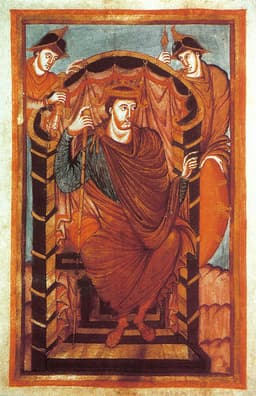
Grimoald I
Emperor · Medieval
48.8Total

Napoleon Bonaparte
General · Modern
70.9Total
Basic Information
Born
610
1769
Died
671
1821
Era
Medieval
Modern
Nationality
Lombards
France
Occupation
Emperor
General
Civilization
Western
Western
Score Comparison
Military (10%)
65.0
94.0
Political (20%)
35.1
72.0
Influence (20%)
51.8
40.0
Legacy (20%)
44.2
80.0
Leadership (15%)
51.9
78.0
Strategy (15%)
52.5
90.0
TOTAL
48.8
70.9
Grimoald I — Complete Timeline
662 AD
Usurpation of the Lombard ThronePolitical Action◆ Major
Grimoald I seized the Lombard throne by assassinating King Godepert and exiling his brother Perctarit. This coup established Grimoald as king, marking a period of strong military rule and territorial expansion.
UsurpationCoupLombard Kingdom
Impact: nationaldestructive
663 AD
Battle of FornovoWar◆ Major
Grimoald defeated a Byzantine invasion force at Fornovo, securing Lombard control over Italy. The victory repelled the Byzantine attempt to reconquer the peninsula, solidifying Lombard dominance.
BattleByzantine-Lombard WarDefense
Impact: regionalconstructive
665 AD
Conquest of BeneventoWar◆ Major
Grimoald conquered the Duchy of Benevento, expanding Lombard territory into southern Italy. This campaign brought the entire Italian peninsula under Lombard influence, except for Byzantine coastal enclaves.
ConquestTerritorial ExpansionSouthern Italy
Impact: regionaldestructive
668 AD
Reform of Lombard LawReform
Grimoald issued a legal code that standardized Lombard customary law, incorporating Roman legal principles. This reform strengthened royal authority and provided a unified legal framework for the kingdom.
Legal ReformLaw CodeLombard Kingdom
Impact: nationalconstructive
Napoleon Bonaparte — Complete Timeline
1799 AD
Coup of 18 BrumaireOther◆ Major
Napoleon Bonaparte, with support from his brother Lucien and key political figures, overthrew the Directory in a bloodless coup. He established the Consulate with himself as First Consul, effectively becoming the ruler of France. This event ended the French Revolution's most unstable period.
French RevolutionCoupRise to Power
Impact: regional
1804 AD
Promulgation of the Napoleonic CodeOther◆ Major
Napoleon enacted the Civil Code of the French, known as the Napoleonic Code, a comprehensive set of laws that replaced the fragmented feudal legal systems. The code established legal equality, protected property rights, and secularized law. It became the basis for legal systems in many European and world countries.
Legal ReformNapoleonic CodeCivil Law
Impact: globalconstructive
1805 AD
Battle of AusterlitzWar◆ Major
Napoleon's Grande Arm
Napoleonic WarsBattleDecisive Victory
Impact: global
1812 AD
Invasion of RussiaWar◆ Major
Napoleon led the Grande Arm
Napoleonic WarsInvasionDisaster
Impact: globaldestructive
1815 AD
Battle of WaterlooWar◆ Major
Napoleon's French army was defeated by the combined forces of the Duke of Wellington's Anglo-Allied army and Gebhard Leberecht von Bl
Napoleonic WarsBattleFinal Defeat
Impact: globaldestructive
Expert Analysis
grimoald-i-vs-napoleon-bonaparte
# The Emperor and the Usurper: Two Paths to Power in an Age of Iron
On a June morning in 1815, Napoleon Bonaparte stood on a muddy field near Waterloo, watching his Imperial Guard march into the cannon fire that would end his reign. A century and a half earlier, in 662, Grimoald I sat on a throne he had taken by blood, knowing that every Lombard noble in the room had already calculated how they might do the same. Both men seized power through violence. Both reshaped their worlds. But the distance between them is not merely the span of centuries—it is the chasm between a man who conquered a continent and a man who conquered only what he could hold in his hands.
Origins
Napoleon was born in 1769 on Corsica, an island that had just passed from Italian to French control. He was the son of minor nobility, but the French Revolution shattered the old order and opened paths that had been closed for centuries. By the time he was twenty-six, he had risen from obscurity to command armies. He was a creature of revolution, of printing presses and mass mobilization, of a world where talent could outrank birth.
Grimoald I, born in 610, came from the Lombard warrior aristocracy of the early Middle Ages. His world was one of oaths, blood feuds, and the constant struggle between Arian and Catholic Christianity. He was a duke of Benevento before he became a king—a man who had learned to fight, to scheme, and to survive in a time when every throne was a target and every ally was a future enemy. The Lombard kingdom was not a modern state but a patchwork of duchies, and Grimoald understood that power was personal.
Rise to Power
Napoleon’s ascent was meteoric. In 1796, at age twenty-six, he took command of the French army in Italy and within a year had crushed the Austrians, dictated peace terms, and returned to Paris a hero. He was not merely a general; he was a political force. In 1799, he overthrew the Directory in a coup d’état and made himself First Consul. By 1804, he crowned himself Emperor. Each step was calculated, each risk measured against the limitless ambition that drove him.
Grimoald’s path was cruder but no less effective. In 662, he murdered King Godepert and forced the king’s brother Perctarit into exile. It was a straightforward usurpation—no constitutions, no legal fictions, just a blade and the will to use it. The Lombard throne was his because he took it, and everyone knew it. He did not need to justify his rule to a nation; he needed only to keep his sword sharp and his allies loyal.
Leadership & Governance
Napoleon governed through a combination of military genius and administrative reform. His Napoleonic Code, implemented in 1804, standardized French law across the empire, abolishing feudal privileges and establishing legal equality. He built roads, founded schools, and centralized the state. On the battlefield, he was a master of maneuver, winning victories at Austerlitz in 1805 and Jena in 1806 that shattered the old European order. His political score of 75.0 reflects a man who understood that power required institutions, not just armies.
Grimoald ruled differently. His military score of 55.2 and political score of 65.2 suggest a competent but not extraordinary leader. In 663, he defeated a Byzantine invasion at the Battle of Fornovo, securing Lombard Italy from external threat. In 665, he conquered the Duchy of Benevento, expanding his territory southward. In 668, he issued a legal reform that standardized Lombard customary law, incorporating Roman principles. These were the actions of a king who understood that even a warrior society needed rules. But his reforms were limited, his vision bounded by the horizons of a small kingdom.
Triumph & Tragedy
Napoleon’s greatest moment was Austerlitz, where he destroyed a combined Russian and Austrian army and forced the Holy Roman Empire into dissolution. His greatest failure was the invasion of Russia in 1812—a disaster that cost half a million men and destroyed his army. He was exiled to Elba in 1814, returned for the Hundred Days in 1815, and was finally defeated at Waterloo. He died in 1821 on Saint Helena, a prisoner of the British.
Grimoald’s triumph was survival. He held the Lombard throne for nine years, from 662 to 671, in an era when kings were murdered as often as they died in bed. He repelled the Byzantines, expanded his territory, and left a legal legacy. His tragedy was that he had no greater ambition. He did not dream of a united Italy or a reformed Europe. He wanted to be king, and he was. When he died in 671, his son Garibald ruled briefly before being overthrown. The dynasty did not last.
Character & Destiny
Napoleon was driven by an insatiable hunger for glory. “I am the revolution,” he once said, and he meant it. He saw himself as a force of history, a man who could reshape the world through will and intellect. This vision made him brilliant but also blind—he could not stop, could not consolidate, could not accept limits. His score of 93.0 in strategy and 94.0 in military skill reflect a man who mastered war but not peace.
Grimoald was more pragmatic. He took what he could hold and held what he took. His leadership score of 77.7 is higher than his military score, suggesting a man who understood that ruling required more than fighting. He was a usurper who became a king, but he never pretended to be more. His ambition was bounded by reality, and that may be why he succeeded where greater men failed.
Legacy
Napoleon’s legacy is enormous. The Napoleonic Code influenced legal systems across Europe and the world. His campaigns reshaped the map of Europe and inspired nationalism in Germany, Italy, and beyond. He is remembered as one of history’s greatest commanders, a flawed genius whose ambition both built and destroyed. His total score of 82.4 reflects his enduring impact.
Grimoald is remembered, if at all, as a footnote in Lombard history. His legal reforms were absorbed into later codes. His kingdom was conquered by Charlemagne in 774. His name appears in chronicles but not in schoolbooks. His total score of 65.3 is a measure of how small a world he ruled.
Conclusion
Standing at Waterloo, Napoleon must have known that he had gambled everything and lost. Grimoald, dying in his bed at Pavia in 671, probably felt no such regret. One man tried to conquer the world and failed. The other conquered a kingdom and held it. Which was the wiser? The answer depends on what you value—the glory of the flame that burns brightest, or the endurance of the ember that still glows when the fire is gone. History remembers Napoleon. It has forgotten Grimoald. But perhaps Grimoald, in his quiet grave, does not mind.
Rankings
🥇
Napoleon BonaparteLeader
Mil: 94.0Pol: 72.0Inf: 40.0
70.9
🥈
Grimoald I
Mil: 65.0Pol: 35.1Inf: 51.8
48.8
+22.1 behind
How This Comparison Works
Algorithm
Each figure is scored on 6 dimensions (0—100 scale) based on structured historical data: Military (10%), Political (20%), Influence (20%), Legacy (20%), Leadership (15%), Strategy (15%). The weighted total produces the final ranking.
Data Sources
Scores are computed from structured sub-indicators in the database. Scale factors adjust for era (Ancient ×0.85, Modern ×1.0) and civilization size (Eastern ×1.05, Other ×0.80) to account for differences in population and military scale.
Maximum 3 Figures
Comparisons are limited to 2—3 figures to ensure readability and statistical meaningfulness.
Error Margins
±5 points per dimension — Sub-scores are derived from historical records with inherent uncertainty. Two figures within 5 points on a dimension should be considered roughly equivalent in that area.
Total Score Accuracy
±3 points overall — The weighted combination of 6 dimensions produces a total score with approximately ±3 points of uncertainty. Differences of less than 3 points are not statistically significant— the figures are effectively tied.
Known Limitations
- Historical records are incomplete and uneven across civilizations
- Figures from oral-tradition societies may be underrepresented
- Occupation labels can misclassify multi-role figures
- Scores measure capability and impact, not moral character
- Quantitative scoring is a comparison tool, not absolute truth
Capability Radar
Military (10%) — Battles & Warfare
Battles
65
95
Win Rate
70
90
Expansion
60
95
Political (20%) — Governance & Reform
Reform
30
95
Diplomacy
35
80
Economy
25
85
Influence (20%) — Cultural & Global Reach
Cultural
30
85
Global
20
90
Legacy (20%) — Historical Impact
Historical
40
95
Longevity
25
90
Leadership (15%) — Power & Stability
Tenure
45
85
Stability
20
70
Strategy (15%) — Tactics & Innovation
Strategy
55
95
Tactics
60
98
Reform
40
92
Similar Comparisons
Comments & Discussion
No comments yet. Be the first to share your thoughts!