Loading...
This comparison has not been analyzed yet.
One-time AI generation (~1 minute). Scores and timeline are already available below.
Gyeon Hwon vs Mircea the Elder
Mircea the Elder leads by 9.0 pts · 2 figures compared
…

Gyeon Hwon
Emperor · Medieval
53.3Total
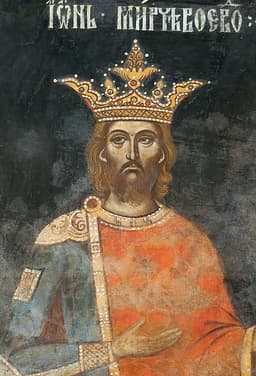
Mircea the Elder
Emperor · Medieval
62.3Total
Basic Information
Born
867
1355
Died
936
1418
Era
Medieval
Medieval
Nationality
Korea
Wallachia
Occupation
Emperor
Emperor
Civilization
Eastern
Western
Score Comparison
Military (10%)
72.5
70.0
Political (20%)
39.4
72.0
Influence (20%)
53.3
55.0
Legacy (20%)
45.0
58.0
Leadership (15%)
65.7
72.0
Strategy (15%)
57.5
55.0
TOTAL
53.3
62.3
Gyeon Hwon — Complete Timeline
892 AD
Foundation of Later BaekjePolitical Action
Gyeon Hwon, a former Silla general, led a rebellion and established the kingdom of Later Baekje in southwestern Korea. He declared himself king, reviving the name of the ancient Baekje kingdom and initiating the Later Three Kingdoms period.
FoundationLater Three KingdomsRebellion
Impact: regional
930 AD
Battle of GochangWar◆ Major
Gyeon Hwon's forces were defeated by the Goryeo army under King Taejo at Gochang. This battle marked a turning point in the Later Three Kingdoms period, weakening Later Baekje and strengthening Goryeo's position.
BattleGoryeo WarTurning Point
Impact: regional
935 AD
Deposition by His SonPolitical Action◆ Major
Gyeon Hwon was deposed by his son, Gyeon Singeom, who seized the throne in a coup. The rebellion was fueled by Gyeon Hwon's favoritism toward his youngest son, leading to internal strife within Later Baekje.
CoupSuccession CrisisFamily Conflict
Impact: nationaldestructive
Defection to GoryeoPolitical Action◆ Major
After being deposed, Gyeon Hwon defected to Goryeo and was welcomed by King Taejo. He provided military intelligence and assistance to Goryeo, contributing to the eventual conquest of Later Baekje in 936.
DefectionGoryeo AllianceBetrayal
Impact: regional
936 AD
Death in GoryeoOther
Gyeon Hwon died in Goryeo shortly after the fall of Later Baekje. His death marked the end of the Later Three Kingdoms period and the unification of Korea under Goryeo.
DeathUnificationEnd of Era
Impact: regional
Mircea the Elder — Complete Timeline
1395 AD
Battle of RovineWar◆ Major
Mircea the Elder led Wallachian forces to victory against the Ottoman army of Bayezid I at Rovine. The battle halted Ottoman expansion into Wallachia for a period and secured Mircea's rule.
Ottoman-Wallachian WarsDefenseVictory
Impact: regional
Treaty with Poland and HungaryPolitical Action◆ Major
Mircea signed an alliance with King Sigismund of Hungary and W
AllianceAnti-Ottoman Coalition
Impact: regionalconstructive
1396 AD
Battle of NicopolisWar◆ Major
Mircea contributed Wallachian troops to the Crusader army that was decisively defeated by the Ottomans at Nicopolis. The defeat weakened the anti-Ottoman coalition and left Wallachia vulnerable.
CrusadeDefeatOttoman Victory
Impact: regionaltragic
1417 AD
Ottoman Invasion of WallachiaWar◆ Major
Ottoman forces under Mehmed I invaded Wallachia, forcing Mircea to accept vassalage and pay tribute. This event marked the beginning of Wallachia's subordination to the Ottoman Empire.
Ottoman ExpansionVassalageDefeat
Impact: regionaltragic
This comparison has not been analyzed yet.
One-time AI generation (~1 minute). Scores and timeline are already available below.
Rankings
🥇
Mircea the ElderLeader
Mil: 70.0Pol: 72.0Inf: 55.0
62.3
🥈
Gyeon Hwon
Mil: 72.5Pol: 39.4Inf: 53.3
53.3
+9.0 behind
How This Comparison Works
Algorithm
Each figure is scored on 6 dimensions (0—100 scale) based on structured historical data: Military (10%), Political (20%), Influence (20%), Legacy (20%), Leadership (15%), Strategy (15%). The weighted total produces the final ranking.
Data Sources
Scores are computed from structured sub-indicators in the database. Scale factors adjust for era (Ancient ×0.85, Modern ×1.0) and civilization size (Eastern ×1.05, Other ×0.80) to account for differences in population and military scale.
Maximum 3 Figures
Comparisons are limited to 2—3 figures to ensure readability and statistical meaningfulness.
Error Margins
±5 points per dimension — Sub-scores are derived from historical records with inherent uncertainty. Two figures within 5 points on a dimension should be considered roughly equivalent in that area.
Total Score Accuracy
±3 points overall — The weighted combination of 6 dimensions produces a total score with approximately ±3 points of uncertainty. Differences of less than 3 points are not statistically significant— the figures are effectively tied.
Known Limitations
- Historical records are incomplete and uneven across civilizations
- Figures from oral-tradition societies may be underrepresented
- Occupation labels can misclassify multi-role figures
- Scores measure capability and impact, not moral character
- Quantitative scoring is a comparison tool, not absolute truth
Capability Radar
Military (10%) — Battles & Warfare
Battles
65
65
Win Rate
60
60
Expansion
55
60
Political (20%) — Governance & Reform
Reform
30
60
Diplomacy
40
75
Economy
35
65
Influence (20%) — Cultural & Global Reach
Cultural
30
55
Global
20
50
Legacy (20%) — Historical Impact
Historical
40
65
Longevity
30
60
Leadership (15%) — Power & Stability
Tenure
50
70
Stability
35
60
Strategy (15%) — Tactics & Innovation
Strategy
60
75
Tactics
55
70
Reform
30
55
Similar Comparisons
Comments & Discussion
No comments yet. Be the first to share your thoughts!