Loading...
Mircea the Elder vs Napoleon Bonaparte
Napoleon Bonaparte leads by 8.6 pts · 2 figures compared
…
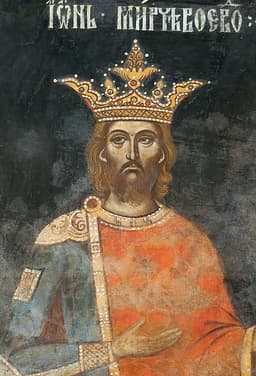
Mircea the Elder
Emperor · Medieval
62.3Total

Napoleon Bonaparte
General · Modern
70.9Total
Basic Information
Born
1355
1769
Died
1418
1821
Era
Medieval
Modern
Nationality
Wallachia
France
Occupation
Emperor
General
Civilization
Western
Western
Score Comparison
Military (10%)
70.0
94.0
Political (20%)
72.0
72.0
Influence (20%)
55.0
40.0
Legacy (20%)
58.0
80.0
Leadership (15%)
72.0
78.0
Strategy (15%)
55.0
90.0
TOTAL
62.3
70.9
Mircea the Elder — Complete Timeline
1395 AD
Battle of RovineWar◆ Major
Mircea the Elder led Wallachian forces to victory against the Ottoman army of Bayezid I at Rovine. The battle halted Ottoman expansion into Wallachia for a period and secured Mircea's rule.
Ottoman-Wallachian WarsDefenseVictory
Impact: regional
Treaty with Poland and HungaryPolitical Action◆ Major
Mircea signed an alliance with King Sigismund of Hungary and W
AllianceAnti-Ottoman Coalition
Impact: regionalconstructive
1396 AD
Battle of NicopolisWar◆ Major
Mircea contributed Wallachian troops to the Crusader army that was decisively defeated by the Ottomans at Nicopolis. The defeat weakened the anti-Ottoman coalition and left Wallachia vulnerable.
CrusadeDefeatOttoman Victory
Impact: regionaltragic
1417 AD
Ottoman Invasion of WallachiaWar◆ Major
Ottoman forces under Mehmed I invaded Wallachia, forcing Mircea to accept vassalage and pay tribute. This event marked the beginning of Wallachia's subordination to the Ottoman Empire.
Ottoman ExpansionVassalageDefeat
Impact: regionaltragic
Napoleon Bonaparte — Complete Timeline
1799 AD
Coup of 18 BrumaireOther◆ Major
Napoleon Bonaparte, with support from his brother Lucien and key political figures, overthrew the Directory in a bloodless coup. He established the Consulate with himself as First Consul, effectively becoming the ruler of France. This event ended the French Revolution's most unstable period.
French RevolutionCoupRise to Power
Impact: regional
1804 AD
Promulgation of the Napoleonic CodeOther◆ Major
Napoleon enacted the Civil Code of the French, known as the Napoleonic Code, a comprehensive set of laws that replaced the fragmented feudal legal systems. The code established legal equality, protected property rights, and secularized law. It became the basis for legal systems in many European and world countries.
Legal ReformNapoleonic CodeCivil Law
Impact: globalconstructive
1805 AD
Battle of AusterlitzWar◆ Major
Napoleon's Grande Arm
Napoleonic WarsBattleDecisive Victory
Impact: global
1812 AD
Invasion of RussiaWar◆ Major
Napoleon led the Grande Arm
Napoleonic WarsInvasionDisaster
Impact: globaldestructive
1815 AD
Battle of WaterlooWar◆ Major
Napoleon's French army was defeated by the combined forces of the Duke of Wellington's Anglo-Allied army and Gebhard Leberecht von Bl
Napoleonic WarsBattleFinal Defeat
Impact: globaldestructive
Expert Analysis
mircea-the-elder-vs-napoleon-bonaparte
# The Emperor and the Voivode: Two Faces of Power at Europe's Crossroads
On a misty October morning in 1395, a Wallachian prince named Mircea stood on a muddy battlefield near Rovine, watching the Ottoman army of Sultan Bayezid I retreat into the forests. He had done what few Christian rulers could manage in that dark century: he had defeated the Turks in open combat. Four hundred years later, on a June evening in 1815, another man—short, intense, and dressed in his trademark gray coat—watched his Imperial Guard crumble near a Belgian village called Waterloo. Napoleon Bonaparte, master of Europe, was about to board a ship for his final exile. Between these two moments lies a gulf not merely of centuries, but of ambition, scale, and historical destiny.
Origins
Mircea the Elder was born in 1355 into a world of feudal fragmentation. Wallachia, a principality straddling the Carpathian Mountains and the Danube River, was a buffer zone between Latin Christendom and the rising Ottoman Empire. His father was a voivode, but the boy grew up surrounded by boyars—nobles who saw their ruler as first among equals, not an absolute sovereign. Mircea learned statecraft in a world where alliances shifted like river currents, and survival meant knowing when to fight and when to negotiate.
Napoleon Bonaparte, born in 1769 on the Mediterranean island of Corsica, entered a different universe. His family were minor Italian nobility in a French possession, and young Napoleon grew up feeling like an outsider among the French elite. The French Revolution had not yet erupted, but its seeds were planted. Where Mircea inherited a tradition of cautious resistance, Napoleon inherited a world in upheaval—a world where a brilliant artillery officer could rise from obscurity to crown himself emperor.
Rise to Power
Mircea’s path to power was traditional: he became voivode of Wallachia in 1386, inheriting a realm squeezed between Hungary and the Ottoman Empire. His rise was not dramatic; it was the slow accumulation of authority through marriage alliances, military campaigns, and careful diplomacy. The key turning point came in 1395, when he signed a treaty with King Sigismund of Hungary and Władysław II of Poland, forming a Christian alliance against the Ottomans. This was not the act of a conqueror, but of a survivor building a coalition.
Napoleon’s ascent was explosive. A captain during the Revolution, he became a general at twenty-four after his artillery shattered the British siege of Toulon in 1793. By 1796, he commanded the Army of Italy, crossing the Alps and defeating Austrian armies in lightning campaigns. Each victory fed his ambition; each defeat—rare as they were—taught him to adapt. By 1799, he was First Consul of France. By 1804, he was Emperor. Where Mircea climbed a ladder of inherited obligation, Napoleon built his own ladder from cannon fire and political cunning.
Leadership & Governance
Mircea ruled as a medieval prince, his authority limited by the boyars and the Orthodox Church. His military genius was defensive: at Rovine in 1395, he used the swampy terrain to neutralize the Ottoman cavalry, a tactical masterpiece that preserved Wallachian independence for another generation. But he was also a realist. After the catastrophic Crusader defeat at Nicopolis in 1396—where he contributed troops to a doomed coalition—Mircea understood that open war against the Ottomans was unsustainable. In 1417, when Mehmed I invaded, Mircea accepted vassalage and paid tribute. It was not surrender; it was survival.
Napoleon governed on a continental scale. His Napoleonic Code reformed French law, establishing principles of equality before the law and secular administration that influenced Europe for centuries. His military strategy was revolutionary: he divided his armies into corps that could march separately and concentrate rapidly, overwhelming opponents with speed and mass. From Austerlitz in 1805 to Jena in 1806, he seemed invincible. But his governance was also imperial—he placed his brothers on thrones, suppressed dissent, and treated conquered nations as tributaries. Where Mircea ruled through negotiation, Napoleon ruled through domination.
Triumph & Tragedy
Mircea’s greatest moment was Rovine, a victory that echoed through the Balkans and proved that Ottoman power could be checked. His tragedy was Nicopolis: he watched a Christian army of 60,000 men be slaughtered because its leaders—Hungarian knights, French crusaders—refused to coordinate with their Wallachian allies. The lesson was bitter: in a fractured Christendom, no single prince could stand alone.
Napoleon’s triumph was Austerlitz, where he destroyed a combined Russian-Austrian army and dissolved the Holy Roman Empire. His tragedy was the invasion of Russia in 1812: 600,000 men marched east; fewer than 100,000 returned. The disaster shattered his aura of invincibility. Waterloo was merely the final punctuation—a defeat born of overreach and the inability to stop fighting even when peace was possible.
Character & Destiny
Mircea was cautious, pragmatic, and patient. He understood that history moves in cycles, that empires rise and fall, and that a small principality could survive by bending without breaking. His personality was shaped by the limitations of his world: he could not conquer Constantinople, so he protected his own borders.
Napoleon was restless, brilliant, and insatiable. He once said, “Power is my mistress”—and he meant it. His personality drove him to conquer, reform, and then conquer again. He could not stop, because stopping meant admitting that his empire, like all empires, had limits. His destiny was to push those limits until they pushed back.
Legacy
Mircea is remembered in Romania as a national hero, the prince who kept Wallachia alive during the Ottoman onslaught. His name appears on coins, streets, and stamps. But outside the Balkans, he is obscure—a footnote in the history of a region that remained under Ottoman rule for centuries after his death.
Napoleon is remembered everywhere. His legal code, his military tactics, his very silhouette have become symbols of ambition and genius. He reshaped Europe’s borders, inspired nationalism, and left a legacy that oscillates between admiration and condemnation. His scores—Military 94, Political 75, Influence 82—reflect a man who changed the world even as he destroyed it.
Conclusion
Mircea and Napoleon faced the same fundamental question: how does a leader preserve his people in a hostile world? Mircea answered by adapting, compromising, and surviving. Napoleon answered by conquering, reforming, and burning. One fought to keep his principality free; the other fought to make himself master of Europe. Both failed in the end—Wallachia fell to the Ottomans, and Napoleon fell to the British—but their failures illuminate different truths. Mircea’s story teaches us about endurance in the face of overwhelming force; Napoleon’s teaches us about the seduction of absolute power. In the end, the voivode and the emperor remind us that history judges not by scale, but by meaning.
Rankings
🥇
Napoleon BonaparteLeader
Mil: 94.0Pol: 72.0Inf: 40.0
70.9
🥈
Mircea the Elder
Mil: 70.0Pol: 72.0Inf: 55.0
62.3
+8.6 behind
How This Comparison Works
Algorithm
Each figure is scored on 6 dimensions (0—100 scale) based on structured historical data: Military (10%), Political (20%), Influence (20%), Legacy (20%), Leadership (15%), Strategy (15%). The weighted total produces the final ranking.
Data Sources
Scores are computed from structured sub-indicators in the database. Scale factors adjust for era (Ancient ×0.85, Modern ×1.0) and civilization size (Eastern ×1.05, Other ×0.80) to account for differences in population and military scale.
Maximum 3 Figures
Comparisons are limited to 2—3 figures to ensure readability and statistical meaningfulness.
Error Margins
±5 points per dimension — Sub-scores are derived from historical records with inherent uncertainty. Two figures within 5 points on a dimension should be considered roughly equivalent in that area.
Total Score Accuracy
±3 points overall — The weighted combination of 6 dimensions produces a total score with approximately ±3 points of uncertainty. Differences of less than 3 points are not statistically significant— the figures are effectively tied.
Known Limitations
- Historical records are incomplete and uneven across civilizations
- Figures from oral-tradition societies may be underrepresented
- Occupation labels can misclassify multi-role figures
- Scores measure capability and impact, not moral character
- Quantitative scoring is a comparison tool, not absolute truth
Capability Radar
Military (10%) — Battles & Warfare
Battles
65
95
Win Rate
60
90
Expansion
60
95
Political (20%) — Governance & Reform
Reform
60
95
Diplomacy
75
80
Economy
65
85
Influence (20%) — Cultural & Global Reach
Cultural
55
85
Global
50
90
Legacy (20%) — Historical Impact
Historical
65
95
Longevity
60
90
Leadership (15%) — Power & Stability
Tenure
70
85
Stability
60
70
Strategy (15%) — Tactics & Innovation
Strategy
75
95
Tactics
70
98
Reform
55
92
Similar Comparisons
Comments & Discussion
No comments yet. Be the first to share your thoughts!