Loading...
Habib Bourguiba vs Venustiano Carranza
Habib Bourguiba leads by 10.9 pts · 2 figures compared
…
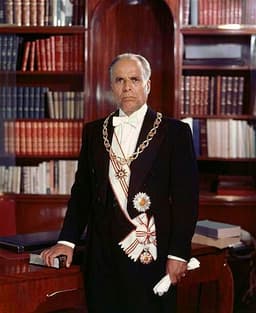
Habib Bourguiba
Politician · Modern
64.4Total

Venustiano Carranza
Politician · Modern
53.5Total
Basic Information
Born
1903
1859
Died
2000
1920
Era
Modern
Modern
Nationality
Tunisia
Mexico
Occupation
Politician
Politician
Civilization
Middle Eastern
Western
Score Comparison
Military (10%)
39.9
20.0
Political (20%)
82.0
45.0
Influence (20%)
68.0
62.0
Legacy (20%)
55.0
52.0
Leadership (15%)
80.0
68.0
Strategy (15%)
53.8
60.0
TOTAL
64.4
53.5
Habib Bourguiba — Complete Timeline
1956 AD
Code of Personal StatusReform◆ Major
Bourguiba enacted the Code of Personal Status, a progressive family law that abolished polygamy, established legal minimum age for marriage, and granted women rights to divorce and custody. This reform was unprecedented in the Arab world and modernized Tunisian society.
Women's RightsLegal ReformSocial Change
Impact: nationalprogressive
Tunisian IndependencePolitical Action
Habib Bourguiba led Tunisia to independence from France through a combination of political negotiation and nationalist pressure. He became the first Prime Minister of independent Tunisia, ending 75 years of French protectorate rule.
IndependenceDecolonizationNationalism
Impact: nationalconstructive
1957 AD
Proclamation of the RepublicPolitical Action◆ Major
Bourguiba abolished the Tunisian monarchy and proclaimed the Republic of Tunisia, with himself as President. This move consolidated his power and established a presidential system that would dominate Tunisian politics for decades.
RepublicConstitutional ChangePresidency
Impact: national
1961 AD
Bizerte CrisisWar◆ Major
Bourguiba demanded the evacuation of the French naval base at Bizerte. When negotiations failed, Tunisian forces blockaded the base, leading to a violent confrontation with French troops. The crisis resulted in hundreds of Tunisian casualties and strained Franco-Tunisian relations.
ConflictDecolonizationBizerte
Impact: regionaltragic
1987 AD
Removal from PowerPolitical Action◆ Major
Prime Minister Zine El Abidine Ben Ali removed Bourguiba from office in a bloodless coup, citing his failing health and inability to govern. Bourguiba was placed under house arrest, ending his 30-year presidency and his role as Tunisia's founding father.
CoupSuccessionBen Ali
Impact: nationaltragic
Venustiano Carranza — Complete Timeline
1911 AD
Governorship of CoahuilaPolitical Action
Carranza was elected Governor of Coahuila in 1911 under President Francisco I. Madero. He used this position to build a political base and later opposed the Huerta coup, becoming a key leader in the Mexican Revolution.
GovernorshipCoahuilaMexican Revolution
Impact: regional
1913 AD
Leadership of the Constitutionalist ArmyWar◆ Major
Carranza led the Constitutionalist Army as First Chief, coordinating military campaigns against Huerta's federal forces. His leadership, along with generals like
Military LeadershipMexican RevolutionConstitutionalist Army
Impact: national
Plan of GuadalupePolitical Action
Carranza issued the Plan of Guadalupe on March 26, 1913, rejecting the Huerta regime and calling for the restoration of constitutional order. This document became the rallying point for the Constitutionalist Army, uniting various revolutionary factions against Huerta.
PlanMexican RevolutionConstitutionalism
Impact: national
1915 AD
Presidency of MexicoPolitical Action◆ Major
Carranza became President of Mexico in 1915, serving until 1920. His administration focused on consolidating the revolution, drafting the Constitution of 1917, and implementing reforms, but faced ongoing conflicts with rival revolutionary factions.
PresidencyMexican RevolutionConsolidation
Impact: nationalconstructive
1917 AD
Constitution of 1917Reform
Carranza oversaw the drafting and promulgation of the Mexican Constitution of 1917, which included progressive articles on land reform, labor rights, and national sovereignty. This constitution remains the foundation of modern Mexican law and politics.
ConstitutionReformMexican Revolution
Impact: nationalprogressive
1920 AD
Assassination of Venustiano CarranzaPolitical Action
Carranza was assassinated on May 21, 1920, while fleeing from a rebellion led by
AssassinationMexican RevolutionEnd of Era
Impact: nationaltragic
Expert Analysis
Origins
Habib Bourguiba was born on August 3, 1903, in Monastir, Tunisia, then a French protectorate. His father, Ali Bourguiba, was a former army officer, and his mother, Fatima Khefacha, was a homemaker. Bourguiba studied at the Sadiki College in Tunis and later at the University of Paris, where he earned a law degree. His exposure to French republican ideals shaped his nationalist views.
Venustiano Carranza was born on December 29, 1859, in Cuatro Ciénegas, Coahuila, Mexico, into a wealthy landowning family. His father, Jesús Carranza, was a rancher and politician. Carranza studied at the Ateneo Fuente in Saltillo and later at the National Preparatory School in Mexico City, but he did not complete a degree. He entered politics early, serving as a municipal president and later as a federal deputy.
Rise to Power
Bourguiba rose to prominence as a leader of the Tunisian nationalist movement. In 1934, he founded the Neo Destour party, which became the vehicle for independence. He was arrested multiple times by French authorities, including a period of exile from 1952 to 1954. His political acumen scored 82.0, reflecting his strategic use of negotiation and mass mobilization. The turning point came with the Tunisian Independence agreement on March 20, 1956, after which Bourguiba became prime minister and later president.
Carranza emerged as a key figure in the Mexican Revolution. In 1910, he initially supported Francisco I. Madero against Porfirio Díaz. After Madero's assassination in 1913, Carranza issued the Plan of Guadalupe on March 26, 1913, rejecting the Huerta regime and calling for constitutional restoration. He became the First Chief of the Constitutionalist Army, a coalition that included generals like Álvaro Obregón and Pancho Villa. By 1915, Carranza's forces had defeated Huerta and Villa, allowing him to assume the presidency. His political score of 45.0 indicates a more pragmatic and less charismatic leadership.
Leadership & Governance
Bourguiba's leadership style was authoritarian but reformist. He centralized power, abolished the monarchy in 1957, and declared himself president for life in 1975. His most significant governance achievement was the Code of Personal Status (1956), which banned polygamy, set a minimum marriage age, and granted women legal rights. This progressive law was unprecedented in the Arab world. Bourguiba also promoted secular education, state-controlled religion, and economic modernization. However, his regime suppressed political dissent and jailed opponents.
Carranza governed Mexico from 1915 to 1920, focusing on consolidating the revolution. He oversaw the drafting of the Constitution of 1917, which included progressive articles on land reform (Article 27), labor rights (Article 123), and education. However, Carranza was conservative in implementation, often resisting radical reforms. He faced opposition from revolutionary generals like Obregón and Villa, leading to constant instability. His leadership score of 68.0 reflects his ability to maintain power but not to unite the country.
Triumph & Tragedy
Bourguiba's greatest triumph was securing Tunisian independence without prolonged war. He also implemented the Code of Personal Status, which transformed women's rights. His tragedy was the Bizerte Crisis in 1961, when a confrontation with France over the naval base led to 630 Tunisian deaths and international humiliation. Later, his authoritarian rule and economic mismanagement led to his ousting in a bloodless coup on November 7, 1987.
Carranza's triumph was the Constitution of 1917, which laid the foundation for modern Mexico. He also defeated the Huerta regime and restored constitutional order. His tragedy was his inability to control the revolution's radical factions. He was assassinated on May 21, 1920, while fleeing a rebellion led by Obregón. His death marked the end of the first revolutionary phase, but his vision of a constitutional republic endured.
Character & Destiny
Bourguiba was pragmatic, ambitious, and stubborn. He believed in gradual reform and often clashed with more radical nationalists. His character shaped Tunisia's path toward secularism and women's rights, but also his eventual downfall due to his refusal to step down. Historians note his strategic brilliance but also his isolation in later years.
Carranza was reserved, legalistic, and authoritarian. He insisted on constitutional order, which alienated many revolutionary allies. His cautious approach to reform limited his popularity. His destiny was shaped by his inability to compromise, leading to betrayal and assassination.
Legacy
Bourguiba's legacy is mixed. He is revered as the founder of modern Tunisia and a pioneer of women's rights. The Code of Personal Status remains in force, influencing other Arab countries. However, his authoritarian model and the cult of personality he built were rejected after his ousting. His total score of 64.4 reflects his high political and leadership scores but moderate legacy.
Carranza's legacy is tied to the Constitution of 1917, which remains the basis of Mexican law. He is considered a key revolutionary leader, but his reputation is overshadowed by more radical figures like Emiliano Zapata and Pancho Villa. His political score of 45.0 and legacy score of 52.0 reflect his institutional contributions but limited personal impact.
Conclusion
Habib Bourguiba had a greater impact on his nation than Venustiano Carranza. With a total score of 64.4 against Carranza's 53.5, Bourguiba's political reforms were more transformative and lasting. While Carranza's constitution was foundational, Bourguiba's Code of Personal Status directly changed the lives of Tunisian women and set a precedent in the Arab world. Bourguiba's leadership score of 80.0 versus Carranza's 68.0 further underscores his effectiveness. Despite his authoritarian excesses, Bourguiba's legacy of secularism and women's rights endures, whereas Carranza's revolution was subsumed by later events. Thus, Bourguiba stands as the more consequential figure.
Rankings
🥇
Habib BourguibaLeader
Mil: 39.9Pol: 82.0Inf: 68.0
64.4
🥈
Venustiano Carranza
Mil: 20.0Pol: 45.0Inf: 62.0
53.5
+10.9 behind
How This Comparison Works
Algorithm
Each figure is scored on 6 dimensions (0—100 scale) based on structured historical data: Military (10%), Political (20%), Influence (20%), Legacy (20%), Leadership (15%), Strategy (15%). The weighted total produces the final ranking.
Data Sources
Scores are computed from structured sub-indicators in the database. Scale factors adjust for era (Ancient ×0.85, Modern ×1.0) and civilization size (Eastern ×1.05, Other ×0.80) to account for differences in population and military scale.
Maximum 3 Figures
Comparisons are limited to 2—3 figures to ensure readability and statistical meaningfulness.
Error Margins
±5 points per dimension — Sub-scores are derived from historical records with inherent uncertainty. Two figures within 5 points on a dimension should be considered roughly equivalent in that area.
Total Score Accuracy
±3 points overall — The weighted combination of 6 dimensions produces a total score with approximately ±3 points of uncertainty. Differences of less than 3 points are not statistically significant— the figures are effectively tied.
Known Limitations
- Historical records are incomplete and uneven across civilizations
- Figures from oral-tradition societies may be underrepresented
- Occupation labels can misclassify multi-role figures
- Scores measure capability and impact, not moral character
- Quantitative scoring is a comparison tool, not absolute truth
Capability Radar
Military (10%) — Battles & Warfare
Battles
5
55
Win Rate
5
60
Expansion
5
40
Political (20%) — Governance & Reform
Reform
90
75
Diplomacy
85
55
Economy
75
50
Influence (20%) — Cultural & Global Reach
Cultural
70
50
Global
65
50
Legacy (20%) — Historical Impact
Historical
75
65
Longevity
65
55
Leadership (15%) — Power & Stability
Tenure
85
60
Stability
70
45
Strategy (15%) — Tactics & Innovation
Strategy
5
65
Tactics
5
50
Reform
10
70
Similar Comparisons
Comments & Discussion
No comments yet. Be the first to share your thoughts!