Loading...
Harold Godwinson vs John Balliol
Harold Godwinson leads by 0.9 pts · 2 figures compared
…
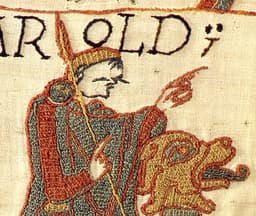
Harold Godwinson
Emperor · Medieval
45.8Total

John Balliol
Emperor · Medieval
44.9Total
Basic Information
Born
1022
1249
Died
1066
1314
Era
Medieval
Medieval
Nationality
England
Scotland
Occupation
Emperor
Emperor
Civilization
Western
Western
Score Comparison
Military (10%)
47.5
55.0
Political (20%)
35.1
39.4
Influence (20%)
54.1
47.1
Legacy (20%)
49.2
35.8
Leadership (15%)
31.2
48.4
Strategy (15%)
52.5
55.0
TOTAL
45.8
44.9
Harold Godwinson — Complete Timeline
1066 AD
Battle of Stamford BridgeWar◆ Major
Harold defeated an invading Norwegian army under King Harald Hardrada at Stamford Bridge in Yorkshire. The victory was decisive, but Harold's army was weakened and exhausted.
BattleVictoryViking Invasion
Impact: national
Battle of HastingsWar
Harold's army was defeated by William of Normandy at Hastings on October 14. Harold was killed in the battle, traditionally by an arrow in the eye, ending Anglo-Saxon rule in England.
BattleDefeatNorman Conquest
Impact: globaltragic
Coronation of Harold GodwinsonPolitical Action◆ Major
Harold was crowned king of England on January 6, 1066, the day after Edward the Confessor's death. His claim was contested by William of Normandy and Harald Hardrada of Norway.
CoronationSuccessionContested Claim
Impact: national
John Balliol — Complete Timeline
1290 AD
Signing of the Treaty of BirghamPolitical Action
John Balliol, as a claimant, was party to the Treaty of Birgham which arranged the marriage of Margaret, Maid of Norway to Edward II. The treaty promised Scottish independence, but it was never fully implemented after Margaret's death.
TreatyMarriageIndependence
Impact: national
1292 AD
Installation as King by Edward IPolitical Action
John Balliol was selected as King of Scots by Edward I of England after the Great Cause arbitration. Edward I oversaw the selection process and Balliol swore fealty to him, effectively making Scotland a vassal state.
CoronationVassalageGreat Cause
Impact: nationaldestructive
1296 AD
Battle of DunbarWar◆ Major
John Balliol's Scottish army was decisively defeated by English forces under John de Warenne at Dunbar. The defeat led to Balliol's abdication and Edward I's conquest of Scotland, with the Stone of Destiny taken to Westminster.
BattleDefeatEnglish Conquest
Impact: nationaldestructive
Abdication and ImprisonmentPolitical Action◆ Major
John Balliol abdicated the Scottish throne after his defeat at Dunbar. He was stripped of his royal regalia and imprisoned in the Tower of London, later being exiled to France. His reign ended with Scotland under English occupation.
AbdicationImprisonmentExile
Impact: nationaltragic
Expert Analysis
Origins
Harold Godwinson was born around 1022 into the most powerful noble family in England. His father, Godwin, Earl of Wessex, was a key advisor to King Edward the Confessor. Harold inherited the earldom of Wessex in 1053 and became the dominant figure in English politics. He had no royal blood but was chosen as king by the Witenagemot after Edward's death.
John Balliol was born around 1249 into a prominent Anglo-Norman family with claims to the Scottish throne. His father, John de Balliol, founded Balliol College, Oxford. John Balliol's claim came through his mother, Devorguilla, who was the daughter of Alan, Lord of Galloway. He was educated in England and France, and his selection as king in 1292 was heavily influenced by Edward I of England.
Rise to Power
Harold's rise was rooted in his military and political acumen. In 1063, he led a successful campaign against the Welsh king Gruffydd ap Llywelyn, expanding his influence. When Edward the Confessor died childless on January 5, 1066, Harold claimed the throne, citing Edward's alleged deathbed promise. He was crowned the next day, but faced immediate challenges from William of Normandy and Harald Hardrada of Norway.
John Balliol's rise was engineered by Edward I. After the death of Alexander III of Scotland in 1286 and his granddaughter Margaret in 1290, the Scottish throne had multiple claimants. Edward I was asked to arbitrate in the Great Cause (1291-1292). He chose Balliol, who swore fealty to Edward, effectively making Scotland a vassal state. Balliol was crowned on November 30, 1292.
Leadership & Governance
Harold's leadership was tested immediately. He organized a defense against two invasions. In September 1066, he marched north and defeated Harald Hardrada at Stamford Bridge (September 25). His army, however, was exhausted and undermanned when he learned of William's landing in the south. Harold's governance lasted only nine months, but he maintained the Anglo-Saxon system of local administration and attempted to secure his rule through key appointments.
John Balliol's leadership was constrained by Edward I. He was expected to follow English policies, but Scottish nobles pressured him to resist. In 1295, Balliol signed a treaty with France (the Auld Alliance) against England, provoking Edward's wrath. Balliol's governance score of 48.4 is higher than Harold's 31.2, but reflects a king who was a puppet rather than an independent ruler.
Triumph & Tragedy
Harold's greatest triumph was the victory at Stamford Bridge, where he defeated a formidable Norwegian army. His tragedy was the defeat at Hastings on October 14, 1066, where he was killed. Harold's military score of 47.5 and strategy of 52.5 reflect his tactical skill at Stamford Bridge but also his decision to fight at Hastings immediately after a long march.
John Balliol's triumph was his selection as king, but his tragedy was his abdication in 1296 after the Battle of Dunbar. He was imprisoned and later released, dying in obscurity in 1314. His legacy score of 35.8 is the lowest among his metrics, reflecting his failure to secure Scottish independence.
Character & Destiny
Harold was decisive and courageous, but his rushed campaign against William proved fatal. He chose to engage at Hastings without waiting for reinforcements, a decision that cost him his kingdom and his life. His total score of 45.8 indicates a capable leader undone by circumstance.
John Balliol was weak and indecisive, unable to resist Edward I's demands. His character of compliance led to his downfall. He scored 55.0 in military and strategy, but his political score of 39.4 shows his inability to navigate the complex feudal relationships.
Legacy
Harold's legacy is as the last Anglo-Saxon king, symbolizing the end of an era. His defeat at Hastings led to Norman rule, which transformed English language, culture, and governance. He is remembered in the Bayeux Tapestry and as a tragic hero. His influence score of 54.1 reflects the enduring impact of his brief reign.
John Balliol's legacy is largely negative. He is seen as a puppet king who weakened Scotland. His reign sparked the Wars of Scottish Independence, with figures like William Wallace and Robert the Bruce emerging. His influence score of 47.1 is lower, as his impact is overshadowed by subsequent events.
Conclusion
Harold Godwinson had a greater impact on history than John Balliol. Despite his short reign, Harold's defeat at Hastings was a pivotal moment, leading to the Norman Conquest that reshaped England. John Balliol's rule was a failure that catalyzed Scottish resistance, but he himself was a passive figure. Harold's total score of 45.8 edges out Balliol's 44.9, but the qualitative difference is larger: Harold's actions had direct and lasting consequences, while Balliol was largely a pawn. Therefore, Harold Godwinson is the more significant historical figure.
Rankings
🥇
Harold GodwinsonLeader
Mil: 47.5Pol: 35.1Inf: 54.1
45.8
🥈
John Balliol
Mil: 55.0Pol: 39.4Inf: 47.1
44.9
+0.9 behind
How This Comparison Works
Algorithm
Each figure is scored on 6 dimensions (0—100 scale) based on structured historical data: Military (10%), Political (20%), Influence (20%), Legacy (20%), Leadership (15%), Strategy (15%). The weighted total produces the final ranking.
Data Sources
Scores are computed from structured sub-indicators in the database. Scale factors adjust for era (Ancient ×0.85, Modern ×1.0) and civilization size (Eastern ×1.05, Other ×0.80) to account for differences in population and military scale.
Maximum 3 Figures
Comparisons are limited to 2—3 figures to ensure readability and statistical meaningfulness.
Error Margins
±5 points per dimension — Sub-scores are derived from historical records with inherent uncertainty. Two figures within 5 points on a dimension should be considered roughly equivalent in that area.
Total Score Accuracy
±3 points overall — The weighted combination of 6 dimensions produces a total score with approximately ±3 points of uncertainty. Differences of less than 3 points are not statistically significant— the figures are effectively tied.
Known Limitations
- Historical records are incomplete and uneven across civilizations
- Figures from oral-tradition societies may be underrepresented
- Occupation labels can misclassify multi-role figures
- Scores measure capability and impact, not moral character
- Quantitative scoring is a comparison tool, not absolute truth
Capability Radar
Military (10%) — Battles & Warfare
Battles
60
5
Win Rate
55
0
Expansion
40
0
Political (20%) — Governance & Reform
Reform
20
0
Diplomacy
40
5
Economy
30
0
Influence (20%) — Cultural & Global Reach
Cultural
35
5
Global
30
5
Legacy (20%) — Historical Impact
Historical
55
10
Longevity
40
5
Leadership (15%) — Power & Stability
Tenure
15
10
Stability
20
0
Strategy (15%) — Tactics & Innovation
Strategy
60
0
Tactics
65
0
Reform
30
0
Similar Comparisons
Comments & Discussion
No comments yet. Be the first to share your thoughts!