Loading...
Harold Godwinson vs Napoleon Bonaparte
Napoleon Bonaparte leads by 25.1 pts · 2 figures compared
…
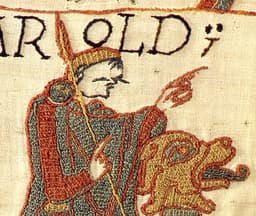
Harold Godwinson
Emperor · Medieval
45.8Total

Napoleon Bonaparte
General · Modern
70.9Total
Basic Information
Born
1022
1769
Died
1066
1821
Era
Medieval
Modern
Nationality
England
France
Occupation
Emperor
General
Civilization
Western
Western
Score Comparison
Military (10%)
47.5
94.0
Political (20%)
35.1
72.0
Influence (20%)
54.1
40.0
Legacy (20%)
49.2
80.0
Leadership (15%)
31.2
78.0
Strategy (15%)
52.5
90.0
TOTAL
45.8
70.9
Harold Godwinson — Complete Timeline
1066 AD
Battle of Stamford BridgeWar◆ Major
Harold defeated an invading Norwegian army under King Harald Hardrada at Stamford Bridge in Yorkshire. The victory was decisive, but Harold's army was weakened and exhausted.
BattleVictoryViking Invasion
Impact: national
Battle of HastingsWar
Harold's army was defeated by William of Normandy at Hastings on October 14. Harold was killed in the battle, traditionally by an arrow in the eye, ending Anglo-Saxon rule in England.
BattleDefeatNorman Conquest
Impact: globaltragic
Coronation of Harold GodwinsonPolitical Action◆ Major
Harold was crowned king of England on January 6, 1066, the day after Edward the Confessor's death. His claim was contested by William of Normandy and Harald Hardrada of Norway.
CoronationSuccessionContested Claim
Impact: national
Napoleon Bonaparte — Complete Timeline
1799 AD
Coup of 18 BrumaireOther◆ Major
Napoleon Bonaparte, with support from his brother Lucien and key political figures, overthrew the Directory in a bloodless coup. He established the Consulate with himself as First Consul, effectively becoming the ruler of France. This event ended the French Revolution's most unstable period.
French RevolutionCoupRise to Power
Impact: regional
1804 AD
Promulgation of the Napoleonic CodeOther◆ Major
Napoleon enacted the Civil Code of the French, known as the Napoleonic Code, a comprehensive set of laws that replaced the fragmented feudal legal systems. The code established legal equality, protected property rights, and secularized law. It became the basis for legal systems in many European and world countries.
Legal ReformNapoleonic CodeCivil Law
Impact: globalconstructive
1805 AD
Battle of AusterlitzWar◆ Major
Napoleon's Grande Arm
Napoleonic WarsBattleDecisive Victory
Impact: global
1812 AD
Invasion of RussiaWar◆ Major
Napoleon led the Grande Arm
Napoleonic WarsInvasionDisaster
Impact: globaldestructive
1815 AD
Battle of WaterlooWar◆ Major
Napoleon's French army was defeated by the combined forces of the Duke of Wellington's Anglo-Allied army and Gebhard Leberecht von Bl
Napoleonic WarsBattleFinal Defeat
Impact: globaldestructive
Expert Analysis
harold-godwinson-vs-napoleon-bonaparte
# The Crown and the Eagle
On an autumn morning in 1066, King Harold Godwinson stood on a hill in southern England, his shield wall bristling against the Norman tide. Less than three weeks earlier, he had marched his army 200 miles north to crush a Viking invasion at Stamford Bridge, then turned around and force-marched them south again. Exhausted, outnumbered, he died on that field with an arrow in his eye. Seven centuries later, another man stood on a hill in Belgium, watching Prussian reinforcements arrive to seal his fate. Napoleon Bonaparte had conquered Europe, redrawn borders, and codified laws that would outlive him. At Waterloo, he lost everything. Both men fell in battle. But only one built a world that endured. Why?
Origins
Harold Godwinson was born in 1022 into the treacherous world of Anglo-Saxon politics. His father, Godwin, was the most powerful earl in England, a kingmaker who had risen from obscurity through cunning and force. Harold inherited that world of shifting loyalties, where power was personal, oaths were binding, and a crown could be won by blood and sword. When Edward the Confessor died childless on January 5, 1066, Harold claimed the throne the next day—not because he was the rightful heir by blood, but because he was the strongest man in the room.
Napoleon Bonaparte was born in 1769 on the island of Corsica, a place that had just become French. He came from minor nobility, but his real inheritance was the chaos of revolution. The old order of kings and aristocracies was collapsing across Europe, and in that vacuum, talent could rise faster than birth. A boy with a mathematical mind and a hunger for glory could become an artillery officer at sixteen, a general at twenty-four, and emperor of France at thirty-five. The French Revolution did not just give Napoleon opportunity—it gave him a world to remake.
Rise to Power
Harold’s path to power was a ladder of crises. He spent years consolidating his family’s influence, crushing rivals in Wales, and negotiating with the great lords of England. When Edward the Confessor died, Harold moved with ruthless speed: he secured the support of the Witan, the council of nobles, and had himself crowned at Westminster Abbey on January 6, 1066. But his crown was contested from three sides—by William of Normandy, who claimed Edward had promised him the throne; by Harald Hardrada of Norway, who had a Viking’s claim through blood; and by his own brother Tostig, who had been exiled and wanted revenge.
Napoleon’s rise was a masterpiece of opportunity seized. In 1795, he saved the revolutionary government from a royalist mob with a “whiff of grapeshot”—a brutal artillery barrage that cleared the streets of Paris. At twenty-six, he was given command of the French army in Italy, where he transformed starving, demoralized troops into a conquering force. He won battles not by overwhelming numbers but by speed, deception, and the ability to strike where the enemy least expected. By 1799, he had returned from Egypt, overthrown the corrupt Directory in a coup, and made himself First Consul. Five years later, he crowned himself Emperor.
Leadership & Governance
Harold ruled for only nine months—too short a time to leave any lasting reforms. His governance was reactive: he raised armies, negotiated with earls, and prepared for invasion. His military leadership was impressive in the field: at Stamford Bridge on September 25, 1066, he caught the Norwegian army off guard and destroyed it, killing King Harald Hardrada in a battle that remains one of the great strategic victories of the age. But he made a fatal error: he disbanded his army after the victory, believing William would not invade so late in the year. When William landed in Sussex, Harold had to scrape together a new force.
Napoleon ruled for fifteen years and left a mark that still shapes Europe. His Napoleonic Code standardized French law, abolishing feudal privileges and establishing equality before the law—a revolutionary idea that spread across the continent. He reformed education, created the Bank of France, and built roads and canals that unified his empire. As a military commander, he was a genius of maneuver: at Austerlitz in 1805, he lured the combined Russian and Austrian armies into a trap and destroyed them, a victory so complete that it ended the Third Coalition. But his ambition became his undoing. The invasion of Russia in 1812—a campaign of 600,000 men that ended with fewer than 100,000 returning—was a catastrophe of overreach.
Triumph & Tragedy
Harold’s greatest moment was Stamford Bridge, where he proved he could defeat a formidable enemy through speed and courage. His tragedy was Hastings, where exhaustion, poor timing, and the death of his elite housecarls cost him everything. He died fighting, surrounded by his bodyguard, and with him died Anglo-Saxon England. The Norman Conquest would transform the language, culture, and governance of the island forever.
Napoleon’s greatest moment was Austerlitz, where he destroyed two empires in a single day. His tragedy was Waterloo, where he faced the combined armies of the Duke of Wellington and Gebhard von Blücher. He came close to victory—his Old Guard broke Wellington’s center—but the arrival of Prussian troops turned the tide. He was exiled to Saint Helena, a remote island in the South Atlantic, where he died in 1821 at the age of fifty-one.
Character & Destiny
Harold was a pragmatist, a man who understood that power in medieval England was about personal loyalty and oaths. He made a fatal decision at Hastings: he chose to fight William immediately rather than wait for reinforcements or use scorched-earth tactics. Some historians argue he was too proud, too eager to prove himself. Others say he had no choice—his army was hungry, his supplies low, and delay would mean desertion.
Napoleon was a visionary who believed he could reshape the world through will and genius. “Impossible,” he once said, “is a word to be found only in the dictionary of fools.” He was a master of propaganda, of inspiring loyalty in his soldiers, of seeing the battlefield with a clarity that few have matched. But his hubris was immense: he refused to delegate, micromanaged campaigns, and believed he could defeat any coalition, any climate, any distance. Russia broke him, but his own refusal to compromise broke his empire.
Legacy
Harold Godwinson is remembered as the last Anglo-Saxon king, a tragic figure who fought three battles in a single year and died defending his crown. His legacy is less his own achievements than what he lost: the Battle of Hastings is the most famous date in English history, the moment when one world ended and another began. He is a footnote to the Norman Conquest, a name on a tapestry.
Napoleon’s legacy is vast. His legal code governs much of Europe and beyond. His military innovations—the corps system, the use of massed artillery, the emphasis on speed and decisive battle—shaped warfare for a century. He inspired nationalism across Europe, even as he tried to suppress it. He is remembered as both a liberator and a tyrant, a man who spread the ideals of the French Revolution even as he betrayed them by crowning himself emperor.
Conclusion
Harold and Napoleon were both men of war, both defeated in battle, both destroyed by the very ambition that raised them. But one ruled for nine months and left a memory; the other ruled for fifteen years and left a world. The difference was not in their courage or their skill—Harold’s victory at Stamford Bridge was as brilliant as Napoleon’s at Austerlitz. The difference was in the scope of their vision. Harold fought to keep his crown. Napoleon fought to remake the world. One died with his kingdom; the other died with his empire. But only one of them built something that outlasted the fall.
Rankings
🥇
Napoleon BonaparteLeader
Mil: 94.0Pol: 72.0Inf: 40.0
70.9
🥈
Harold Godwinson
Mil: 47.5Pol: 35.1Inf: 54.1
45.8
+25.1 behind
How This Comparison Works
Algorithm
Each figure is scored on 6 dimensions (0—100 scale) based on structured historical data: Military (10%), Political (20%), Influence (20%), Legacy (20%), Leadership (15%), Strategy (15%). The weighted total produces the final ranking.
Data Sources
Scores are computed from structured sub-indicators in the database. Scale factors adjust for era (Ancient ×0.85, Modern ×1.0) and civilization size (Eastern ×1.05, Other ×0.80) to account for differences in population and military scale.
Maximum 3 Figures
Comparisons are limited to 2—3 figures to ensure readability and statistical meaningfulness.
Error Margins
±5 points per dimension — Sub-scores are derived from historical records with inherent uncertainty. Two figures within 5 points on a dimension should be considered roughly equivalent in that area.
Total Score Accuracy
±3 points overall — The weighted combination of 6 dimensions produces a total score with approximately ±3 points of uncertainty. Differences of less than 3 points are not statistically significant— the figures are effectively tied.
Known Limitations
- Historical records are incomplete and uneven across civilizations
- Figures from oral-tradition societies may be underrepresented
- Occupation labels can misclassify multi-role figures
- Scores measure capability and impact, not moral character
- Quantitative scoring is a comparison tool, not absolute truth
Capability Radar
Military (10%) — Battles & Warfare
Battles
60
95
Win Rate
55
90
Expansion
40
95
Political (20%) — Governance & Reform
Reform
20
95
Diplomacy
40
80
Economy
30
85
Influence (20%) — Cultural & Global Reach
Cultural
35
85
Global
30
90
Legacy (20%) — Historical Impact
Historical
55
95
Longevity
40
90
Leadership (15%) — Power & Stability
Tenure
15
85
Stability
20
70
Strategy (15%) — Tactics & Innovation
Strategy
60
95
Tactics
65
98
Reform
30
92
Similar Comparisons
Comments & Discussion
SHIELD-WALL SKEPTIC6/17/2026
Military historians love to romanticize Harold's forced march, but let's be real—that 200-mile sprint in 19 days was strategically insane. It exhausted his best huscarls before the real fight even started. Napoleon would've never made that blunder; he knew logistics win wars. Harold's death at Hastings wasn't heroism—it was hubris. If he'd rested his army instead of rushing south, the arrow might've missed.
法典剑客6/17/2026
拿破仑才配谈论“持久影响”——他留下的民法典至今是欧洲法律的骨架,而哈罗德死后连王冠都没守住。哈罗德算什么?一个被诺曼底公爵用战术碾压的倒霉蛋,他的“遗产”只有贝叶挂毯和那句“箭射眼睛”的传说。拿破仑在滑铁卢败了,但他的法律体系仍在我每天签的合同里活着——这才是胜利。
PIQUET'S PARADOX6/17/2026
Let's cut the "enduring legacy" nonsense. Napoleon's Code may have survived, but his empire lasted barely a decade. Harold's Anglo-Saxon England was a political nightmare of feuding earls and pseudo-Viking raiders—of course he died fast. The real irony? Both men built fragile systems on personal ambition, not institutions. Harold's Witan couldn't hold England, Napoleon's marshals couldn't hold France. They're both cautionary tales about overreach, not lesson books for statecraft.
遗产判官6/17/2026
你们吹拿破仑建了“持久的世界”?他那套制度是为复辟波旁王室当垫脚石用的!民法典?那是大革命的火种,不是他个人的功劳。哈罗德至少为英格兰存续战斗到死,而拿破仑在厄尔巴岛和圣赫勒拿岛之间当了两回阶下囚。结论:拿破仑是机会主义者的教科书,哈罗德是失败英雄的绝唱。
ARROW AMNESIA6/17/2026
Everyone fixates on the arrow-in-eye myth, but historical sources barely even confirm it. The Carmen de Hastingae Proelio says knights dismembered Harold after he fell. That's the real story: a messy, butcher's-block death for a king who gambled everything on a single battle. Napoleon got a carved coffin and a national epic. Harold got a Bayeux tapestry stitch and a bad reputation. Legacy is about who writes the history, not who lived it best.