Loading...
Haruo Remeliik vs Napoleon Bonaparte
Napoleon Bonaparte leads by 29.1 pts · 2 figures compared
…
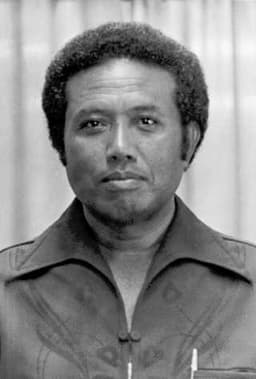
Haruo Remeliik
Politician · Modern
41.8Total

Napoleon Bonaparte
General · Modern
70.9Total
Basic Information
Born
1933
1769
Died
—
1821
Era
Modern
Modern
Nationality
Palau
France
Occupation
Politician
General
Civilization
Other
Western
Score Comparison
Military (10%)
42.8
94.0
Political (20%)
35.1
72.0
Influence (20%)
48.6
40.0
Legacy (20%)
38.3
80.0
Leadership (15%)
41.5
78.0
Strategy (15%)
43.4
90.0
TOTAL
41.8
70.9
Haruo Remeliik — Complete Timeline
1981 AD
Elected first President of PalauPolitical Action
Haruo Remeliik was elected as the first President of Palau in 1981, following the adoption of the country's constitution. He led the nation during its transition from a Trust Territory to self-government, overseeing the establishment of democratic institutions.
IndependenceFoundingDemocracy
Impact: nationalconstructive
1984 AD
Re-elected to a second termPolitical Action
Remeliik was re-elected as President in 1984, defeating challenger Roman Tmetuchl. His second term focused on economic development and negotiations with the United States over the Compact of Free Association, which he supported.
Re-electionCompact Negotiations
Impact: national
1985 AD
AssassinatedOther◆ Major
Haruo Remeliik was assassinated on June 30, 1985, outside his home in Koror. The murder shocked the nation and remained unsolved for years, with several suspects tried and acquitted. His death created a political crisis and led to a period of instability.
AssassinationPolitical ViolenceUnsolved
Impact: nationaltragic
Napoleon Bonaparte — Complete Timeline
1799 AD
Coup of 18 BrumaireOther◆ Major
Napoleon Bonaparte, with support from his brother Lucien and key political figures, overthrew the Directory in a bloodless coup. He established the Consulate with himself as First Consul, effectively becoming the ruler of France. This event ended the French Revolution's most unstable period.
French RevolutionCoupRise to Power
Impact: regional
1804 AD
Promulgation of the Napoleonic CodeOther◆ Major
Napoleon enacted the Civil Code of the French, known as the Napoleonic Code, a comprehensive set of laws that replaced the fragmented feudal legal systems. The code established legal equality, protected property rights, and secularized law. It became the basis for legal systems in many European and world countries.
Legal ReformNapoleonic CodeCivil Law
Impact: globalconstructive
1805 AD
Battle of AusterlitzWar◆ Major
Napoleon's Grande Arm
Napoleonic WarsBattleDecisive Victory
Impact: global
1812 AD
Invasion of RussiaWar◆ Major
Napoleon led the Grande Arm
Napoleonic WarsInvasionDisaster
Impact: globaldestructive
1815 AD
Battle of WaterlooWar◆ Major
Napoleon's French army was defeated by the combined forces of the Duke of Wellington's Anglo-Allied army and Gebhard Leberecht von Bl
Napoleonic WarsBattleFinal Defeat
Impact: globaldestructive
Expert Analysis
haruo-remeliik-vs-napoleon-bonaparte
# The Emperor and the Islander
On a June night in 1985, a single gunshot echoed through the quiet streets of Koror, the capital of a tiny Pacific nation most of the world had never heard of. Haruo Remeliik, the first president of Palau, lay dying on his own driveway. Half a world away and a century and a half earlier, another leader had met a very different end: Napoleon Bonaparte, exiled on a remote Atlantic island, spent his final days dictating memoirs and plotting his return. One man had conquered Europe and reshaped its laws; the other had governed a country smaller than many American counties. Yet both were products of their time, their ambitions, and their limitations. What drives a man to seek power over millions, and what happens when he gets it? The answers lie not in the scale of their achievements, but in the forces that shaped them.
Origins
Napoleon was born in 1769 on Corsica, an island that had just been sold to France by Genoa. His family was minor nobility, but poor. The French Revolution, which erupted when he was twenty, shattered the old order and opened doors that had been closed to a Corsican outsider. He was a product of the Enlightenment and the chaos of revolution—a man who believed in merit, order, and destiny. His education at military academies drilled into him the science of war, but his reading of Rousseau and Voltaire gave him a vision of a rational, centralized state.
Haruo Remeliik was born in 1933 in Palau, then a Japanese mandate after Germany’s defeat in World War I. His father was a Japanese settler, his mother a Palauan. He grew up under Japanese colonial rule, then American administration after 1944. Palau was a world of coral reefs and coconut palms, where power flowed through clan connections and oral traditions. There were no military academies, no revolutionary upheavals. Remeliik’s path was forged in the quiet bureaucracy of trusteeship, where the greatest challenge was not conquering armies but negotiating with distant superpowers.
Rise to Power
Napoleon’s ascent was meteoric. In 1793, at age twenty-four, he drove British forces from Toulon and was promoted to brigadier general. By 1796, he was commanding the Army of Italy, where he won a series of stunning victories against Austria. His 1798 Egyptian campaign was a disaster militarily but a propaganda triumph. In 1799, he returned to a France weary of revolutionary turmoil and seized power in a coup d’état. He was thirty years old. His rise was built on cannon fire, political cunning, and an unshakable belief that he was destined to rule.
Remeliik’s path was slower, quieter. After Palau became a U.S. Trust Territory in 1947, he worked his way through the administrative ranks. He served as a district administrator, then as a senator in the Palauan Congress. When Palau adopted its constitution in 1981, he was elected its first president. There was no coup, no battlefield glory—just the patient accumulation of political capital in a society where consensus mattered more than charisma. His turning point was not a victory but a vote.
Leadership & Governance
Napoleon governed as he fought: decisively, ruthlessly, and with grand ambition. He centralized the French state, created the Bank of France, and established the Napoleonic Code—a civil law system that influenced legal frameworks across Europe and beyond. He reformed education, built roads, and promoted merit over birth. But he also suppressed dissent, censored the press, and crowned himself emperor in 1804. His military genius was undeniable: at Austerlitz in 1805, he crushed a combined Russian and Austrian army, cementing his dominance. Yet his strategic brilliance was paired with a fatal overreach—the 1812 invasion of Russia, the Peninsular War in Spain, and the eventual disaster at Waterloo in 1815.
Remeliik governed a nation of 20,000 people, not 30 million. His challenges were different: negotiating the Compact of Free Association with the United States, which would define Palau’s relationship with its former colonial master; balancing traditional clan authority with modern democratic institutions; and managing a fragile economy dependent on aid. He was a consensus-builder, not a conqueror. His leadership score of 42.4 reflects a quiet competence rather than a towering presence. He focused on economic development and infrastructure, but his presidency was marked by political infighting and the slow grind of negotiations. There were no grand reforms, no Napoleonic Code—just the patient work of building a nation from scratch.
Triumph & Tragedy
Napoleon’s greatest moment was perhaps the Battle of Austerlitz in 1805, where he outmaneuvered a larger enemy force and destroyed the Third Coalition. His worst was the retreat from Moscow in 1812, where his Grande Armée of over 600,000 men was reduced to a few thousand. He was exiled to Elba in 1814, escaped in 1815, and was defeated at Waterloo. His final exile on Saint Helena was a slow death from stomach cancer, surrounded by guards and memories.
Remeliik’s triumph was less dramatic but no less significant: leading Palau from colonial dependency to self-government. His tragedy was his assassination on June 30, 1985, outside his home in Koror. The murder shocked the nation and remained unsolved for years, casting a shadow over Palau’s young democracy. He died not on a battlefield but in his own driveway, killed by unknown hands for reasons that remain murky—perhaps political rivalry, perhaps personal vendetta.
Character & Destiny
Napoleon was driven by an insatiable hunger for glory. “Impossible is a word to be found only in the dictionary of fools,” he once said. His character was a blend of brilliance and arrogance, charm and ruthlessness. He believed he could bend the world to his will, and for a time, he did. But his hubris led to his downfall. He could not stop, could not consolidate, could not accept limits.
Remeliik was a different kind of leader. He was a pragmatist, not a visionary. His scores—Political 51.7, Leadership 42.4—suggest a man who was competent but not extraordinary. He operated within constraints, not against them. His destiny was not to reshape the world but to guide his small nation through its first uncertain steps. He was a bridge between the colonial past and an independent future.
Legacy
Napoleon’s legacy is immense. The Napoleonic Code, the modern French administrative system, and the spread of nationalism across Europe all bear his imprint. He is remembered as both a liberator and a tyrant, a military genius and a cautionary tale. His influence score of 82.0 reflects a man whose shadow stretches across two centuries.
Remeliik’s legacy is smaller but no less real. He is remembered as Palau’s founding president, a man who helped steer his country through the treacherous waters of decolonization. His legacy score of 50.0 is modest, but it matters to the people of Palau. He is a reminder that leadership is not only about scale but about context—about doing what is needed in the time and place you are given.
Conclusion
Napoleon Bonaparte and Haruo Remeliik lived in different worlds, but they faced the same fundamental question: what does it mean to lead? Napoleon answered with ambition, conquest, and the dream of a unified Europe under his rule. Remeliik answered with patience, negotiation, and the quiet work of building a nation. One ended his life in exile, the other in a pool of blood on his own driveway. Both shaped the destinies of their people, though in vastly different ways. Perhaps the most striking difference is not in their achievements but in their failures: Napoleon’s was the tragedy of overreach, Remeliik’s the tragedy of vulnerability. In the end, history remembers the emperor and the islander, but it is the islander’s story that reminds us that leadership is not always about glory—sometimes it is simply about showing up, day after day, and doing the work.
Rankings
🥇
Napoleon BonaparteLeader
Mil: 94.0Pol: 72.0Inf: 40.0
70.9
🥈
Haruo Remeliik
Mil: 42.8Pol: 35.1Inf: 48.6
41.8
+29.1 behind
How This Comparison Works
Algorithm
Each figure is scored on 6 dimensions (0—100 scale) based on structured historical data: Military (10%), Political (20%), Influence (20%), Legacy (20%), Leadership (15%), Strategy (15%). The weighted total produces the final ranking.
Data Sources
Scores are computed from structured sub-indicators in the database. Scale factors adjust for era (Ancient ×0.85, Modern ×1.0) and civilization size (Eastern ×1.05, Other ×0.80) to account for differences in population and military scale.
Maximum 3 Figures
Comparisons are limited to 2—3 figures to ensure readability and statistical meaningfulness.
Error Margins
±5 points per dimension — Sub-scores are derived from historical records with inherent uncertainty. Two figures within 5 points on a dimension should be considered roughly equivalent in that area.
Total Score Accuracy
±3 points overall — The weighted combination of 6 dimensions produces a total score with approximately ±3 points of uncertainty. Differences of less than 3 points are not statistically significant— the figures are effectively tied.
Known Limitations
- Historical records are incomplete and uneven across civilizations
- Figures from oral-tradition societies may be underrepresented
- Occupation labels can misclassify multi-role figures
- Scores measure capability and impact, not moral character
- Quantitative scoring is a comparison tool, not absolute truth
Capability Radar
Military (10%) — Battles & Warfare
Battles
24
95
Win Rate
23
90
Expansion
27
95
Political (20%) — Governance & Reform
Reform
25
95
Diplomacy
30
80
Economy
20
85
Influence (20%) — Cultural & Global Reach
Cultural
15
85
Global
15
90
Legacy (20%) — Historical Impact
Historical
20
95
Longevity
10
90
Leadership (15%) — Power & Stability
Tenure
20
85
Stability
10
70
Strategy (15%) — Tactics & Innovation
Strategy
28
95
Tactics
36
98
Reform
36
92
Similar Comparisons
Comments & Discussion
BLUNDERBUSS & BLUNDERBALLS6/17/2026
Napoleon conquered half of Europe with cold steel and hot ambition. Remeliik got himself shot in his own driveway. That’s not a comparison—that’s a punchline. One man changed the course of history with the Napoleonic Code; the other ran a country smaller than Luxembourg and couldn’t keep his own peace. Respect to the dead, yes, but let’s not pretend Remeliik belongs in the same sentence as the Emperor. Greatness is measured in impact, not sympathy.