Loading...
Hassan Rouhani vs Napoleon Bonaparte
Napoleon Bonaparte leads by 20.8 pts · 2 figures compared
…
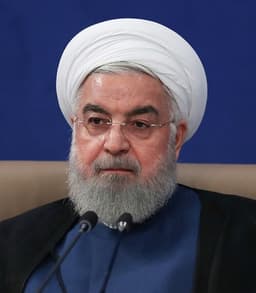
Hassan Rouhani
Politician · Modern
50.1Total

Napoleon Bonaparte
General · Modern
70.9Total
Basic Information
Born
1948
1769
Died
—
1821
Era
Modern
Modern
Nationality
Iran
France
Occupation
Politician
General
Civilization
Middle Eastern
Western
Score Comparison
Military (10%)
34.1
94.0
Political (20%)
45.0
72.0
Influence (20%)
60.0
40.0
Legacy (20%)
50.0
80.0
Leadership (15%)
53.2
78.0
Strategy (15%)
44.4
90.0
TOTAL
50.1
70.9
Hassan Rouhani — Complete Timeline
2013 AD
Elected President of IranPolitical Action◆ Major
Rouhani won the presidential election with a landslide, promising to improve relations with the West and revive the economy. His victory was seen as a mandate for moderation and reform after the hardline presidency of Mahmoud Ahmadinejad.
ElectionReformIran
Impact: nationalconstructive
2015 AD
Joint Comprehensive Plan of Action (JCPOA)Political Action
Rouhani's government negotiated the JCPOA with the P5+1 (US, UK, France, Russia, China, Germany). The deal limited Iran's nuclear program in exchange for sanctions relief, marking a major diplomatic achievement.
Nuclear DealDiplomacySanctions
Impact: globalconstructive
2018 AD
US withdrawal from JCPOAPolitical Action◆ Major
President Trump withdrew the US from the JCPOA and reimposed sanctions. Rouhani's government struggled to maintain the deal with European partners, but the economic pressure led to protests and a currency crisis in Iran.
Nuclear DealSanctionsUS-Iran
Impact: globaldestructive
2019 AD
2019-2020 Iranian protestsPolitical Action◆ Major
Rouhani's government faced nationwide protests over fuel price hikes and economic mismanagement. The protests were violently suppressed, with hundreds killed according to human rights groups, damaging Rouhani's reformist image.
ProtestsSuppressionEconomy
Impact: nationaldestructive
Napoleon Bonaparte — Complete Timeline
1799 AD
Coup of 18 BrumaireOther◆ Major
Napoleon Bonaparte, with support from his brother Lucien and key political figures, overthrew the Directory in a bloodless coup. He established the Consulate with himself as First Consul, effectively becoming the ruler of France. This event ended the French Revolution's most unstable period.
French RevolutionCoupRise to Power
Impact: regional
1804 AD
Promulgation of the Napoleonic CodeOther◆ Major
Napoleon enacted the Civil Code of the French, known as the Napoleonic Code, a comprehensive set of laws that replaced the fragmented feudal legal systems. The code established legal equality, protected property rights, and secularized law. It became the basis for legal systems in many European and world countries.
Legal ReformNapoleonic CodeCivil Law
Impact: globalconstructive
1805 AD
Battle of AusterlitzWar◆ Major
Napoleon's Grande Arm
Napoleonic WarsBattleDecisive Victory
Impact: global
1812 AD
Invasion of RussiaWar◆ Major
Napoleon led the Grande Arm
Napoleonic WarsInvasionDisaster
Impact: globaldestructive
1815 AD
Battle of WaterlooWar◆ Major
Napoleon's French army was defeated by the combined forces of the Duke of Wellington's Anglo-Allied army and Gebhard Leberecht von Bl
Napoleonic WarsBattleFinal Defeat
Impact: globaldestructive
Expert Analysis
hassan-rouhani-vs-napoleon-bonaparte
# The Emperor and the Diplomat: Napoleon and Rouhani's Divergent Paths to Power
On a December morning in 1804, Napoleon Bonaparte placed a crown upon his own head in Notre Dame Cathedral, signaling to the world that he answered to no pope, no king, no tradition but his own will. Two centuries later, in August 2013, Hassan Rouhani stood before the Iranian parliament, receiving votes of confidence for a cabinet he had assembled to heal a fractured economy and mend relations with the West. One man seized power with the force of cannon and cavalry; the other earned it through ballots and backroom bargains. Yet both faced the same fundamental question: how does a leader reshape a nation's destiny when the weight of history presses against every move?
Origins
Napoleon was born in 1769 on the island of Corsica, a year after France purchased the territory from Genoa. His family belonged to the minor nobility, but they were poor, proud, and resentful of French domination. Young Napoleon spoke Italian before French, and his early letters burned with Corsican nationalism. He entered a military academy at nine, where classmates mocked his accent and his small stature. The humiliation forged something steel-hard inside him: a conviction that he would prove his worth through sheer achievement.
Hassan Rouhani was born in 1948 in Sorkheh, a small town in Semnan Province, into a religious family. His father was a spice merchant, and Rouhani grew up in the shadow of the 1953 CIA-backed coup that toppled Iran's democratically elected prime minister. That event planted a deep suspicion of foreign powers in his generation. He studied at Qom's seminaries and Tehran University, becoming both a cleric and a lawyer—a dual identity that would serve him well in a theocratic state.
The difference in their origins is not merely one of geography or class. Napoleon emerged from a world of revolutionary upheaval where merit could topple monarchy. Rouhani came of age in a world of revolutionary theocracy where piety and political maneuvering were the only currencies that mattered.
Rise to Power
Napoleon's ascent was meteoric. At 24, he drove British forces from Toulon and was promoted to brigadier general. At 26, he saved the revolutionary government from a royalist uprising with a "whiff of grapeshot"—cannon fire that cleared the streets of Paris. At 27, he conquered Italy. By 30, he had staged a coup and installed himself as First Consul. His path was paved with victories: the Battle of the Pyramids in 1798, Marengo in 1800, Austerlitz in 1805. Each triumph added territory, prestige, and power.
Rouhani's rise was glacial by comparison. He entered politics in the 1980s, serving as a commander in the Iran-Iraq War and later as a nuclear negotiator under President Khatami. For decades, he was a voice of pragmatism in a system dominated by hardliners. His moment came in 2013, when Iran's economy was crippled by sanctions and public frustration boiled over. Rouhani won the presidency with 50.7% of the vote in the first round—a landslide by Iranian standards—promising to "restore the economy and bring back dignity to the nation."
Where Napoleon climbed a ladder of blood and glory, Rouhani ascended a staircase of elections, committees, and careful compromises. One man conquered; the other persuaded.
Leadership & Governance
Napoleon ruled with a combination of military genius and administrative brilliance. His Napoleonic Code standardized French law, abolished feudal privileges, and established merit-based advancement. He built roads, founded banks, and reformed education. But his governance rested on the sword: he appointed his brothers as puppet kings, suppressed dissent with secret police, and silenced newspapers. When he needed money, he looted conquered territories. When he needed soldiers, he conscripted them by the hundreds of thousands.
Rouhani governed within the tight constraints of Iran's theocratic system, where ultimate authority rests with the Supreme Leader. His signature achievement was the 2015 Joint Comprehensive Plan of Action (JCPOA), negotiated with the United States, Britain, France, Russia, China, and Germany. The deal limited Iran's uranium enrichment in exchange for sanctions relief. It was a masterpiece of diplomacy—but it was fragile. When President Trump withdrew the US from the agreement in 2018 and reimposed sanctions, Rouhani's domestic position crumbled. The economy contracted, inflation soared, and protests erupted in 2019 over fuel price hikes, leading to a violent crackdown.
Napoleon commanded armies; Rouhani commanded no army. Napoleon rewrote laws with a stroke of his pen; Rouhani had to navigate a maze of clerical councils and revolutionary guards. The difference in their governance reflects the difference between absolute power and constrained power—and the vulnerability of the latter.
Triumph & Tragedy
Napoleon's greatest triumph was Austerlitz in 1805, where he destroyed a larger Austro-Russian army and forced the Holy Roman Empire to dissolve. His greatest tragedy came a decade later at Waterloo in 1815, where a combination of Prussian reinforcements, British resilience, and his own tactical errors ended his empire. He died in exile on Saint Helena in 1821, a prisoner of the British.
Rouhani's greatest triumph was the JCPOA in 2015, a deal that promised to reintegrate Iran into the global economy and avert war. His greatest tragedy was watching that deal unravel, piece by piece, as American policy shifted and Iranian hardliners reasserted control. By the end of his second term in 2021, the economy was in ruins, and his legacy was overshadowed by the protests and repression of 2019.
Both men experienced the arc of rise and fall, but Napoleon's fall was dramatic and final—a thunderclap that echoed across Europe. Rouhani's fall was a slow erosion, a death by a thousand sanctions.
Character & Destiny
Napoleon was driven by an insatiable hunger for glory. "Impossible is a word to be found only in the dictionary of fools," he once said. His ambition knew no bounds, and his hubris knew no limits. He invaded Russia in 1812 with 600,000 men; fewer than 100,000 returned. He refused to negotiate when he could have settled for peace. His character was his destiny: the same will that lifted him to power eventually pushed him over the edge.
Rouhani was cautious, patient, and pragmatic. He was a man of the system, not a revolutionary. He believed in incremental change, in negotiation, in the power of words over weapons. But caution has its own perils. In a system that rewards boldness, Rouhani's moderation left him vulnerable to hardliners who never accepted his vision. His character, too, shaped his fate: he was a diplomat in a country that often preferred martyrs.
Legacy
Napoleon's legacy is monumental. The Napoleonic Code influenced legal systems across Europe and the Americas. He redrew the map of Europe, inspired nationalism in Germany and Italy, and sold the Louisiana Territory to the United States. He is remembered as a military genius, a reformer, and a tyrant—a man who changed the world, for better and worse.
Rouhani's legacy is more ambiguous. The JCPOA remains a template for nuclear diplomacy, even if it failed to achieve lasting peace. He demonstrated that Iran could engage with the West, but his achievements were undone by forces beyond his control. He is remembered as a moderate who tried, and failed, to steer his country toward openness.
Conclusion
Napoleon and Rouhani are separated by two centuries, by culture, by the nature of power itself. Yet both faced the same fundamental challenge: how to lead a nation through a moment of crisis. Napoleon chose the sword; Rouhani chose the pen. One built an empire of conquest; the other built a deal of compromise. Both saw their greatest works destroyed, in part, by their own limitations.
Perhaps the deepest difference lies in what they reveal about their eras. Napoleon's story belongs to a world where a single general could reshape continents through sheer force of will. Rouhani's story belongs to a world of nuclear stalemates, economic interdependence, and systems so complex that no single leader can truly control them. The emperor and the diplomat: one a comet, the other a candle. Both burned, and both were consumed.
Rankings
🥇
Napoleon BonaparteLeader
Mil: 94.0Pol: 72.0Inf: 40.0
70.9
🥈
Hassan Rouhani
Mil: 34.1Pol: 45.0Inf: 60.0
50.1
+20.8 behind
How This Comparison Works
Algorithm
Each figure is scored on 6 dimensions (0—100 scale) based on structured historical data: Military (10%), Political (20%), Influence (20%), Legacy (20%), Leadership (15%), Strategy (15%). The weighted total produces the final ranking.
Data Sources
Scores are computed from structured sub-indicators in the database. Scale factors adjust for era (Ancient ×0.85, Modern ×1.0) and civilization size (Eastern ×1.05, Other ×0.80) to account for differences in population and military scale.
Maximum 3 Figures
Comparisons are limited to 2—3 figures to ensure readability and statistical meaningfulness.
Error Margins
±5 points per dimension — Sub-scores are derived from historical records with inherent uncertainty. Two figures within 5 points on a dimension should be considered roughly equivalent in that area.
Total Score Accuracy
±3 points overall — The weighted combination of 6 dimensions produces a total score with approximately ±3 points of uncertainty. Differences of less than 3 points are not statistically significant— the figures are effectively tied.
Known Limitations
- Historical records are incomplete and uneven across civilizations
- Figures from oral-tradition societies may be underrepresented
- Occupation labels can misclassify multi-role figures
- Scores measure capability and impact, not moral character
- Quantitative scoring is a comparison tool, not absolute truth
Capability Radar
Military (10%) — Battles & Warfare
Battles
19
95
Win Rate
26
90
Expansion
26
95
Political (20%) — Governance & Reform
Reform
55
95
Diplomacy
75
80
Economy
50
85
Influence (20%) — Cultural & Global Reach
Cultural
30
85
Global
60
90
Legacy (20%) — Historical Impact
Historical
55
95
Longevity
40
90
Leadership (15%) — Power & Stability
Tenure
60
85
Stability
40
70
Strategy (15%) — Tactics & Innovation
Strategy
30
95
Tactics
32
98
Reform
37
92
Similar Comparisons
Comments & Discussion
Corsica's Cannon6/17/2026
Comparing a man who crowned himself emperor to a diplomat who earned votes is like comparing a wildfire to a garden hose. Napoleon's Corsican chip-on-shoulder drove him to dominate Europe with the Grand Army—600,000 men marched on Russia in 1812. Rouhani's power came from negotiating a nuclear deal in 2015, not from conquering Moscow. One seized thrones; the other threads needles. Different arenas entirely.
拿破仑的炮兵6/17/2026
拿破仑自己加冕,鲁哈尼等议会背书——一个是火炮和骑兵,一个是选票和密室交易。但别忘了:拿破仑搞定了《拿破仑法典》,至今是欧洲法律基石;鲁哈尼搞定了《伊核协议》,却没挡住美国退出。一个是改变大陆的狂人,一个是困在制度里的实用主义者。历史只记住赢家,而鲁哈尼连协议都没保住。
Death by Data6/17/2026
The analysis ignores a brutal fact: Napoleon ruled an empire of 70 million people and changed warfare forever with the corps system. Rouhani managed a sanctions-crippled Iran of 80 million and couldn't stop the IRGC from dominating policy. One created the Continental System to starve Britain; the other tried to open Iran's economy but saw oil exports collapse. Call them both "leaders" if you want—scale matters, and Napoleon's was continental, not clerical.
古典学粉6/17/2026
拿一个2013年上台的政客跟1804年称帝的军事天才比?拿破仑横扫意大利才26岁,鲁哈尼63岁才当总统。拿破仑在金字塔战役用方块阵打退马穆鲁克,那种战场直觉连恺撒都佩服。鲁哈尼呢?在联合国演讲呼吁“温和对话”。一个是改写欧洲地图的巨人,一个是嘴炮外交的代言人。别拿茶杯比海洋。
Historian2326/17/2026
Both men inherited broken systems—Napoleon a revolutionary France bleeding from the Terror, Rouhani an Iran gutted by sanctions and the Green Movement crackdown. But Napoleon burned his bridges, doubled down on war, and ended up on St. Helena. Rouhani chose cautious reform within the clerical framework—still in power, still playing the game. One lived by the sword and died by it. The other lives by the phone and might just survive.