Loading...
This comparison has not been analyzed yet.
One-time AI generation (~1 minute). Scores and timeline are already available below.
Hattusili I vs Periander
Hattusili I leads by 3.5 pts · 2 figures compared
…
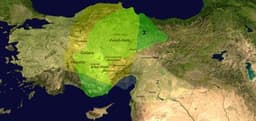
Hattusili I
Emperor · Ancient
57.0Total

Periander
Emperor · Ancient
53.5Total
Basic Information
Born
-1650
-627
Died
-1620
-585
Era
Ancient
Ancient
Nationality
Hittite Empire
Corinth
Occupation
Emperor
Emperor
Civilization
Middle Eastern
Western
Score Comparison
Military (10%)
63.3
50.0
Political (20%)
68.0
59.3
Influence (20%)
54.1
54.9
Legacy (20%)
49.2
47.5
Leadership (15%)
64.0
66.0
Strategy (15%)
50.0
41.0
TOTAL
57.0
53.5
Hattusili I — Complete Timeline
1650 BC
Crossing of the Taurus MountainsWar◆ Major
Hattusili I led the Hittite army across the Taurus Mountains into northern Syria, conquering the kingdom of Alalakh and other cities. This campaign established Hittite control over key trade routes and marked the beginning of the Hittite Old Kingdom's expansion.
Hittite EmpireMilitary CampaignSyria
Impact: regional
Foundation of the Hittite Old KingdomPolitical Action
Hattusili I established the Hittite Old Kingdom by consolidating control over central Anatolia and moving the capital to Hattusa. He initiated a centralized administration and military reforms that laid the foundation for Hittite imperial power.
Hittite EmpireState FormationHattusa
Impact: regionalconstructive
Periander — Complete Timeline
600 BC
Reform of Corinthian CoinageReform◆ Major
Periander introduced a standardized silver coinage for Corinth, replacing earlier barter systems. The coins featured the Pegasus symbol and became widely accepted across Greece, boosting Corinth's economy and establishing it as a major commercial center.
EconomyCurrencyTrade
Impact: regionalconstructive
Construction of the DiolkosInvention◆ Major
Periander oversaw the construction of the Diolkos, a paved trackway across the Isthmus of Corinth that allowed ships to be transported overland. This engineering feat connected the Ionian and Aegean seas, facilitating trade and military transport, and remained in use for over 600 years.
EngineeringTradeCorinth
Impact: regionalconstructive
Murder of His Wife MelissaPolitical Action
According to Herodotus, Periander killed his wife Melissa in a fit of rage, possibly by throwing a footstool at her. He later consulted the Oracle of the Dead to find a lost object, and Melissa's ghost revealed its location, demanding proper burial rites. This act tarnished his reputation.
MurderHerodotusTyranny
destructive
590 BC
Exile of His Son LycophronPolitical Action
Periander exiled his son Lycophron to Corcyra after the son refused to speak to him following Melissa's murder. When Periander later sought reconciliation, the Corcyraeans killed Lycophron to avoid conflict. This family tragedy deepened Periander's isolation and harsh rule.
FamilyExileTyranny
tragic
This comparison has not been analyzed yet.
One-time AI generation (~1 minute). Scores and timeline are already available below.
Rankings
🥇
Hattusili ILeader
Mil: 63.3Pol: 68.0Inf: 54.1
57.0
🥈
Periander
Mil: 50.0Pol: 59.3Inf: 54.9
53.5
+3.5 behind
How This Comparison Works
Algorithm
Each figure is scored on 6 dimensions (0—100 scale) based on structured historical data: Military (10%), Political (20%), Influence (20%), Legacy (20%), Leadership (15%), Strategy (15%). The weighted total produces the final ranking.
Data Sources
Scores are computed from structured sub-indicators in the database. Scale factors adjust for era (Ancient ×0.85, Modern ×1.0) and civilization size (Eastern ×1.05, Other ×0.80) to account for differences in population and military scale.
Maximum 3 Figures
Comparisons are limited to 2—3 figures to ensure readability and statistical meaningfulness.
Error Margins
±5 points per dimension — Sub-scores are derived from historical records with inherent uncertainty. Two figures within 5 points on a dimension should be considered roughly equivalent in that area.
Total Score Accuracy
±3 points overall — The weighted combination of 6 dimensions produces a total score with approximately ±3 points of uncertainty. Differences of less than 3 points are not statistically significant— the figures are effectively tied.
Known Limitations
- Historical records are incomplete and uneven across civilizations
- Figures from oral-tradition societies may be underrepresented
- Occupation labels can misclassify multi-role figures
- Scores measure capability and impact, not moral character
- Quantitative scoring is a comparison tool, not absolute truth
Capability Radar
Military (10%) — Battles & Warfare
Battles
60
10
Win Rate
65
10
Expansion
65
15
Political (20%) — Governance & Reform
Reform
60
75
Diplomacy
50
70
Economy
45
80
Influence (20%) — Cultural & Global Reach
Cultural
45
60
Global
40
40
Legacy (20%) — Historical Impact
Historical
55
55
Longevity
50
50
Leadership (15%) — Power & Stability
Tenure
55
70
Stability
40
65
Strategy (15%) — Tactics & Innovation
Strategy
60
15
Tactics
55
15
Reform
50
20
Similar Comparisons
Comments & Discussion
No comments yet. Be the first to share your thoughts!