Loading...
Hayato Ikeda vs Robert Fico
Hayato Ikeda leads by 8.0 pts · 2 figures compared
…
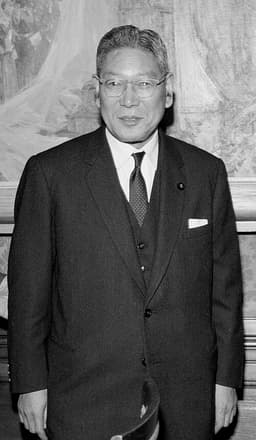
Hayato Ikeda
Politician · Modern
56.3Total

Robert Fico
Politician · Modern
48.3Total
Basic Information
Born
1899
1964
Died
1965
—
Era
Modern
Modern
Nationality
Japan
Slovakia
Occupation
Politician
Politician
Civilization
Eastern
Western
Score Comparison
Military (10%)
12.5
11.5
Political (20%)
78.0
62.7
Influence (20%)
59.0
52.5
Legacy (20%)
52.0
42.5
Leadership (15%)
79.8
72.0
Strategy (15%)
35.9
32.4
TOTAL
56.3
48.3
Hayato Ikeda — Complete Timeline
1960 AD
Launch of the Income-Doubling PlanReform
Prime Minister Hayato Ikeda announced the 'Income-Doubling Plan' in December 1960, a ten-year economic program aiming to double the national income through rapid industrial growth, increased productivity, and expanded trade. The plan successfully guided Japan's high-growth era, achieving its target in seven years and transforming the country into an economic powerhouse.
Economic PolicyGrowthJapan
Impact: nationalconstructive
Liberalization of Trade and CapitalReform◆ Major
Ikeda's government pursued gradual liberalization of trade and capital flows, aligning Japan with international economic norms. This included joining the General Agreement on Tariffs and Trade (GATT) and the International Monetary Fund (IMF) Article VIII, which required removing restrictions on current account transactions, boosting foreign trade.
Trade PolicyLiberalizationEconomic Integration
Impact: nationalconstructive
Political Reconciliation with the OppositionPolitical Action
After the violent protests against the US-Japan Security Treaty in 1960, Ikeda adopted a 'low posture' approach, seeking dialogue with the opposition Socialist Party. He focused on economic growth and social welfare to reduce political polarization, successfully stabilizing Japanese politics during his tenure.
Political StrategyStabilityJapan
Impact: nationalconstructive
Robert Fico — Complete Timeline
2006 AD
First Term as Prime MinisterPolitical Action◆ Major
Fico became Prime Minister of Slovakia after his party Smer-SD won the 2006 parliamentary election. He formed a coalition government and implemented left-wing economic policies.
Prime MinisterSlovakia
Impact: nationalconstructive
2012 AD
Second Term and Euro AdoptionPolitical Action◆ Major
Fico's second term saw Slovakia adopt the euro in 2009. His government pursued fiscal consolidation and social welfare programs, but also faced accusations of corruption.
Euro AdoptionEconomic Policy
Impact: nationalconstructive
2018 AD
Murder of Ján KuciakOther
The murder of investigative journalist J
CorruptionResignation
Impact: nationaltragic
Expert Analysis
Origins
Hayato Ikeda (1899-1965) was born in Takehara, Hiroshima Prefecture, into a family of sake brewers. He studied law at Kyoto Imperial University and entered the Ministry of Finance in 1925, where he developed expertise in tax policy and economic planning. His formative experiences included wartime budgeting and post-war reconstruction under Allied occupation.
Robert Fico (born 1964) grew up in Topoľčany, Czechoslovakia. He earned a law degree from Comenius University and joined the Communist Party of Czechoslovakia in 1986. After the Velvet Revolution, he worked in the Ministry of Justice and later as a lawyer. He was elected to parliament in 1992 for the Party of the Democratic Left, but left to found Smer (Direction) in 1999.
Rise to Power
Ikeda rose through the Ministry of Finance, becoming Vice Minister in 1945. He entered politics in 1949, winning a seat in the Diet. He served as Minister of Finance under Prime Minister Shigeru Yoshida, overseeing post-war economic stabilization. In 1960, after the resignation of Nobusuke Kishi following violent protests over the US-Japan Security Treaty, Ikeda was chosen as prime minister. He adopted a 'low posture' approach, focusing on economic growth to defuse political tensions.
Fico's Smer party won 13.5% of the vote in 2002, becoming the third-largest party. In 2006, Smer won 29.1% and formed a coalition with the nationalist Slovak National Party and the People's Party – Movement for a Democratic Slovakia. Fico became prime minister at age 42, promising a welfare state and anti-corruption measures.
Leadership & Governance
Ikeda's leadership was defined by the Income-Doubling Plan (1960), a ten-year program targeting 7.2% annual growth. He liberalized trade and capital flows, joining the OECD in 1964. He pursued political reconciliation, meeting with opposition leaders and reducing police presence at protests. His governance style was technocratic and consensus-seeking, scoring 79.8 in leadership and 35.9 in strategy.
Fico's governance combined populist welfare policies with centralization of power. He increased social spending, raised the minimum wage, and introduced a 19% flat tax. He also faced accusations of corruption and cronyism, particularly over EU fund allocation. His leadership score is 72.0, with strategy at 32.4. Unlike Ikeda, Fico often clashed with the opposition and the media.
Triumph & Tragedy
Ikeda's greatest success was the Income-Doubling Plan, which achieved 10% average growth in the 1960s, doubling GDP by 1967. He also stabilized Japan's political landscape after the 1960 protests. However, his policy of rapid growth led to environmental pollution and regional disparities. He resigned in 1964 due to throat cancer, dying the next year.
Fico's triumphs include Slovakia's euro adoption in 2009 and a period of economic growth. However, his legacy is marred by the murder of journalist Ján Kuciak in 2018, which exposed government links to organized crime. Fico resigned amid mass protests. He also faced criticism for judicial reforms that weakened the rule of law.
Character & Destiny
Ikeda was pragmatic and reserved, described as a 'technocrat' who prioritized economic data over ideology. His 'low posture' avoided confrontation, but critics saw it as weakness. His cancer likely limited his ambition; he died shortly after leaving office.
Fico is charismatic and combative, known for sharp rhetoric. He centralised power within Smer, suppressing internal dissent. His confrontational style with the EU and media backfired after the Kuciak murder, forcing his resignation. Historical assessments note his initial popularity but eventual authoritarian drift.
Legacy
Ikeda's Income-Doubling Plan set Japan on a path to become the world's second-largest economy. He institutionalized economic planning and export-led growth, influencing subsequent Asian economies. His political reconciliation model reduced violent protests. Legacy score: 52.0.
Fico's legacy is mixed: he modernized Slovakia's economy and infrastructure but weakened democratic institutions. The Kuciak murder and subsequent protests led to a political crisis and Smer's decline. Legacy score: 42.5.
Conclusion
Hayato Ikeda had greater impact. His economic policies transformed Japan's society and global standing, with lasting effects on development economics. Fico's achievements were more modest and overshadowed by scandal. Ikeda's total score of 56.3 versus Fico's 48.3 reflects this. While both were skilled politicians, Ikeda's vision and execution created enduring prosperity, whereas Fico's legacy is one of lost potential.
Rankings
🥇
Hayato IkedaLeader
Mil: 12.5Pol: 78.0Inf: 59.0
56.3
🥈
Robert Fico
Mil: 11.5Pol: 62.7Inf: 52.5
48.3
+8.0 behind
How This Comparison Works
Algorithm
Each figure is scored on 6 dimensions (0—100 scale) based on structured historical data: Military (10%), Political (20%), Influence (20%), Legacy (20%), Leadership (15%), Strategy (15%). The weighted total produces the final ranking.
Data Sources
Scores are computed from structured sub-indicators in the database. Scale factors adjust for era (Ancient ×0.85, Modern ×1.0) and civilization size (Eastern ×1.05, Other ×0.80) to account for differences in population and military scale.
Maximum 3 Figures
Comparisons are limited to 2—3 figures to ensure readability and statistical meaningfulness.
Error Margins
±5 points per dimension — Sub-scores are derived from historical records with inherent uncertainty. Two figures within 5 points on a dimension should be considered roughly equivalent in that area.
Total Score Accuracy
±3 points overall — The weighted combination of 6 dimensions produces a total score with approximately ±3 points of uncertainty. Differences of less than 3 points are not statistically significant— the figures are effectively tied.
Known Limitations
- Historical records are incomplete and uneven across civilizations
- Figures from oral-tradition societies may be underrepresented
- Occupation labels can misclassify multi-role figures
- Scores measure capability and impact, not moral character
- Quantitative scoring is a comparison tool, not absolute truth
Capability Radar
Military (10%) — Battles & Warfare
Battles
16
24
Win Rate
16
24
Expansion
21
26
Political (20%) — Governance & Reform
Reform
75
55
Diplomacy
70
60
Economy
85
55
Influence (20%) — Cultural & Global Reach
Cultural
30
30
Global
55
25
Legacy (20%) — Historical Impact
Historical
65
35
Longevity
55
30
Leadership (15%) — Power & Stability
Tenure
60
65
Stability
70
45
Strategy (15%) — Tactics & Innovation
Strategy
23
33
Tactics
26
35
Reform
28
35
Similar Comparisons
Comments & Discussion
No comments yet. Be the first to share your thoughts!