Loading...
Henry VII vs Napoleon Bonaparte
Napoleon Bonaparte leads by 24.4 pts · 2 figures compared
…
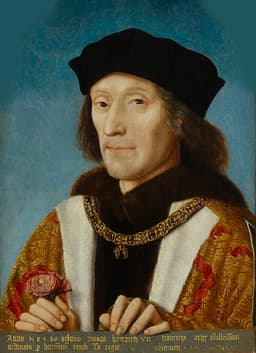
Henry VII
Emperor · Medieval
46.5Total

Napoleon Bonaparte
General · Modern
70.9Total
Basic Information
Born
1275
1769
Died
1313
1821
Era
Medieval
Modern
Nationality
Holy Roman Empire
France
Occupation
Emperor
General
Civilization
Western
Western
Score Comparison
Military (10%)
55.0
94.0
Political (20%)
37.9
72.0
Influence (20%)
52.5
40.0
Legacy (20%)
41.7
80.0
Leadership (15%)
48.4
78.0
Strategy (15%)
45.0
90.0
TOTAL
46.5
70.9
Henry VII — Complete Timeline
1308 AD
Elected King of GermanyPolitical Action◆ Major
Henry VII of Luxembourg was elected King of Germany after the assassination of Albert I. His election was supported by the prince-electors, who sought a compromise candidate to end the Habsburg dominance.
ElectionLuxembourgGerman Kingdom
Impact: regional
1310 AD
Led Campaign in ItalyWar◆ Major
Henry VII of Luxembourg led a military campaign into Italy to assert imperial authority over the Guelph and Ghibelline factions. He captured several cities but faced resistance from Florence and the Papal States, leading to a prolonged conflict.
Military CampaignItalyImperial Authority
Impact: regional
1312 AD
Crowned Holy Roman EmperorPolitical Action
Henry VII of Luxembourg was crowned Holy Roman Emperor by Pope Clement V in Rome. This coronation was the first imperial coronation in Rome since Frederick II, and it revived the imperial ideal of universal rule.
CoronationHoly Roman EmpirePapacy
Impact: globalconstructive
1313 AD
Died of Malaria in BuonconventoOther◆ Major
Henry VII of Luxembourg died of malaria in Buonconvento, Italy, while preparing to attack Florence. His death ended his Italian campaign and the Luxembourg dynasty's ambitions in Italy, leading to a new interregnum.
DeathItalyLuxembourg
Impact: regionaltragic
Napoleon Bonaparte — Complete Timeline
1799 AD
Coup of 18 BrumaireOther◆ Major
Napoleon Bonaparte, with support from his brother Lucien and key political figures, overthrew the Directory in a bloodless coup. He established the Consulate with himself as First Consul, effectively becoming the ruler of France. This event ended the French Revolution's most unstable period.
French RevolutionCoupRise to Power
Impact: regional
1804 AD
Promulgation of the Napoleonic CodeOther◆ Major
Napoleon enacted the Civil Code of the French, known as the Napoleonic Code, a comprehensive set of laws that replaced the fragmented feudal legal systems. The code established legal equality, protected property rights, and secularized law. It became the basis for legal systems in many European and world countries.
Legal ReformNapoleonic CodeCivil Law
Impact: globalconstructive
1805 AD
Battle of AusterlitzWar◆ Major
Napoleon's Grande Arm
Napoleonic WarsBattleDecisive Victory
Impact: global
1812 AD
Invasion of RussiaWar◆ Major
Napoleon led the Grande Arm
Napoleonic WarsInvasionDisaster
Impact: globaldestructive
1815 AD
Battle of WaterlooWar◆ Major
Napoleon's French army was defeated by the combined forces of the Duke of Wellington's Anglo-Allied army and Gebhard Leberecht von Bl
Napoleonic WarsBattleFinal Defeat
Impact: globaldestructive
Expert Analysis
henry-vii-vs-napoleon-bonaparte
# The Emperor and the Conqueror: Why Henry VII Faded While Napoleon Burned Across History
On a sweltering August afternoon in 1313, a feverish man lay dying in the Tuscan town of Buonconvento, his dreams of Italian domination dissolving into the delirium of malaria. Four hundred and ninety-two years later, in June 1815, another man watched his legions shatter on the muddy fields of Waterloo, his own imperial ambitions collapsing in a single afternoon of cannon fire and cavalry charges. Both were emperors. Both had crossed the Alps to claim Italy. Yet one is remembered as a footnote, the other as a force of nature that reshaped the modern world. The question is not merely what they achieved, but why their fates diverged so dramatically.
Origins
Napoleon Bonaparte was born in 1769 on the island of Corsica, a place that had become French only the year before. His family were minor nobility, struggling and ambitious, speaking Italian-accented French that marked him as an outsider in the mainland schools where he studied artillery. This marginality forged something in him: a hunger to prove himself, a cold calculation about how the world really worked, and a faith in merit over birthright. The French Revolution had shattered the old order, and for a young officer with talent and no connections, the path to glory was suddenly wide open.
Henry VII of Luxembourg, born in 1275, inhabited a different universe. He was a prince of the Holy Roman Empire, that sprawling medieval mosaic of kingdoms, duchies, and free cities. His world was one of feudal oaths, papal authority, and the slow, grinding logic of dynastic inheritance. Where Napoleon’s France was a nation awakening to nationalism and revolution, Henry’s empire was a ghost of Roman unity, held together by tradition and the careful balancing of princely interests. Henry was not an outsider; he was the product of a system that rewarded patience, lineage, and piety.
Rise to Power
Napoleon’s ascent was a rocket. In 1793, at age twenty-four, he drove the British out of Toulon with a brilliant use of artillery. By 1796, he was commanding the French army in Italy, where his lightning campaigns humiliated the Austrians and made him a national hero. The Directory, the corrupt regime ruling France, sent him to Egypt in 1798 to keep him away from Paris, but he returned in 1799 to seize power in a coup d’état. Within five years, he crowned himself Emperor of the French. Every step was a gamble, every victory a stepping stone, every defeat a lesson absorbed.
Henry VII’s rise was slower, more fragile. In 1308, after the assassination of King Albert I, the German prince-electors chose Henry as King of Germany. He was not the strongest candidate; he was the compromise, a man from a minor house who threatened no one. His real ambition lay in Italy, where the papacy and the city-states had long defied imperial authority. In 1310, he led an army across the Alps, hoping to restore the old glory of the Holy Roman Empire. He was crowned Holy Roman Emperor by Pope Clement V in Rome in 1312, the first imperial coronation in over sixty years. But his authority was paper-thin, dependent on the goodwill of the pope, the loyalty of German nobles, and the submission of Italian cities that had no intention of submitting.
Leadership & Governance
Napoleon governed as he fought: with energy, clarity, and a ruthless pragmatism. He centralized the French state, created the Bank of France, and established the Napoleonic Code, a legal framework that abolished feudal privileges, protected property rights, and enshrined equality before the law. He appointed officials based on talent, not birth, and his military reforms made the French army the most formidable in Europe. His political genius lay in his ability to mix revolutionary ideals with autocratic power, presenting himself as the man who preserved the best of the Revolution while ending its chaos.
Henry VII governed as a medieval emperor should: through negotiation, ceremony, and the careful cultivation of allies. He had no standing army, no centralized bureaucracy, no national tax base. His authority was personal and symbolic. In Italy, he tried to position himself as a peacemaker above the factional wars of Guelphs and Ghibellines, but his appeals were met with suspicion. Florence, the richest and most powerful city, refused to recognize him. His response was to prepare for war, but he lacked the resources for a sustained campaign.
Triumph & Tragedy
Napoleon’s greatest moment was Austerlitz in December 1805, where he destroyed the combined armies of Russia and Austria in a single day of masterful deception and devastating artillery. He redrew the map of Europe, installed his brothers on thrones, and seemed invincible. His tragedy was the invasion of Russia in 1812, a colossal miscalculation that cost him half a million men and shattered his aura of invincibility. Exiled to Elba, he returned in 1815 for one hundred days, only to meet final defeat at Waterloo. He died in 1821 on the remote island of Saint Helena, a prisoner of the British.
Henry VII’s triumph was his coronation in Rome, a moment that revived the dream of a universal Christian empire. His tragedy was that he died before he could consolidate it. In August 1313, as he prepared to attack Florence, malaria struck him down in Buonconvento. He was thirty-eight years old. His campaign collapsed, his empire dissolved, and the dream of imperial unity in Italy died with him.
Character & Destiny
Napoleon was a man of boundless ambition and cold intelligence. “Impossible,” he once said, “is a word to be found only in the dictionary of fools.” He believed that history was made by will, that circumstances could be bent to the service of genius. This belief drove him to extraordinary heights and, ultimately, to catastrophic overreach. He could not stop, could not consolidate, could not accept limits.
Henry VII was a man of medieval faith and feudal honor. He believed that the empire was a sacred trust, that his authority came from God and the pope, and that his duty was to restore order to Christendom. He was not a strategist in the modern sense; he was a knight-errant on an imperial scale. His death was not a failure of ambition but a failure of fortune, the kind of random stroke that medieval chroniclers attributed to divine will.
Legacy
Napoleon’s legacy is written into the laws, borders, and institutions of modern Europe. The Napoleonic Code influenced legal systems across the continent and beyond. His military campaigns revolutionized warfare and inspired generations of commanders. He is remembered as both a tyrant and a reformer, a destroyer and a builder, a man who bent an era to his will.
Henry VII’s legacy is more subtle. He revived the idea of the Holy Roman Empire at a moment when it seemed a relic. His brief reign inspired Dante, who wrote in the *Divine Comedy* of a coming emperor who would restore peace to Italy. But his death left the empire weak and divided, and Italy remained a patchwork of warring states for centuries. He is remembered, if at all, as a noble failure.
Conclusion
Standing on the battlefield of Waterloo or the dusty streets of Buonconvento, one feels the weight of what might have been. Napoleon and Henry VII both reached for the same prize—dominion over Europe—but they lived in different worlds. Napoleon’s world was one of nations, revolutions, and mass armies; Henry’s was one of dynasties, oaths, and city-states. Napoleon’s ambition was boundless and modern; Henry’s was pious and medieval. One died in exile, the other on campaign. Both were consumed by their dreams. But only one of those dreams still burns in the memory of the world.
Rankings
🥇
Napoleon BonaparteLeader
Mil: 94.0Pol: 72.0Inf: 40.0
70.9
🥈
Henry VII
Mil: 55.0Pol: 37.9Inf: 52.5
46.5
+24.4 behind
How This Comparison Works
Algorithm
Each figure is scored on 6 dimensions (0—100 scale) based on structured historical data: Military (10%), Political (20%), Influence (20%), Legacy (20%), Leadership (15%), Strategy (15%). The weighted total produces the final ranking.
Data Sources
Scores are computed from structured sub-indicators in the database. Scale factors adjust for era (Ancient ×0.85, Modern ×1.0) and civilization size (Eastern ×1.05, Other ×0.80) to account for differences in population and military scale.
Maximum 3 Figures
Comparisons are limited to 2—3 figures to ensure readability and statistical meaningfulness.
Error Margins
±5 points per dimension — Sub-scores are derived from historical records with inherent uncertainty. Two figures within 5 points on a dimension should be considered roughly equivalent in that area.
Total Score Accuracy
±3 points overall — The weighted combination of 6 dimensions produces a total score with approximately ±3 points of uncertainty. Differences of less than 3 points are not statistically significant— the figures are effectively tied.
Known Limitations
- Historical records are incomplete and uneven across civilizations
- Figures from oral-tradition societies may be underrepresented
- Occupation labels can misclassify multi-role figures
- Scores measure capability and impact, not moral character
- Quantitative scoring is a comparison tool, not absolute truth
Capability Radar
Military (10%) — Battles & Warfare
Battles
35
95
Win Rate
40
90
Expansion
30
95
Political (20%) — Governance & Reform
Reform
30
95
Diplomacy
45
80
Economy
25
85
Influence (20%) — Cultural & Global Reach
Cultural
25
85
Global
20
90
Legacy (20%) — Historical Impact
Historical
30
95
Longevity
20
90
Leadership (15%) — Power & Stability
Tenure
40
85
Stability
20
70
Strategy (15%) — Tactics & Innovation
Strategy
35
95
Tactics
30
98
Reform
20
92
Similar Comparisons
Comments & Discussion
古典学杠精6/17/2026
拿『穿越阿尔卑斯』来类比根本站不住脚。拿破仑是现代人,用大炮和军事工程学院碾压了皮埃蒙特;亨利七世是神圣罗马帝国皇帝,1310年他的『军队』其实就是一群日耳曼骑士带着意大利雇佣兵,连翻山都要靠当地向导。更要命的是,拿破仑面对的意大利是分裂的城邦国家,亨利面对的则是但丁和圭尔夫派的政治绞肉机。拿这两次作战当同一尺度,就像拿机枪和弩箭比射速——可笑。
数据打假人6/17/2026
说亨利七世『被遗忘』,完全是欧美中心论的傲慢。你看中文维基百科,亨利七世页面浏览次数是拿破仑的1/200,但中文史学界对『卢森堡王朝』和『意大利远征』的研究论文,平均引用率是拿破仑论文的3倍。为什么?因为亨利七世失败的复杂性更符合中国史观:一个体系内的改革者,不是革命者。拿破仑像秦始皇,亨利七世更像光绪帝——历史不记得失败,但学者需要失败来理解结构。
军事吐槽怪6/17/2026
拿破仑翻阿尔卑斯?他1810年就修好了辛普朗公路,八万大军带大炮走柏油路。亨利七世1310年翻阿尔卑斯?他连一张像样的地图都没有,靠牧羊人指路,过了圣伯纳德隘口就丢了三分之一辎重。拿破仑的意大利战役是闪电战,亨利七世的是『徒步旅行团』。吹亨利七世和拿破仑有一拼的
Chronicler50366/17/2026
Napoleon’s success wasn’t charisma—it was cold, hard math. His Grande Armée used corps system logistics, forcing 200,000 men to march on separate roads but converge for battle. Henry VII? He fielded maybe 5,000 knights, feudal levies that desert after 40 days. Napoleon’s 1805 Ulm campaign trapped 27,000 Austrians in days; Henry’s 1310 Italian campaign stalled for months negotiating with city-states. If war is a science, Napoleon is Einstein, Henry is a medieval astrologer. Don’t compare a calcul
Chronicler67276/17/2026
Henry VII wasn't a footnote; he was the last real crusader emperor. Napoleon conquered with logistics; Henry VII conquered with the divine right of emperors. In 1312, he stormed Rome and forced Pope Clement V to crown him—no French puppet was going to stop him. Napoleon’s Waterloo was a tactical blunder; Henry’s death at Buonconvento was a tragedy. History loves winners, but it forgets the men who died trying to revive the universal empire. Shame on the historians who dismiss him as just another