Loading...
Herbert Hoover vs Walter Lini
Walter Lini leads by 2.6 pts · 2 figures compared
…
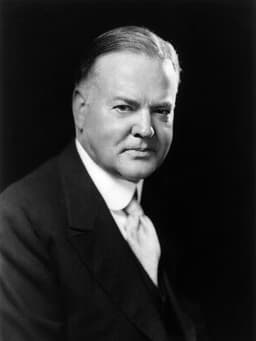
Herbert Hoover
Politician · Modern
53.8Total
Walter Lini
Politician · Modern
56.4Total
Basic Information
Born
1874
1942
Died
1964
—
Era
Modern
Modern
Nationality
United States
Vanuatu
Occupation
Politician
Politician
Civilization
Western
Other
Score Comparison
Military (10%)
49.1
42.3
Political (20%)
54.7
72.0
Influence (20%)
58.0
59.0
Legacy (20%)
49.2
50.0
Leadership (15%)
65.0
66.0
Strategy (15%)
41.8
41.7
TOTAL
53.8
56.4
Herbert Hoover — Complete Timeline
1928 AD
Election as President of the United StatesPolitical Action◆ Major
Hoover, a Republican, won the 1928 presidential election in a landslide against Democrat Al Smith. Hoover's reputation as a successful businessman and humanitarian, particularly for his relief work in Europe during and after World War I, contributed to his victory.
Presidential ElectionRepublican Party
Impact: national
1929 AD
Stock Market Crash of 1929Other
The Wall Street Crash of 1929 occurred in October, marking the beginning of the Great Depression. Hoover's response, including calls for voluntary cooperation and limited federal intervention, was widely criticized as inadequate, and the depression deepened.
Great DepressionEconomic Crisis
Impact: globaltragic
1930 AD
Signing of the Smoot-Hawley TariffPolitical Action◆ Major
Hoover signed the Smoot-Hawley Tariff, which raised tariffs on thousands of imported goods to record levels. The tariff sparked retaliatory measures from other countries, contributing to a collapse in international trade and worsening the Great Depression.
Tariff PolicyGreat Depression
Impact: globaldestructive
Walter Lini — Complete Timeline
1980 AD
Implemented Melanesian socialism policiesReform◆ Major
Lini's government pursued Melanesian socialism, nationalizing key industries and promoting land reform. These policies aimed to reduce foreign influence but faced economic challenges.
SocialismNationalization
Impact: nationalconstructive
Led Vanuatu to independencePolitical Action
Walter Lini, as leader of the Vanua'aku Pati, led the New Hebrides to independence from joint French-British colonial rule, becoming the first Prime Minister of Vanuatu.
IndependenceFounding Father
Impact: nationalprogressive
1988 AD
Survived a no-confidence motionPolitical Action
Lini faced a no-confidence motion in Parliament but survived, maintaining power. The motion reflected growing internal dissent within his party.
Political CrisisNo-confidence
Impact: national
Expert Analysis
Origins
Herbert Hoover was born on August 10, 1874, in West Branch, Iowa, to a Quaker family. Orphaned at age nine, he was raised by relatives and worked his way through Stanford University, graduating in 1895 with a degree in geology. He became a successful mining engineer and businessman, amassing a fortune through international mining ventures. His early career was marked by humanitarian work during World War I, organizing relief for Belgium and later serving as U.S. Food Administrator.
Walter Lini was born in 1942 on the island of Pentecost, New Hebrides (now Vanuatu), into an Anglican family. He studied at the University of the South Pacific in Fiji and later at the University of Papua New Guinea, where he earned a degree in law. Lini worked as a priest in the Anglican Church before entering politics. His formative experiences included exposure to colonial rule and the independence movements sweeping the Pacific.
Rise to Power
Hoover's rise was meteoric. After a successful career as a mining engineer, he gained fame for his humanitarian work during and after World War I. He served as U.S. Secretary of Commerce under Presidents Harding and Coolidge from 1921 to 1928, where he promoted efficiency and economic growth. In 1928, he won the presidency in a landslide, defeating Democrat Al Smith. His victory was built on his reputation as a capable manager and his promise of "a chicken in every pot and a car in every garage."
Lini rose through the ranks of the Vanua'aku Pati, a political party advocating for independence from joint French-British colonial rule. He became the party's leader in the 1970s. In 1979, he led the New Hebrides to self-government and then to full independence on July 30, 1980, becoming the first Prime Minister of Vanuatu. His rise was fueled by nationalist sentiment and his ability to unite diverse island communities.
Leadership & Governance
Hoover's leadership style was technocratic and hands-off. He believed in voluntary cooperation and limited government intervention. When the Great Depression struck after the 1929 stock market crash, he responded with measures like the Reconstruction Finance Corporation (1932) to support banks and businesses, but he resisted direct federal relief for individuals. His signing of the Smoot-Hawley Tariff in 1930, which raised tariffs to record levels, exacerbated global trade wars. Hoover's governance scored 65.0 in leadership but only 41.8 in strategy, reflecting his inability to adapt to the crisis.
Lini's governance was characterized by Melanesian socialism, which sought to blend traditional communal values with socialist economic policies. He nationalized key industries, including the coconut plantation and banking sectors, and implemented land reforms to return land to indigenous people. His government also pursued a non-aligned foreign policy, establishing relations with countries like Cuba and Libya. Lini's leadership score is 66.0, slightly above Hoover's, but his strategic score of 41.7 is nearly identical, indicating similar challenges in implementing long-term plans.
Triumph & Tragedy
Hoover's greatest triumph was his humanitarian work before his presidency, including organizing relief for millions in Europe during and after World War I. As Secretary of Commerce, he modernized the department and promoted aviation and radio. However, his presidency is marked by the tragedy of the Great Depression. His failure to effectively address the economic collapse led to widespread suffering and his landslide defeat in 1932. Hoover's legacy score of 49.2 reflects this mixed record.
Lini's triumph is leading Vanuatu to independence, a monumental achievement for a small island nation. He also successfully navigated the early years of nation-building, including suppressing a secessionist rebellion on Santo Island in 1980 with the help of Papua New Guinea and Australian forces. However, his later years were marred by internal dissent, a no-confidence motion he survived in 1987, and economic difficulties under his socialist policies. Lini's legacy score of 50.0 is marginally higher than Hoover's.
Character & Destiny
Hoover was a stoic, principled individual who believed in self-reliance and scientific management. His Quaker upbringing instilled a sense of duty but also a resistance to government handouts. This character led him to underestimate the severity of the Depression and to reject direct relief, which ultimately doomed his presidency. Historians often describe him as a capable humanitarian who was out of his depth as a crisis manager.
Lini was a charismatic and determined leader, driven by a vision of independence and self-determination. His Anglican priesthood background gave him moral authority, but his inflexibility on socialist policies and his tendency to centralize power led to factionalism within his party. He stepped down in 1991 after losing a confidence vote, marking the end of his political dominance. Both men were shaped by their convictions, which proved both strengths and weaknesses.
Legacy
Hoover's legacy is overshadowed by the Great Depression, but his humanitarian work and the Hoover Institution on War, Revolution and Peace at Stanford remain enduring contributions. The Smoot-Hawley Tariff is remembered as a cautionary tale in trade policy. His presidency set the stage for the New Deal, though he opposed it. Hoover's influence score is 58.0, reflecting his long-term impact on American governance and international relief.
Lini's legacy is as the father of Vanuatu's independence. He established the political framework for the nation and promoted a distinct Melanesian identity. However, his socialist policies had mixed results; some nationalized industries later struggled. Vanuatu remains a stable democracy, and Lini is commemorated with a national holiday, Independence Day. His influence score of 59.0 edges out Hoover's.
Conclusion
While both leaders faced significant challenges, Walter Lini had a greater impact relative to his context. Lini's total score of 56.4 surpasses Hoover's 53.8, driven by higher political skill (72.0 vs 54.7) and influence (59.0 vs 58.0). Hoover's presidency was a failure in crisis management, while Lini successfully founded a nation. Hoover's humanitarian achievements are notable, but Lini's role in ending colonial rule and building a new state constitutes a more transformative legacy. Thus, Walter Lini emerges as the more effective leader in achieving his core objectives.
Rankings
🥇
Walter LiniLeader
Mil: 42.3Pol: 72.0Inf: 59.0
56.4
🥈
Herbert Hoover
Mil: 49.1Pol: 54.7Inf: 58.0
53.8
+2.6 behind
How This Comparison Works
Algorithm
Each figure is scored on 6 dimensions (0—100 scale) based on structured historical data: Military (10%), Political (20%), Influence (20%), Legacy (20%), Leadership (15%), Strategy (15%). The weighted total produces the final ranking.
Data Sources
Scores are computed from structured sub-indicators in the database. Scale factors adjust for era (Ancient ×0.85, Modern ×1.0) and civilization size (Eastern ×1.05, Other ×0.80) to account for differences in population and military scale.
Maximum 3 Figures
Comparisons are limited to 2—3 figures to ensure readability and statistical meaningfulness.
Error Margins
±5 points per dimension — Sub-scores are derived from historical records with inherent uncertainty. Two figures within 5 points on a dimension should be considered roughly equivalent in that area.
Total Score Accuracy
±3 points overall — The weighted combination of 6 dimensions produces a total score with approximately ±3 points of uncertainty. Differences of less than 3 points are not statistically significant— the figures are effectively tied.
Known Limitations
- Historical records are incomplete and uneven across civilizations
- Figures from oral-tradition societies may be underrepresented
- Occupation labels can misclassify multi-role figures
- Scores measure capability and impact, not moral character
- Quantitative scoring is a comparison tool, not absolute truth
Capability Radar
Military (10%) — Battles & Warfare
Battles
30
21
Win Rate
29
23
Expansion
38
29
Political (20%) — Governance & Reform
Reform
30
70
Diplomacy
55
75
Economy
40
45
Influence (20%) — Cultural & Global Reach
Cultural
30
50
Global
50
35
Legacy (20%) — Historical Impact
Historical
55
55
Longevity
40
40
Leadership (15%) — Power & Stability
Tenure
60
60
Stability
20
55
Strategy (15%) — Tactics & Innovation
Strategy
36
31
Tactics
40
35
Reform
44
36
Similar Comparisons
Comments & Discussion
No comments yet. Be the first to share your thoughts!