Loading...
Hiempsal II of Numidia vs Napoleon Bonaparte
Napoleon Bonaparte leads by 37.5 pts · 2 figures compared
…
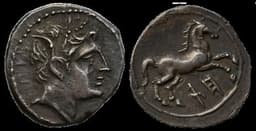
Hiempsal II of Numidia
Emperor · Ancient
33.4Total

Napoleon Bonaparte
General · Modern
70.9Total
Basic Information
Born
-100
1769
Died
-60
1821
Era
Ancient
Modern
Nationality
Numidia
France
Occupation
Emperor
General
Civilization
Other
Western
Score Comparison
Military (10%)
10.2
94.0
Political (20%)
26.4
72.0
Influence (20%)
42.4
40.0
Legacy (20%)
32.5
80.0
Leadership (15%)
34.6
78.0
Strategy (15%)
45.0
90.0
TOTAL
33.4
70.9
Hiempsal II of Numidia — Complete Timeline
81 BC
Restoration as King of NumidiaPolitical Action◆ Major
After the Jugurthine War, the Roman general Sulla restored Hiempsal II to the Numidian throne. This restoration made Hiempsal a Roman client king, securing Roman influence over Numidia.
Roman Client KingdomNumidiaSulla
Impact: regionalconstructive
Napoleon Bonaparte — Complete Timeline
1799 AD
Coup of 18 BrumaireOther◆ Major
Napoleon Bonaparte, with support from his brother Lucien and key political figures, overthrew the Directory in a bloodless coup. He established the Consulate with himself as First Consul, effectively becoming the ruler of France. This event ended the French Revolution's most unstable period.
French RevolutionCoupRise to Power
Impact: regional
1804 AD
Promulgation of the Napoleonic CodeOther◆ Major
Napoleon enacted the Civil Code of the French, known as the Napoleonic Code, a comprehensive set of laws that replaced the fragmented feudal legal systems. The code established legal equality, protected property rights, and secularized law. It became the basis for legal systems in many European and world countries.
Legal ReformNapoleonic CodeCivil Law
Impact: globalconstructive
1805 AD
Battle of AusterlitzWar◆ Major
Napoleon's Grande Arm
Napoleonic WarsBattleDecisive Victory
Impact: global
1812 AD
Invasion of RussiaWar◆ Major
Napoleon led the Grande Arm
Napoleonic WarsInvasionDisaster
Impact: globaldestructive
1815 AD
Battle of WaterlooWar◆ Major
Napoleon's French army was defeated by the combined forces of the Duke of Wellington's Anglo-Allied army and Gebhard Leberecht von Bl
Napoleonic WarsBattleFinal Defeat
Impact: globaldestructive
Expert Analysis
hiempsal-ii-of-numidia-vs-napoleon-bonaparte
# The Emperor and the Client King
On a December morning in 1805, Napoleon Bonaparte stood on a hill overlooking the frozen battlefield of Austerlitz, watching his Grand Army crush the combined forces of Russia and Austria. Twenty-three years earlier, on the dusty plains of North Africa, another ruler had watched Roman legions march into his capital, knowing his crown depended entirely on their favor. Between these two moments lies the vast gulf that separates a man who reshaped the world from one who was reshaped by it. How did two rulers, both anointed by ambition and circumstance, end up on such different paths?
Origins
Napoleon was born in 1769 on the island of Corsica, a place that had only recently become French territory. His family belonged to the minor nobility, but they were neither wealthy nor powerful. From his earliest days, he absorbed the tensions of a conquered people, and this gave him a restless, almost hungry quality—a sense that the world owed him something he would have to take. The French Revolution, which erupted when he was twenty, tore down the old order and created a ladder for talent. Napoleon climbed it.
Hiempsal II of Numidia, born around 100 BC, inherited a different world. Numidia was a client kingdom of Rome, a buffer state between the Roman Republic and the chaos of North Africa. His family had learned the hard lesson of the Jugurthine War: that Rome’s patience was finite and its power absolute. Hiempsal grew up not with hunger but with caution, understanding that survival meant knowing one’s place. His world had no revolution to climb, only a master to please.
Rise to Power
Napoleon’s ascent was meteoric. In 1793, at age twenty-four, he drove British forces from Toulon and was promoted to brigadier general. By 1796, he commanded the Army of Italy, where his lightning campaigns stunned Europe. He was thirty years old when he became First Consul of France in 1799, and thirty-five when he crowned himself Emperor. Each step was taken at the point of a sword, and each victory made him more indispensable.
Hiempsal’s rise was quieter and far more precarious. He was restored to the Numidian throne in 81 BC by the Roman general Sulla, after the chaos of the Jugurthine War had left his family in exile. He did not conquer his kingdom; he received it as a gift from a foreign power. His authority came not from his own military prowess but from the legions that had placed him there. Where Napoleon seized his moment, Hiempsal accepted his.
Leadership & Governance
As emperor, Napoleon was a whirlwind of reform. He centralized the French government, created the Bank of France, and most famously, codified French law into the Napoleonic Code—a system that spread across Europe and still influences legal thinking today. His military campaigns were masterpieces of speed, logistics, and decisive battle. At Austerlitz in 1805, he destroyed a larger enemy army by feigning weakness and then striking at its center. His political wisdom, however, was flawed: he placed family members on thrones across Europe, believing loyalty could be inherited, and he underestimated the resilience of his enemies.
Hiempsal ruled as a Roman client, and his governance reflected that reality. He maintained order in Numidia, collected taxes, and likely kept trade routes secure—all under the watchful eye of Rome. His military score of 39.0 and political score of 36.4 suggest a ruler who was competent but not exceptional. He had no Napoleonic Code, no grand reforms, no epic battles. His strategy score of 57.9 hints at some native cunning, but it was the cunning of a survivor, not a conqueror. He governed not to change the world but to keep his place in it.
Triumph & Tragedy
Napoleon’s greatest triumph was his empire at its height in 1810, stretching from Spain to the borders of Russia. His greatest tragedy was the invasion of Russia in 1812, where he lost over 400,000 men to the winter and the scorched-earth tactics of the Tsar. He was exiled to Elba in 1814, returned to power for a Hundred Days, and was finally defeated at Waterloo in 1815. His end was lonely, imprisoned on the remote island of Saint Helena, where he died in 1821 at age fifty-one.
Hiempsal’s triumphs and tragedies are harder to measure. His restoration in 81 BC was a victory of sorts—he got his throne back. But his tragedy was the tragedy of all client kings: he was never truly his own master. He died around 60 BC, probably of natural causes, and his kingdom was eventually absorbed into the Roman province of Africa. He left no Waterloo, no exile, no epic fall—only the quiet disappearance of a man who had never been allowed to rise too high.
Character & Destiny
Napoleon was driven by an almost supernatural self-belief. “Impossible is a word to be found only in the dictionary of fools,” he once said. That confidence allowed him to achieve the impossible, but it also blinded him to his limits. He could not stop, could not compromise, could not accept that even he could be beaten. His character was his destiny: restless ambition that built an empire and then destroyed it.
Hiempsal’s character was shaped by dependence. He knew that Rome gave and Rome could take away. His leadership score of 32.6 reflects a man who led not by inspiring loyalty but by managing submission. He was cautious, pragmatic, and ultimately forgettable—not because he lacked ability, but because his world allowed him no room to be otherwise.
Legacy
Napoleon’s legacy is immense. The Napoleonic Code, the modern French state, the concept of meritocracy, and the very shape of nineteenth-century Europe all bear his mark. He is remembered as a military genius, a reformer, and a cautionary tale about the dangers of unchecked ambition. His total score of 82.4 reflects a figure who changed history.
Hiempsal II is barely remembered. His total score of 44.6 places him among the minor figures of history. He is a footnote in Roman history, a name in a list of client kings. His legacy is not a code or an empire but a lesson: that some rulers are not the architects of their fate, but the tenants of it.
Conclusion
Standing at Austerlitz, Napoleon could see the future in his hands. Standing in his palace, Hiempsal could only see the shadows of Rome. The difference between them was not simply talent or ambition—it was opportunity. The French Revolution shattered an old world and let a Corsican artillery officer remake it. The Roman Republic, with its iron grip on the Mediterranean, left no such cracks for a Numidian king to slip through. Napoleon’s story is one of will; Hiempsal’s is one of circumstance. And perhaps that is the deepest lesson of all: history does not just make great men—it decides who gets to be great at all.
Rankings
🥇
Napoleon BonaparteLeader
Mil: 94.0Pol: 72.0Inf: 40.0
70.9
🥈
Hiempsal II of Numidia
Mil: 10.2Pol: 26.4Inf: 42.4
33.4
+37.5 behind
How This Comparison Works
Algorithm
Each figure is scored on 6 dimensions (0—100 scale) based on structured historical data: Military (10%), Political (20%), Influence (20%), Legacy (20%), Leadership (15%), Strategy (15%). The weighted total produces the final ranking.
Data Sources
Scores are computed from structured sub-indicators in the database. Scale factors adjust for era (Ancient ×0.85, Modern ×1.0) and civilization size (Eastern ×1.05, Other ×0.80) to account for differences in population and military scale.
Maximum 3 Figures
Comparisons are limited to 2—3 figures to ensure readability and statistical meaningfulness.
Error Margins
±5 points per dimension — Sub-scores are derived from historical records with inherent uncertainty. Two figures within 5 points on a dimension should be considered roughly equivalent in that area.
Total Score Accuracy
±3 points overall — The weighted combination of 6 dimensions produces a total score with approximately ±3 points of uncertainty. Differences of less than 3 points are not statistically significant— the figures are effectively tied.
Known Limitations
- Historical records are incomplete and uneven across civilizations
- Figures from oral-tradition societies may be underrepresented
- Occupation labels can misclassify multi-role figures
- Scores measure capability and impact, not moral character
- Quantitative scoring is a comparison tool, not absolute truth
Capability Radar
Military (10%) — Battles & Warfare
Battles
5
95
Win Rate
5
90
Expansion
5
95
Political (20%) — Governance & Reform
Reform
10
95
Diplomacy
30
80
Economy
10
85
Influence (20%) — Cultural & Global Reach
Cultural
5
85
Global
5
90
Legacy (20%) — Historical Impact
Historical
10
95
Longevity
5
90
Leadership (15%) — Power & Stability
Tenure
30
85
Stability
10
70
Strategy (15%) — Tactics & Innovation
Strategy
5
95
Tactics
5
98
Reform
5
92
Similar Comparisons
Comments & Discussion
AusterlitzArchitect6/17/2026
Napoleon’s 1805 victory at Austerlitz wasn’t just luck—it was the result of a brilliant deception, faking a weak right flank to lure the Allies into a trap. Hiempsal II, by contrast, clung to Rome’s favor like a leaky lifeboat. You can’t compare a man who reshaped Europe’s map to a client king who’d be forgotten if not for some obscure coinage. One is a masterclass in strategy; the other, a footnote in imperial overhead. Give me the Emperor any day.
NumidianSkeptic6/17/2026
Sorry, but this comparison is a joke—like pitting a chess grandmaster against a kid playing checkers. Hiempsal II ruled a Roman puppet state, where “ambition” meant not getting crushed by the Senate’s next tax hike. Napoleon commanded 600,000 men and rewrote European law. Let’s be real: Hiempsal’s biggest problem was probably water rights in the Sahara. The only thing these two share is a throne, and even that’s a stretch. Apples and oranges, folks.
古典学笔客6/17/2026
拿皇是革命沙场上杀出的枭雄,高卢之鹰振翅便搅翻欧洲;而希姆普萨尔二世不过是北非王座上的‘罗马镶边’,连他那小国的边界都要靠元老院的怜悯来画。读读萨路斯特笔下的朱古达战争吧,努米底亚王室从不是主角,只是罗马棋局上的卒子。拿战改变了世界格局,希姆普萨尔呢?他连一场像样的叛乱都没留下。称两者为‘君主’已是最大宽容。
海内存知己6/17/2026
别被野心叙事忽悠了。拿破仑用滑铁卢证明了天才也会翻车,而希姆普萨尔二世至少把王国传给了儿子,活过复杂的罗马政治风暴——这需要天赋?不,是生存智慧。分析里说拿皇‘重塑世界’,但1815年后他的帝国灰飞烟灭;Numidia却撑到了公元前46年凯撒才把它吞并。谁更持久?别只盯着华丽的战役,看看谁的王座坐得稳。
重读历史人6/17/2026
拿皇与希姆普萨尔,一个是史诗里的暴风,一个是大漠里的沙粒。但别小看沙粒——努米底亚的骑兵战术曾让罗马军团头疼不已,而希姆普萨尔二世有能力稳住附庸地位,不被罗马撕碎,这本身就是一种政治艺术。拿破仑挥霍天赋点燃了欧洲,而这位北非王默默守护了王国数十年。谁说伟大只有一种模样?历史不是排行榜,位置不同,打法自然不同。