Loading...
This comparison has not been analyzed yet.
One-time AI generation (~1 minute). Scores and timeline are already available below.
Hosokawa Tadaoki vs Sun Li-jen
Hosokawa Tadaoki leads by 1.2 pts · 2 figures compared
…

Hosokawa Tadaoki
General · Modern
58.0Total
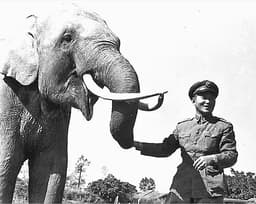
Sun Li-jen
General · Modern
56.8Total
Basic Information
Born
1563
1900
Died
1646
1990
Era
Modern
Modern
Nationality
Japan
China
Occupation
General
General
Civilization
Eastern
Eastern
Score Comparison
Military (10%)
50.0
70.0
Political (20%)
68.0
40.8
Influence (20%)
53.3
61.0
Legacy (20%)
45.8
50.0
Leadership (15%)
80.0
61.1
Strategy (15%)
60.0
67.2
TOTAL
58.0
56.8
Hosokawa Tadaoki — Complete Timeline
1578 AD
Marriage to Hosokawa GraciaOther
Hosokawa Tadaoki married Hosokawa Gracia, a Christian convert. Their marriage was notable for Gracia's faith and her eventual death during the Siege of Tanabe in 1600.
MarriageChristianityGracia
Impact: national
1600 AD
Battle of SekigaharaWar◆ Major
Hosokawa Tadaoki fought for Tokugawa Ieyasu's Eastern Army. He commanded a contingent and played a role in the victory, later being rewarded with a domain in Buzen Province.
SekigaharaEastern ArmyTokugawa
Impact: national
1614 AD
Siege of OsakaWar◆ Major
Hosokawa Tadaoki served the Tokugawa shogunate during the siege of Osaka Castle. He commanded troops and contributed to the defeat of the Toyotomi forces.
OsakaTokugawaSiege
Impact: national
Sun Li-jen — Complete Timeline
1927 AD
Graduated from Virginia Military InstituteCultural
Sun Li-jen graduated from the Virginia Military Institute (VMI) in the United States. His American military education influenced his tactical approach and distinguished him among Chinese commanders.
EducationMilitary Training
Impact: national
1942 AD
Commanded the Chinese Expeditionary Force in BurmaWar◆ Major
Sun Li-jen commanded the 38th Division of the Chinese Expeditionary Force in Burma. He led his troops to victory at the Battle of Yenangyaung, rescuing trapped British forces and earning the nickname 'Rommel of the East.'
World War IIBurma CampaignAllied Cooperation
Impact: regionalconstructive
1944 AD
Commander of the New First ArmyPolitical Action◆ Major
Sun Li-jen was appointed commander of the New First Army, one of the best-equipped Nationalist units. He led the army in the Burma Campaign and later in the Chinese Civil War.
Military CommandWorld War II
Impact: regional
1955 AD
Arrested and Imprisoned by Chiang Kai-shekPolitical Action◆ Major
Sun Li-jen was arrested by Chiang Kai-shek on charges of conspiracy with the United States to stage a coup. He was placed under house arrest for 33 years, ending his military career and becoming a symbol of Nationalist repression.
Political RepressionTaiwanHouse Arrest
Impact: nationaltragic
This comparison has not been analyzed yet.
One-time AI generation (~1 minute). Scores and timeline are already available below.
Rankings
🥇
Hosokawa TadaokiLeader
Mil: 50.0Pol: 68.0Inf: 53.3
58.0
🥈
Sun Li-jen
Mil: 70.0Pol: 40.8Inf: 61.0
56.8
+1.2 behind
How This Comparison Works
Algorithm
Each figure is scored on 6 dimensions (0—100 scale) based on structured historical data: Military (10%), Political (20%), Influence (20%), Legacy (20%), Leadership (15%), Strategy (15%). The weighted total produces the final ranking.
Data Sources
Scores are computed from structured sub-indicators in the database. Scale factors adjust for era (Ancient ×0.85, Modern ×1.0) and civilization size (Eastern ×1.05, Other ×0.80) to account for differences in population and military scale.
Maximum 3 Figures
Comparisons are limited to 2—3 figures to ensure readability and statistical meaningfulness.
Error Margins
±5 points per dimension — Sub-scores are derived from historical records with inherent uncertainty. Two figures within 5 points on a dimension should be considered roughly equivalent in that area.
Total Score Accuracy
±3 points overall — The weighted combination of 6 dimensions produces a total score with approximately ±3 points of uncertainty. Differences of less than 3 points are not statistically significant— the figures are effectively tied.
Known Limitations
- Historical records are incomplete and uneven across civilizations
- Figures from oral-tradition societies may be underrepresented
- Occupation labels can misclassify multi-role figures
- Scores measure capability and impact, not moral character
- Quantitative scoring is a comparison tool, not absolute truth
Capability Radar
Military (10%) — Battles & Warfare
Battles
45
75
Win Rate
50
70
Expansion
35
30
Political (20%) — Governance & Reform
Reform
35
25
Diplomacy
45
35
Economy
40
20
Influence (20%) — Cultural & Global Reach
Cultural
30
45
Global
20
50
Legacy (20%) — Historical Impact
Historical
35
55
Longevity
30
40
Leadership (15%) — Power & Stability
Tenure
50
40
Stability
45
25
Strategy (15%) — Tactics & Innovation
Strategy
50
75
Tactics
55
85
Reform
30
60
Similar Comparisons
Comments & Discussion
No comments yet. Be the first to share your thoughts!