Loading...
Hugo Chavez vs Napoleon Bonaparte
Napoleon Bonaparte leads by 20.0 pts · 2 figures compared
…
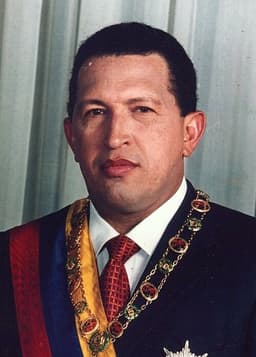
Hugo Chavez
Politician · Modern
50.9Total

Napoleon Bonaparte
General · Modern
70.9Total
Basic Information
Born
1954
1769
Died
—
1821
Era
Modern
Modern
Nationality
Venezuela
France
Occupation
Politician
General
Civilization
Western
Western
Score Comparison
Military (10%)
10.0
94.0
Political (20%)
62.7
72.0
Influence (20%)
56.7
40.0
Legacy (20%)
49.2
80.0
Leadership (15%)
68.0
78.0
Strategy (15%)
38.3
90.0
TOTAL
50.9
70.9
Hugo Chavez — Complete Timeline
1992 AD
Failed 1992 coup attemptPolitical Action◆ Major
Chávez, then a lieutenant colonel, led a failed military coup against President Carlos Andrés Pérez. The coup was crushed, and Chávez was imprisoned. His televised speech accepting responsibility made him a national figure and martyr for the poor.
CoupImprisonmentPolitical Rise
Impact: national
1998 AD
Election as President of VenezuelaPolitical Action
Chávez won the presidential election with 56% of the vote, running on a platform of anti-corruption and social justice. His victory marked the beginning of the Bolivarian Revolution, a leftist movement aimed at transforming Venezuela's political and economic system.
ElectionBolivarian RevolutionPopulism
Impact: nationalconstructive
2001 AD
Nationalization of oil industryReform◆ Major
Chávez enacted a new Hydrocarbons Law that increased state control over the oil industry, raising royalties and taxes on foreign companies. He also reasserted control over PDVSA, the state oil company, using oil revenues to fund social programs.
NationalizationOilEconomic Policy
Impact: nationalconstructive
2002 AD
2002 coup attempt and return to powerPolitical Action◆ Major
Chávez was briefly overthrown in a coup led by business and military sectors, but was restored to power after 47 hours due to mass protests and loyalist military units. The coup attempt deepened political polarization in Venezuela.
CoupPolitical CrisisReturn
Impact: national
2004 AD
Creation of the Bolivarian Alliance for the Americas (ALBA)Political Action◆ Major
Chávez founded ALBA as an alternative to the Free Trade Area of the Americas, promoting regional integration based on solidarity, barter, and social welfare. The alliance included Cuba, Bolivia, and other leftist governments in Latin America.
Regional IntegrationSocialismAnti-imperialism
Impact: regionalconstructive
Napoleon Bonaparte — Complete Timeline
1799 AD
Coup of 18 BrumaireOther◆ Major
Napoleon Bonaparte, with support from his brother Lucien and key political figures, overthrew the Directory in a bloodless coup. He established the Consulate with himself as First Consul, effectively becoming the ruler of France. This event ended the French Revolution's most unstable period.
French RevolutionCoupRise to Power
Impact: regional
1804 AD
Promulgation of the Napoleonic CodeOther◆ Major
Napoleon enacted the Civil Code of the French, known as the Napoleonic Code, a comprehensive set of laws that replaced the fragmented feudal legal systems. The code established legal equality, protected property rights, and secularized law. It became the basis for legal systems in many European and world countries.
Legal ReformNapoleonic CodeCivil Law
Impact: globalconstructive
1805 AD
Battle of AusterlitzWar◆ Major
Napoleon's Grande Arm
Napoleonic WarsBattleDecisive Victory
Impact: global
1812 AD
Invasion of RussiaWar◆ Major
Napoleon led the Grande Arm
Napoleonic WarsInvasionDisaster
Impact: globaldestructive
1815 AD
Battle of WaterlooWar◆ Major
Napoleon's French army was defeated by the combined forces of the Duke of Wellington's Anglo-Allied army and Gebhard Leberecht von Bl
Napoleonic WarsBattleFinal Defeat
Impact: globaldestructive
Expert Analysis
hugo-chavez-vs-napoleon-bonaparte
# The Emperor and the Revolutionary: Napoleon and Chávez, Two Paths to Power
On a December morning in 1804, Notre-Dame Cathedral witnessed a scene that would shock Europe. Napoleon Bonaparte, the short Corsican who had risen from obscurity, snatched the imperial crown from Pope Pius VII’s hands and placed it on his own head. Two centuries later, in the sweltering heat of Caracas, another man in military uniform stood before a microphone on a bullet-riddled balcony, having just been restored to power after a coup that lasted forty-seven hours. Hugo Chávez wept openly, then declared: “I will never betray the people.” Both men seized history by the throat. But where Napoleon conquered a continent, Chávez conquered only his own country. The difference tells us everything about the nature of ambition, the weight of circumstance, and the limits of will.
Origins
Napoleon was born in 1769 on Corsica, an island that had been French for barely a year. His family was minor nobility, poor but proud. He spoke French with a thick Italian accent, and his schoolmates mocked him. That humiliation burned. He devoured military history, studied artillery, and emerged from the École Militaire in Paris at sixteen, a second lieutenant who already believed he was destined for greatness. France in the 1790s was a revolutionary furnace—the old order had collapsed, the king was dead, and every ambitious young man saw an open road.
Hugo Chávez was born in 1954 in Sabaneta, a dusty cattle town in the Venezuelan plains. His parents were schoolteachers, poor enough that he lived with his grandmother for a time. He played baseball, painted, and dreamed of becoming a priest. Instead, he entered the military academy at seventeen, where he absorbed leftist ideas smuggled in books alongside his training. Venezuela in the 1970s was a stable democracy, but it was a democracy built on oil wealth that enriched a few while leaving millions in dirt-floor shacks. Chávez saw the corruption firsthand. He began to believe that only a revolution could cleanse the nation.
The key difference was timing. Napoleon was born into chaos and learned to ride the storm. Chávez was born into stagnation and learned to hate the calm.
Rise to Power
Napoleon’s ascent was meteoric. At twenty-four, he drove the British out of Toulon. At twenty-six, he saved the revolutionary government from a royalist uprising with a “whiff of grapeshot.” At twenty-seven, he was given command of the Army of Italy—and he conquered it in weeks. He crossed the Alps, won the Battle of Marengo, and by 1804, at thirty-five, he was Emperor of the French. Each victory fed the next. His strategy was simple: move fast, strike hard, and never let the enemy recover.
Chávez’s rise was slower and more dangerous. In 1992, as a lieutenant colonel, he led a coup against President Carlos Andrés Pérez. It failed. He was captured, and on national television, he was allowed a brief speech. He said only that his movement had “failed for now”—but that phrase, “for now,” became a legend. He spent two years in prison, then emerged, not defeated but reborn. He ran for president in 1998 and won with 56 percent of the vote. Where Napoleon took power by the sword, Chávez took it by the ballot. But both understood that legitimacy was a weapon.
Leadership & Governance
Napoleon governed as he fought: with total control and relentless energy. He centralized the French state, created the Bank of France, and most importantly, drafted the Napoleonic Code—a legal system that enshrined equality before the law, property rights, and secular governance. It was a revolutionary document, and it spread across Europe wherever his armies marched. He built roads, founded schools, and reformed education. But he also censored the press, exiled critics, and crowned himself emperor. He believed that order was the highest virtue, and that he alone could provide it.
Chávez governed differently. He called it “Bolivarian socialism,” named after Simón Bolívar, the liberator of South America. He nationalized the oil industry in 2001, raising royalties and taxes to fund social programs. He created the Bolivarian Alliance for the Americas (ALBA) in 2004 as a counterweight to U.S. influence. He built clinics, schools, and subsidized grocery stores for the poor. But he also shut down opposition television stations, packed the Supreme Court, and rewrote the constitution to allow indefinite re-election. Where Napoleon imposed order, Chávez imposed loyalty.
The difference reflects their worlds. Napoleon ruled a continent of 70 million people, with a professional bureaucracy and a standing army. Chávez ruled a nation of 25 million, dependent on oil prices and popular adoration. Napoleon’s power was institutional; Chávez’s was personal.
Triumph & Tragedy
Napoleon’s greatest moment was Austerlitz in 1805, where he crushed the combined armies of Russia and Austria with a feigned retreat that became a military masterpiece. His worst was the invasion of Russia in 1812—a disaster of hubris, logistics, and winter that cost half a million men. He was exiled to Elba, escaped, ruled for a hundred days, and was finally defeated at Waterloo in 1815. The tragedy was not his fall, but that he could not stop. He once said, “Power is my mistress. I have worked too hard to conquer her to let anyone take her from me.”
Chávez’s greatest moment was his return to power in 2002, after the coup that lasted forty-seven hours. The streets of Caracas filled with his supporters, the military split, and he was flown back to the presidential palace. He turned that crisis into a mandate. His worst moment was the slow decay that followed: inflation, crime, and oil prices that collapsed after 2014. He died in 2013 of cancer, leaving behind a country in crisis. The tragedy was not his death, but that his revolution could not survive him.
Character & Destiny
Napoleon was a man of iron will and boundless ambition. He slept four hours a night, dictated multiple letters at once, and believed he could bend reality to his plans. His personality drove him to conquer, but it also drove him to overreach. He could not share power. He could not stop.
Chávez was a man of charisma and emotion. He wept on television, hugged his supporters, and spoke for hours in rambling speeches. He was a performer, and his performance created a bond with millions. But that bond was personal, not institutional. When he died, there was no clear successor, no party structure, no system that could function without him.
Napoleon’s destiny was to be the last great conqueror of Europe. Chávez’s destiny was to be the first great populist of the twenty-first century. Both changed history, but in opposite directions.
Legacy
Napoleon left a legal code, a myth, and a map of Europe that still bears his mark. He is remembered as a genius and a tyrant, a liberator and a despot. His legacy is debated in every history department, but it is undeniable.
Chávez left a divided country, a broken economy, and a movement that still carries his name. He is remembered as a hero by the poor and a villain by the rich. His legacy is still being written, and the ink is not dry.
Conclusion
Standing in the rain at Les Invalides in Paris, you can see Napoleon’s tomb—a massive sarcophagus of red porphyry, surrounded by the flags of his victories. Standing in the barrios of Caracas, you can see murals of Chávez’s face, fading in the tropical sun. Both men believed they could change the world. One did, and the other tried. But perhaps the real lesson is that power is not a destination. It is a journey, and the road is always steeper than it appears.
Rankings
🥇
Napoleon BonaparteLeader
Mil: 94.0Pol: 72.0Inf: 40.0
70.9
🥈
Hugo Chavez
Mil: 10.0Pol: 62.7Inf: 56.7
50.9
+20.0 behind
How This Comparison Works
Algorithm
Each figure is scored on 6 dimensions (0—100 scale) based on structured historical data: Military (10%), Political (20%), Influence (20%), Legacy (20%), Leadership (15%), Strategy (15%). The weighted total produces the final ranking.
Data Sources
Scores are computed from structured sub-indicators in the database. Scale factors adjust for era (Ancient ×0.85, Modern ×1.0) and civilization size (Eastern ×1.05, Other ×0.80) to account for differences in population and military scale.
Maximum 3 Figures
Comparisons are limited to 2—3 figures to ensure readability and statistical meaningfulness.
Error Margins
±5 points per dimension — Sub-scores are derived from historical records with inherent uncertainty. Two figures within 5 points on a dimension should be considered roughly equivalent in that area.
Total Score Accuracy
±3 points overall — The weighted combination of 6 dimensions produces a total score with approximately ±3 points of uncertainty. Differences of less than 3 points are not statistically significant— the figures are effectively tied.
Known Limitations
- Historical records are incomplete and uneven across civilizations
- Figures from oral-tradition societies may be underrepresented
- Occupation labels can misclassify multi-role figures
- Scores measure capability and impact, not moral character
- Quantitative scoring is a comparison tool, not absolute truth
Capability Radar
Military (10%) — Battles & Warfare
Battles
0
95
Win Rate
0
90
Expansion
0
95
Political (20%) — Governance & Reform
Reform
70
95
Diplomacy
60
80
Economy
40
85
Influence (20%) — Cultural & Global Reach
Cultural
60
85
Global
55
90
Legacy (20%) — Historical Impact
Historical
55
95
Longevity
40
90
Leadership (15%) — Power & Stability
Tenure
75
85
Stability
30
70
Strategy (15%) — Tactics & Innovation
Strategy
0
95
Tactics
0
98
Reform
10
92
Similar Comparisons
Comments & Discussion
MilitarySkeptic6/17/2026
Calling Chávez a "failure" because he didn't invade Moscow is stupid. Napoleon's military "genius" gave us Austerlitz and Borodino, fine—but also exile twice. Chávez held power for 14 years against internal coups and external pressure. That's not a continent, sure, but it’s a hell of a lot more stable than the Hundred Days. Smaller stage, bigger finish.
NapoleonConquest6/17/2026
Napoleon’s “genius” is overrated. His 1812 Russian campaign alone—600,000 men lost to weather, logistics, and stubborn resistance—proves he was a glory-chaser, not a master strategist. Chávez at least knew his limits: he never invaded Argentina. Give me a leader who builds schools over one who builds monuments to his own ego any day.
历史拆台者6/17/2026
拿过皇冠的手,没一个干净的。拿破仑偷了教皇的冠冕,查韦斯偷了人民的选票——就凭他2002年政变后那场“胜利”,跟拿破仑从厄尔巴岛跑回巴黎有啥区别?两人都是玩权力的戏子,只不过一个在巴黎圣母院庆功,一个在阳台上哭。别美化他们,历史从来都是赢家写的剧本。
ClassicsSculptor6/17/2026
Napoleon’s self-coronation wasn’t audacity—it was insecurity. He needed to steal the magic from the Church because his own legitimacy was hollow. Compare that to Chávez, who drew power from the people and wept with them. One built a European dynasty; the other tried to forge a Bolivarian soul. I’d take the balcony over the altar any century.
历史冷静眼6/17/2026
数据不会撒谎:拿破仑的战争害死了超过300万欧洲人,GDP缩水持续十年。查韦斯的委内瑞拉呢?石油收入翻了五倍,贫困率从49%降到27%。别拿拿破仑的骑兵炫耀,拿数字说话。谁更成功?一个留住了国界,一个留住了饭碗——答案写在历史账本上,不在教科书里。