Loading...
Humayun vs Isabella II of Spain
Humayun leads by 3.1 pts · 2 figures compared
…

Humayun
Emperor · Modern
49.6Total
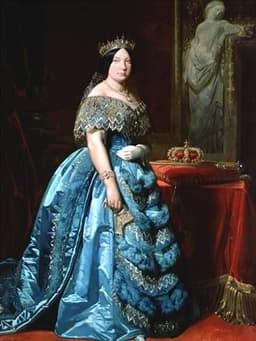
Isabella II of Spain
Emperor · Modern
46.5Total
Basic Information
Born
1508
1830
Died
1556
1904
Era
Modern
Modern
Nationality
Mughal Empire
Spain
Occupation
Emperor
Emperor
Civilization
Indian
Western
Score Comparison
Military (10%)
45.0
24.4
Political (20%)
36.5
35.1
Influence (20%)
58.0
51.0
Legacy (20%)
50.0
41.7
Leadership (15%)
55.3
65.7
Strategy (15%)
43.3
57.8
TOTAL
49.6
46.5
Humayun — Complete Timeline
1539 AD
Battle of ChausaWar◆ Major
Humayun's army was defeated by the Afghan ruler Sher Shah Suri at Chausa in Bihar. Humayun barely escaped with his life, reportedly crossing the Ganges River on a water skin. This defeat led to the loss of Mughal control over Bengal and Bihar, weakening Humayun's position.
BattleDefeatSher Shah Suri
Impact: regionaltragic
1540 AD
Battle of KannaujWar◆ Major
Humayun was decisively defeated by Sher Shah Suri at Kannauj (also known as the Battle of Bilgram). This defeat forced Humayun to flee India entirely, seeking refuge in Persia. Sher Shah Suri established the Sur Empire, which ruled northern India for the next 15 years.
BattleExileSur Empire
Impact: regionaltragic
1555 AD
Restoration of the Mughal EmpireWar
Humayun, with military support from the Safavid Shah Tahmasp I, recaptured Delhi and Agra from the Sur Empire. He defeated the Sur forces at the Battle of Sirhind. This victory restored the Mughal Empire in India, though Humayun died shortly after, leaving the empire to his son Akbar.
RestorationMughal EmpireSafavid Alliance
Impact: regionalconstructive
1556 AD
Death from a FallOther◆ Major
Humayun died after falling down the stairs of his library in Delhi. He was reportedly carrying a load of books when he heard the call to prayer and slipped. His death occurred just months after restoring the Mughal Empire, leaving his 13-year-old son Akbar as his successor.
DeathAccidentSuccession
Impact: nationaltragic
Isabella II of Spain — Complete Timeline
1833 AD
First Carlist WarWar◆ Major
The First Carlist War broke out between the Isabelline forces (liberals) and the Carlists (absolutists). The war lasted until 1840 and ended with the defeat of the Carlists, but left Spain politically divided.
Civil WarCarlist WarsLiberal vs Absolutist
Impact: nationaldestructive
Accession to the thronePolitical Action◆ Major
Isabella II became Queen of Spain at age three after the death of her father Ferdinand VII. Her minority sparked the First Carlist War between supporters of Isabella and those of her uncle Carlos.
SuccessionCarlist WarsRegency
Impact: national
1843 AD
Declaration of majorityPolitical Action◆ Major
Isabella II was declared of age at 13, ending the regency of General Espartero. Her personal rule was marked by instability, with frequent changes of government and military interventions.
RegencyMonarchyPolitical Instability
Impact: national
1868 AD
Revolution of 1868 and exilePolitical Action
The Glorious Revolution (La Gloriosa) overthrew Isabella II, who fled to France. The revolution ended the Bourbon monarchy and led to the Sexenio Democr
RevolutionExileBourbon Restoration
Impact: nationaltragic
Expert Analysis
Origins
Humayun was born on March 6, 1508, in Kabul, the eldest son of Babur, founder of the Mughal Empire. He received a princely education in Persian, astronomy, and warfare. After Babur's death in 1530, Humayun inherited a fragile realm beset by Afghan and Rajput rivals. Isabella II was born on October 10, 1830, in Madrid, daughter of Ferdinand VII and Maria Christina. Her birth triggered a succession crisis as Ferdinand's brother Don Carlos claimed the throne, leading to the Carlist Wars. Isabella became queen at age three after Ferdinand's death in 1833, with her mother as regent.
Rise to Power
Humayun ascended the throne at 22 but faced immediate challenges from his brothers and the Afghan leader Sher Shah Suri. In 1539, at the Battle of Chausa, Sher Shah defeated Humayun's army, forcing him to flee. A year later, the Battle of Kannauj (1540) sealed his fate, and Humayun spent 15 years in exile, first in Sindh and then at the Safavid court in Persia. Isabella's rise was formalized by the Pragmatic Sanction of 1830, which abolished Salic law and allowed female succession. Her accession sparked the First Carlist War (1833-1840), a brutal conflict between liberals supporting Isabella and absolutists backing Don Carlos. By 1840, the Isabelline forces prevailed, but Isabella's personal rule began only in 1843 when she was declared of age at 13.
Leadership & Governance
Humayun's leadership was marked by a blend of cultural patronage and military fragility. He established a library and promoted Persian arts, but his military score of 45.0 reflects repeated battlefield failures. His political score of 36.5 indicates poor consolidation of power. In contrast, Isabella II's leadership score of 65.7 is higher due to her symbolic role as a constitutional monarch, but her political score of 35.1 is similar, reflecting her inability to control factions. Her reign saw over 30 government changes and constant military intervention by generals like Espartero and Narváez. Humayun's governance was more centralized but ineffective; Isabella's was chaotic but allowed liberal reforms to proceed.
Triumph & Tragedy
Humayun's greatest triumph was the restoration of the Mughal Empire. With Safavid support, he recaptured Kabul in 1545 and Delhi in 1555 after defeating the Sur dynasty. His tragedy was his premature death in 1556 from a fall down library stairs, just as he was stabilizing his realm. Isabella's triumph was surviving the Carlist wars and maintaining the Bourbon line, but her reign ended in the 1868 Glorious Revolution, forcing her into exile in France. Her legacy is tarnished by accusations of corruption and personal scandal, including multiple lovers and a disputed marriage.
Character & Destiny
Humayun was known for his intellectual curiosity and fatal indecision. He was fascinated by astrology and often delayed military actions, leading to his defeats. His character scored 49.6 overall, with influence at 58.0. Isabella II was impulsive and poorly educated, dominated by courtiers and military strongmen. Her strategy score of 57.8 is higher than Humayun's 43.3, but her lack of discipline undermined her political power. Both rulers were shaped by external forces: Humayun by Sher Shah and the Safavids; Isabella by the Carlists and liberal generals.
Legacy
Humayun's legacy is primarily as the father of Akbar, under whom the Mughal Empire reached its zenith. His restoration ensured the dynasty's survival, and his tomb in Delhi is a UNESCO World Heritage site. His military score of 45.0 and legacy score of 50.0 reflect a transitional figure. Isabella II's legacy is mixed: she is seen as a symbol of Spain's turbulent 19th century, where liberal and absolutist forces clashed. Her reign ended the Old Regime but led to the First Spanish Republic. Her legacy score of 41.7 is lower, as she is often overshadowed by the political changes she failed to control.
Conclusion
Humayun had greater historical impact than Isabella II. Despite a lower leadership score (55.3 vs 65.7 for Isabella), his restoration of the Mughal Empire directly enabled Akbar's golden age, which shaped South Asia for centuries. Isabella's reign, while marking Spain's transition to liberalism, was ultimately a failure that ended in revolution. The score gap of 3.1 points (49.6 vs 46.5) reflects Humayun's higher influence (58.0 vs 51.0) and legacy (50.0 vs 41.7). Though both were flawed rulers, Humayun's dynastic achievement outweighs Isabella's troubled tenure.
Rankings
🥇
HumayunLeader
Mil: 45.0Pol: 36.5Inf: 58.0
49.6
🥈
Isabella II of Spain
Mil: 24.4Pol: 35.1Inf: 51.0
46.5
+3.1 behind
How This Comparison Works
Algorithm
Each figure is scored on 6 dimensions (0—100 scale) based on structured historical data: Military (10%), Political (20%), Influence (20%), Legacy (20%), Leadership (15%), Strategy (15%). The weighted total produces the final ranking.
Data Sources
Scores are computed from structured sub-indicators in the database. Scale factors adjust for era (Ancient ×0.85, Modern ×1.0) and civilization size (Eastern ×1.05, Other ×0.80) to account for differences in population and military scale.
Maximum 3 Figures
Comparisons are limited to 2—3 figures to ensure readability and statistical meaningfulness.
Error Margins
±5 points per dimension — Sub-scores are derived from historical records with inherent uncertainty. Two figures within 5 points on a dimension should be considered roughly equivalent in that area.
Total Score Accuracy
±3 points overall — The weighted combination of 6 dimensions produces a total score with approximately ±3 points of uncertainty. Differences of less than 3 points are not statistically significant— the figures are effectively tied.
Known Limitations
- Historical records are incomplete and uneven across civilizations
- Figures from oral-tradition societies may be underrepresented
- Occupation labels can misclassify multi-role figures
- Scores measure capability and impact, not moral character
- Quantitative scoring is a comparison tool, not absolute truth
Capability Radar
Military (10%) — Battles & Warfare
Battles
35
36
Win Rate
30
37
Expansion
30
42
Political (20%) — Governance & Reform
Reform
25
20
Diplomacy
30
25
Economy
25
15
Influence (20%) — Cultural & Global Reach
Cultural
40
20
Global
40
15
Legacy (20%) — Historical Impact
Historical
55
30
Longevity
50
20
Leadership (15%) — Power & Stability
Tenure
30
60
Stability
20
5
Strategy (15%) — Tactics & Innovation
Strategy
35
45
Tactics
40
51
Reform
20
49
Similar Comparisons
Comments & Discussion
No comments yet. Be the first to share your thoughts!