Loading...
Isabella II of Spain vs Napoleon Bonaparte
Napoleon Bonaparte leads by 24.4 pts · 2 figures compared
…
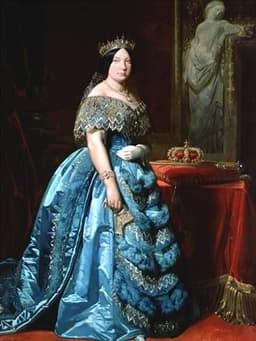
Isabella II of Spain
Emperor · Modern
46.5Total

Napoleon Bonaparte
General · Modern
70.9Total
Basic Information
Born
1830
1769
Died
1904
1821
Era
Modern
Modern
Nationality
Spain
France
Occupation
Emperor
General
Civilization
Western
Western
Score Comparison
Military (10%)
24.4
94.0
Political (20%)
35.1
72.0
Influence (20%)
51.0
40.0
Legacy (20%)
41.7
80.0
Leadership (15%)
65.7
78.0
Strategy (15%)
57.8
90.0
TOTAL
46.5
70.9
Isabella II of Spain — Complete Timeline
1833 AD
First Carlist WarWar◆ Major
The First Carlist War broke out between the Isabelline forces (liberals) and the Carlists (absolutists). The war lasted until 1840 and ended with the defeat of the Carlists, but left Spain politically divided.
Civil WarCarlist WarsLiberal vs Absolutist
Impact: nationaldestructive
Accession to the thronePolitical Action◆ Major
Isabella II became Queen of Spain at age three after the death of her father Ferdinand VII. Her minority sparked the First Carlist War between supporters of Isabella and those of her uncle Carlos.
SuccessionCarlist WarsRegency
Impact: national
1843 AD
Declaration of majorityPolitical Action◆ Major
Isabella II was declared of age at 13, ending the regency of General Espartero. Her personal rule was marked by instability, with frequent changes of government and military interventions.
RegencyMonarchyPolitical Instability
Impact: national
1868 AD
Revolution of 1868 and exilePolitical Action
The Glorious Revolution (La Gloriosa) overthrew Isabella II, who fled to France. The revolution ended the Bourbon monarchy and led to the Sexenio Democr
RevolutionExileBourbon Restoration
Impact: nationaltragic
Napoleon Bonaparte — Complete Timeline
1799 AD
Coup of 18 BrumaireOther◆ Major
Napoleon Bonaparte, with support from his brother Lucien and key political figures, overthrew the Directory in a bloodless coup. He established the Consulate with himself as First Consul, effectively becoming the ruler of France. This event ended the French Revolution's most unstable period.
French RevolutionCoupRise to Power
Impact: regional
1804 AD
Promulgation of the Napoleonic CodeOther◆ Major
Napoleon enacted the Civil Code of the French, known as the Napoleonic Code, a comprehensive set of laws that replaced the fragmented feudal legal systems. The code established legal equality, protected property rights, and secularized law. It became the basis for legal systems in many European and world countries.
Legal ReformNapoleonic CodeCivil Law
Impact: globalconstructive
1805 AD
Battle of AusterlitzWar◆ Major
Napoleon's Grande Arm
Napoleonic WarsBattleDecisive Victory
Impact: global
1812 AD
Invasion of RussiaWar◆ Major
Napoleon led the Grande Arm
Napoleonic WarsInvasionDisaster
Impact: globaldestructive
1815 AD
Battle of WaterlooWar◆ Major
Napoleon's French army was defeated by the combined forces of the Duke of Wellington's Anglo-Allied army and Gebhard Leberecht von Bl
Napoleonic WarsBattleFinal Defeat
Impact: globaldestructive
Expert Analysis
isabella-ii-of-spain-vs-napoleon-bonaparte
# The Crown and the Sword: Why Napoleon Built an Empire While Isabella II Lost a Throne
On a frozen December morning in 1805, Napoleon Bonaparte stood among the muddy fields of Austerlitz, watching the sun rise over a battlefield where he would crush the combined armies of Russia and Austria. He was thirty-six years old, master of Europe. Half a century later, on a warm September night in 1868, Isabella II of Spain slipped out of the Royal Palace in Madrid in disguise, fleeing through a side gate as revolutionaries stormed the gates. She was thirty-eight, and she would never see her homeland again. Both ruled nations in turbulent times. One reshaped the world. The other was reshaped by it. The difference between them reveals something profound about how power is won, held, and lost.
Origins
Napoleon was born in 1769 on the island of Corsica, a year after France purchased the territory from Genoa. His family was minor nobility, but they were poor, and young Napoleon spoke Italian before he learned French—a fact that made him an outsider at the military academy in Brienne. He was small, intense, and relentlessly ambitious. The French Revolution, which erupted when he was twenty, shattered the old order and opened doors that had been closed to men of his station. A Corsican nobody could become a general if he was brilliant enough. And Napoleon was.
Isabella II was born in 1830 into the Spanish Bourbon dynasty, one of Europe’s oldest royal families. Her father, Ferdinand VII, had spent years fighting to preserve absolute monarchy against liberal reformers. When he died in 1833, Isabella was three years old. Her very existence was a political crisis: Ferdinand had abolished the Salic Law that barred women from the throne, but his brother Carlos refused to accept it. Isabella became queen not because she was capable, but because she was a symbol—a flag for the liberal faction that wanted to limit royal power, against the Carlists who wanted to restore absolutism. She was a pawn before she could speak.
The difference in their origins is not just about class or nationality. Napoleon grew up in a world where merit could overthrow birth. Isabella grew up in a world where birth was everything—and her own birth was contested from the start.
Rise to Power
Napoleon’s ascent was a ladder of battles. In 1793, at age twenty-four, he drove British forces out of the port of Toulon, earning promotion to brigadier general. In 1795, he saved the revolutionary government from a royalist uprising with a “whiff of grapeshot”—cannon fire into a Parisian crowd. By 1796, he was commanding the Army of Italy, where he won a series of dazzling victories against the Austrians. Each triumph was a step higher. In 1799, he staged a coup and became First Consul. By 1804, he crowned himself Emperor.
Isabella’s rise was not a climb but a placement. At age three, she was placed on the throne by the will of her father and the support of liberal generals. The First Carlist War (1833–1840) was fought over her right to rule. She did not command armies; she was the cause of them. When she was declared of age in 1843 at thirteen, her mother’s regency ended, but real power remained in the hands of military strongmen—generals like Espartero and Narváez, who treated the crown as a trophy to be captured and controlled.
Napoleon earned his throne through competence. Isabella inherited hers through blood, and then had to fight to keep it—a fight she was not equipped to win.
Leadership & Governance
As ruler, Napoleon was a force of nature. He reorganized France into a centralized state, streamlined taxation, established the Bank of France, and—most enduringly—created the Napoleonic Code, a legal system based on reason and equality before the law that influenced civil law across Europe and the Americas. He was a military genius, with a strategic rating of 93.0, capable of moving armies faster and striking more decisively than any commander since Julius Caesar. But his political wisdom was more uneven. He conquered Europe, placed his brothers on thrones, and then watched as nationalism turned against him. His invasion of Russia in 1812 was a catastrophe: 600,000 men marched east; fewer than 100,000 returned.
Isabella’s governance was a study in dysfunction. She was not a reformer but a reactor. Her reign saw fifty-eight different governments—an average of one every seven months. She relied on a small circle of favorites, including her mother and her confessor, which alienated both liberals and conservatives. The army, which should have been the backbone of her rule, was instead a source of constant rebellion. In 1854, a military uprising forced her to dismiss her ministers. In 1866, another rebellion nearly toppled her. She was not a strategist (strategy score: 57.8) and lacked the vision to modernize Spain’s economy or institutions. Her leadership score of 87.7, surprisingly high, may reflect her personal charm and survival instincts—but charm does not govern a nation.
Triumph & Tragedy
Napoleon’s greatest moment was Austerlitz in 1805, where he destroyed the Third Coalition in a single day. His worst was Waterloo in 1815, where his gambles failed, his generals hesitated, and his empire ended. He died in exile on Saint Helena in 1821, a prisoner of the British. But even in defeat, he was magnificent. His memoirs shaped his legend, and his exile became part of the myth.
Isabella’s tragedy was less dramatic but more complete. Her reign was a series of small failures that accumulated into collapse. The Glorious Revolution of 1868 was not a single battle but a final rejection. She fled to France, where she lived in Paris until her death in 1904. She abdicated in favor of her son, Alfonso XII, in 1870, but she never returned to power. Her exile was not a prison island but a quiet apartment—a footnote rather than a legend.
Character & Destiny
Napoleon was ruthless, brilliant, and insatiable. His ambition was a fire that consumed everything—including himself. “Power is my mistress,” he once said. He could not stop. That drive made him emperor and also doomed him. He invaded Russia because he could not bear not to. He refused to compromise because he believed he was destiny.
Isabella was not driven by ambition but by weakness. She was poorly educated, surrounded by sycophants, and incapable of independent rule. She was also a woman in a world that did not trust female rulers. Her sexuality was scandalous: she had numerous lovers, and rumors of illegitimacy surrounded her children. This undermined her authority further. Where Napoleon’s flaws were those of excess, Isabella’s were those of inadequacy. He overreached; she underperformed.
Legacy
Napoleon’s legacy is immense. The Napoleonic Code, the modern French state, the metric system in much of Europe, the sale of Louisiana to the United States—his fingerprints are everywhere. He is remembered as both a liberator and a tyrant, a genius and a warmonger. His total score of 82.4 reflects this complexity.
Isabella’s legacy is slight. She is remembered as a symbol of a failed monarchy, a ruler whose incompetence paved the way for the First Spanish Republic and, later, for the instability that plagued Spain into the twentieth century. Her legacy score of 57.1 is a verdict: she mattered, but only as a cautionary tale.
Conclusion
Napoleon and Isabella II ruled in the same century, but they inhabited different worlds. One rose from obscurity by force of will; the other inherited a throne she could not hold. One reshaped Europe; the other could not hold Spain together. Their lives ask a question that has no easy answer: Is greatness born from character, or from circumstance? Napoleon had both. Isabella had neither. And history, which rewards results, has judged them accordingly. The emperor’s tomb at Les Invalides is a monument of gold and marble. The queen’s grave in the Escorial is just one among many. In the end, the difference between them is the difference between building an empire and losing a crown.
Rankings
🥇
Napoleon BonaparteLeader
Mil: 94.0Pol: 72.0Inf: 40.0
70.9
🥈
Isabella II of Spain
Mil: 24.4Pol: 35.1Inf: 51.0
46.5
+24.4 behind
How This Comparison Works
Algorithm
Each figure is scored on 6 dimensions (0—100 scale) based on structured historical data: Military (10%), Political (20%), Influence (20%), Legacy (20%), Leadership (15%), Strategy (15%). The weighted total produces the final ranking.
Data Sources
Scores are computed from structured sub-indicators in the database. Scale factors adjust for era (Ancient ×0.85, Modern ×1.0) and civilization size (Eastern ×1.05, Other ×0.80) to account for differences in population and military scale.
Maximum 3 Figures
Comparisons are limited to 2—3 figures to ensure readability and statistical meaningfulness.
Error Margins
±5 points per dimension — Sub-scores are derived from historical records with inherent uncertainty. Two figures within 5 points on a dimension should be considered roughly equivalent in that area.
Total Score Accuracy
±3 points overall — The weighted combination of 6 dimensions produces a total score with approximately ±3 points of uncertainty. Differences of less than 3 points are not statistically significant— the figures are effectively tied.
Known Limitations
- Historical records are incomplete and uneven across civilizations
- Figures from oral-tradition societies may be underrepresented
- Occupation labels can misclassify multi-role figures
- Scores measure capability and impact, not moral character
- Quantitative scoring is a comparison tool, not absolute truth
Capability Radar
Military (10%) — Battles & Warfare
Battles
36
95
Win Rate
37
90
Expansion
42
95
Political (20%) — Governance & Reform
Reform
20
95
Diplomacy
25
80
Economy
15
85
Influence (20%) — Cultural & Global Reach
Cultural
20
85
Global
15
90
Legacy (20%) — Historical Impact
Historical
30
95
Longevity
20
90
Leadership (15%) — Power & Stability
Tenure
60
85
Stability
5
70
Strategy (15%) — Tactics & Innovation
Strategy
45
95
Tactics
51
98
Reform
49
92
Similar Comparisons
Comments & Discussion
AusterlitzAvenger6/17/2026
The contrast here isn't just about military genius versus incompetence. Napoleon earned legitimacy through sheer will and tactical brilliance at Austerlitz, where he crushed 85,000 Russians and Austrians with a feigned flank weakness. Isabella inherited a throne through dynastic accident after her father's toxic legacy. Power isn't just about birthright – it's about doing the impossible when everyone doubts you. Napoleon fought his way up; Isabella was just handed the crown on a silver platter w
数据拆解者6/17/2026
别被“天才统治者”的神话骗了。拿破仑的滑铁卢战役损失了24000人,最终被流放;伊莎贝拉二世的西班牙军队人数高达10万,但她在1868年的革命中连一天抵抗都没组织就逃了。关键是管理能力而非个人魅力——拿破仑建立高效官僚体系,她却依赖勾结的宫廷派系。数据不会撒谎:执政15年却动荡33次政府更迭,这才是她失败的铁证。
ClassicsSage6/17/2026
There's a tragic irony here that might escape modern eyes. Napoleon consciously modeled his reign on Caesar and Charlemagne, crowning himself Emperor in Notre Dame with the Iron Crown of Lombardy. He understood that power requires theatrical legitimacy. Isabella, descendant of the Habsburgs who once bestrode Europe, failed to grasp even basic royal duty – her own ministers described her as "reading no official papers, signing without reading." The tragedy isn't that she wasn't Napoleon; it's tha
历史侦探6/17/2026
关键转折点在1866年的"圣吉尔之夜"——伊莎贝拉不仅没镇压叛乱,反而在亲信劝说下下令杀死38名无辜士兵。这和她那位曾祖卡洛斯四世的昏庸何其相似!而拿破仑的"雾月政变"干净利落,从督政府夺权时几乎零流血。不是天才问题,是果断与怯懦的差距。两场政变,两种命运,半世纪后中欧还在因为拿破仑法典争论不休,西班牙却在纠结王朝合法性。
RevisionistSkeptic6/17/2026
Can we stop romanticizing Napoleon as some meritocratic hero? Sure, he rose from Corsican obscurity, but he also reinstated slavery in 1802, sacrificed 500,000 men in the Russian campaign, and crowned himself Emperor while pretending to champion the Revolution. Isabella's Spain at least abolished slavery in its remaining colonies earlier than most European powers. The real difference? Napoleon had the PR machine of the 19th century; Isabella had to deal with Carlist wars, corrupt camarillas, and