Loading...
Hun Jian vs Muqali
Muqali leads by 15.9 pts · 2 figures compared
…

Hun Jian
General · Medieval
45.4Total
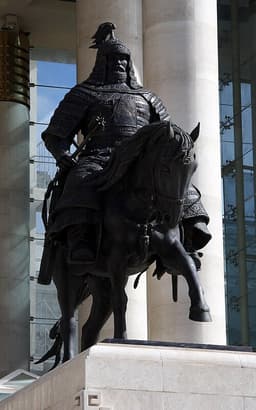
Muqali
General · Medieval
61.3Total
Basic Information
Born
736
1170
Died
799
1223
Era
Medieval
Medieval
Nationality
China
Mongol Empire
Occupation
General
General
Civilization
Eastern
Eastern
Score Comparison
Military (10%)
70.0
65.0
Political (20%)
26.4
68.0
Influence (20%)
46.3
58.0
Legacy (20%)
40.0
49.2
Leadership (15%)
50.7
70.4
Strategy (15%)
52.5
72.0
TOTAL
45.4
61.3
Hun Jian — Complete Timeline
763 AD
Suppressed An Lushan RebellionWar
Hun Jian participated in the suppression of the An Lushan Rebellion, fighting against rebel forces in northern China. His service during this conflict established his military reputation.
An Lushan RebellionTang DynastyMilitary Campaign
Impact: national
784 AD
Helped Recapture Chang'an from Zhu CiWar◆ Major
Hun Jian, a general of Tiele descent, fought alongside Li Sheng to recapture Chang'an from the rebel Zhu Ci. His cavalry forces were instrumental in the victory, restoring the Tang emperor to power.
Zhu Ci RebellionChang'an RecaptureTang Dynasty
Impact: nationalconstructive
785 AD
Appointed to High Military OfficePolitical Action
After his role in recapturing Chang'an, Hun Jian was appointed to a high military office in the Tang court. This appointment reflected his importance as a loyal general of non-Han origin.
Tang DynastyMilitary AppointmentTiele Descent
Impact: nationalconstructive
Muqali — Complete Timeline
1211 AD
Campaign in Northern ChinaWar◆ Major
Muqali was a key commander in Genghis Khan's invasion of the Jin Dynasty. He led forces in the capture of numerous cities and fortresses in northern China, including the victory at the Battle of Yehuling in 1211, which broke Jin resistance.
Jin DynastyYehulingNorthern China
Impact: regional
1212 AD
Conquest of ManchuriaWar
Muqali led a campaign to subdue the Khitan and Jurchen tribes in Manchuria. He defeated the rebel Khitan leader Yel
ManchuriaKhitanJurchen
Impact: regional
1215 AD
Siege of ZhongduWar◆ Major
Muqali participated in the Mongol siege of Zhongdu (modern Beijing), the capital of the Jin Dynasty. The city fell after a prolonged siege, leading to the massacre of its inhabitants and the effective collapse of Jin authority in northern China.
ZhongduBeijingSiege
Impact: regionaldestructive
1217 AD
Appointment as Viceroy of ChinaPolitical Action◆ Major
Genghis Khan appointed Muqali as viceroy (guo-wang) of all conquered territories in China, granting him command of the Mongol forces in the region. This made Muqali the de facto ruler of Mongol-occupied northern China.
ViceroyChinaGenghis Khan
Impact: regionalconstructive
Expert Analysis
Origins
Hun Jian was born around 736 AD into a Tiele (Turkic) family that had served the Tang dynasty for generations. His father, Hun Duojie, was a general, and Hun Jian grew up in the military culture of the Tang frontier. He began his career as a cavalry officer, fighting against the Tibetan Empire and the Uyghurs. His early experiences shaped his skills in mobile warfare and loyalty to the Tang throne.
Muqali was born around 1170 AD into the Jalayir clan of the Mongol steppe. He was captured by Genghis Khan (then Temujin) during a tribal war and became a trusted nöker (companion). Muqali rose through merit, not birth, and was known for his strategic acumen and unwavering loyalty. By 1206, he was one of Genghis Khan's most trusted generals, appointed as one of the "Four Hounds of War."
Rise to Power
Hun Jian rose to prominence during the An Lushan Rebellion (755-763). He fought under the Tang general Li Guangbi, distinguishing himself in several battles. However, his greatest achievement came in 783, when the rebel Zhu Ci seized Chang'an. Hun Jian, alongside Li Sheng, led a counterattack. In 784, Hun Jian's cavalry played a crucial role in the recapture of the capital, earning him the title of "Prince of Xianyang" and a high military office. His political score of 26.4 reflects his limited role in court politics.
Muqali's rise was meteoric after Genghis Khan unified the Mongol tribes. In 1211, he was a key commander in the invasion of the Jin Dynasty. He captured the fortified city of Ulaan Bator (modern) and later led the siege of Zhongdu (Beijing), which fell in 1215. In 1217, Genghis Khan appointed Muqali as viceroy (guo-wang) of all conquered territories in China, granting him command of 23,000 troops and full authority to expand Mongol control. This appointment gave Muqali a political score of 68.0, far higher than Hun Jian's.
Leadership & Governance
Hun Jian's leadership style was that of a loyal Tang general: he followed orders, excelled in cavalry tactics, and maintained discipline among his troops. He did not engage in governance or political maneuvering, focusing solely on military campaigns. His leadership score of 50.7 reflects his competence but lack of independent command.
Muqali, by contrast, governed as a viceroy. He established administrative structures in conquered territories, appointed Chinese officials, and implemented policies to win over the local population. His strategy score of 72.0 highlights his ability to combine military conquest with political consolidation. For example, he used siege warfare and psychological tactics to capture cities like Taiyuan, often offering terms to avoid prolonged resistance.
Triumph & Tragedy
Hun Jian's triumphs include the recapture of Chang'an in 784, which restored Tang authority, and his role in suppressing the An Lushan Rebellion. However, his failures include an inability to prevent the decline of the Tang military and the rise of warlordism. He died in 795, but his legacy was overshadowed by the eventual collapse of the Tang.
Muqali's triumphs are numerous: he conquered most of northern China for the Mongols, including the capture of Zhongdu and the subjugation of Manchuria. His greatest failure came in 1223 during the siege of Jingzhao (modern Xi'an), where he died of illness before the city fell. The siege dragged on, and the Jin held out until 1234. Muqali's death at age 53 cut short his campaign.
Character & Destiny
Hun Jian was a loyal soldier, but his limited political ambition meant he never shaped the fate of the Tang dynasty. He scored 70.0 in military but only 26.4 in politics, reflecting a narrow focus. Historical assessments view him as a capable general but not a transformative figure.
Muqali was both a brilliant strategist and a shrewd politician. His loyalty to Genghis Khan was absolute, but he also showed independence in governance. His character—disciplined, calculating, and adaptable—allowed him to succeed in the chaotic Mongol conquest. His destiny was to be the architect of Mongol rule in China, paving the way for the Yuan dynasty.
Legacy
Hun Jian's legacy is confined to Tang military history. He is remembered as a loyal general who helped restore the dynasty, but his impact was temporary. The Tang fell in 907, and his contributions faded.
Muqali's legacy is far-reaching. He established the administrative framework for Mongol rule in China, which later evolved into the Yuan dynasty (1271-1368). His strategies influenced later Mongol campaigns, and his appointment as viceroy set a precedent for governing conquered territories. His influence score of 58.0 and legacy score of 49.2 reflect his lasting impact on Chinese history.
Conclusion
Muqali had a greater impact on history than Hun Jian. His military score of 65.0 is slightly lower than Hun Jian's 70.0, but his political (68.0 vs 26.4), leadership (70.4 vs 50.7), and strategy (72.0 vs 52.5) scores are decisively higher. Muqali's total score of 61.3 surpasses Hun Jian's 45.4 by 15.9 points. While Hun Jian was a capable general in a declining empire, Muqali was a foundational figure in the Mongol conquest of China, which reshaped Eurasia. Muqali's role as viceroy and his administrative innovations had enduring consequences, whereas Hun Jian's achievements were limited to a single dynasty's restoration.
Rankings
🥇
MuqaliLeader
Mil: 65.0Pol: 68.0Inf: 58.0
61.3
🥈
Hun Jian
Mil: 70.0Pol: 26.4Inf: 46.3
45.4
+15.9 behind
How This Comparison Works
Algorithm
Each figure is scored on 6 dimensions (0—100 scale) based on structured historical data: Military (10%), Political (20%), Influence (20%), Legacy (20%), Leadership (15%), Strategy (15%). The weighted total produces the final ranking.
Data Sources
Scores are computed from structured sub-indicators in the database. Scale factors adjust for era (Ancient ×0.85, Modern ×1.0) and civilization size (Eastern ×1.05, Other ×0.80) to account for differences in population and military scale.
Maximum 3 Figures
Comparisons are limited to 2—3 figures to ensure readability and statistical meaningfulness.
Error Margins
±5 points per dimension — Sub-scores are derived from historical records with inherent uncertainty. Two figures within 5 points on a dimension should be considered roughly equivalent in that area.
Total Score Accuracy
±3 points overall — The weighted combination of 6 dimensions produces a total score with approximately ±3 points of uncertainty. Differences of less than 3 points are not statistically significant— the figures are effectively tied.
Known Limitations
- Historical records are incomplete and uneven across civilizations
- Figures from oral-tradition societies may be underrepresented
- Occupation labels can misclassify multi-role figures
- Scores measure capability and impact, not moral character
- Quantitative scoring is a comparison tool, not absolute truth
Capability Radar
Military (10%) — Battles & Warfare
Battles
55
75
Win Rate
60
80
Expansion
30
85
Political (20%) — Governance & Reform
Reform
20
65
Diplomacy
35
72
Economy
20
60
Influence (20%) — Cultural & Global Reach
Cultural
25
55
Global
20
55
Legacy (20%) — Historical Impact
Historical
40
65
Longevity
30
50
Leadership (15%) — Power & Stability
Tenure
40
70
Stability
30
68
Strategy (15%) — Tactics & Innovation
Strategy
55
82
Tactics
50
78
Reform
20
60
Similar Comparisons
Comments & Discussion
No comments yet. Be the first to share your thoughts!