Loading...
Injong of Goryeo vs Napoleon Bonaparte
Napoleon Bonaparte leads by 25.5 pts · 2 figures compared
…
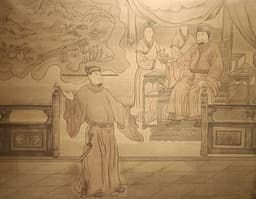
Injong of Goryeo
Emperor · Medieval
45.4Total

Napoleon Bonaparte
General · Modern
70.9Total
Basic Information
Born
1109
1769
Died
1146
1821
Era
Medieval
Modern
Nationality
Korea
France
Occupation
Emperor
General
Civilization
Eastern
Western
Score Comparison
Military (10%)
25.9
94.0
Political (20%)
37.9
72.0
Influence (20%)
50.2
40.0
Legacy (20%)
45.0
80.0
Leadership (15%)
62.2
78.0
Strategy (15%)
39.6
90.0
TOTAL
45.4
70.9
Injong of Goryeo — Complete Timeline
1135 AD
Myocheong rebellionWar◆ Major
The Buddhist monk Myocheong led a rebellion in Pyongyang, advocating for moving the capital and attacking the Jurchen Jin dynasty. King Injong initially supported the plan but later opposed it, leading to a three-year revolt that was crushed by the general Kim Bu-sik.
RebellionCapital MoveGoryeo
Impact: nationaldestructive
1136 AD
Suppression of the Myocheong rebellion by Kim Bu-sikWar◆ Major
General Kim Bu-sik, acting on Injong's orders, besieged and captured Pyongyang, ending the Myocheong rebellion. The victory strengthened the authority of the civil bureaucracy over military and religious factions, but also deepened regional tensions.
Civil WarMilitary CampaignGoryeo
Impact: national
1140 AD
Adoption of the 'Goryeo dogyeong' (Goryeo Code)Reform
Injong oversaw the compilation of a new legal code based on Tang and Song Chinese models. The code standardized administrative procedures and criminal law, but its implementation was uneven due to aristocratic resistance.
Legal ReformCodeGoryeo
Impact: nationalconstructive
Napoleon Bonaparte — Complete Timeline
1799 AD
Coup of 18 BrumaireOther◆ Major
Napoleon Bonaparte, with support from his brother Lucien and key political figures, overthrew the Directory in a bloodless coup. He established the Consulate with himself as First Consul, effectively becoming the ruler of France. This event ended the French Revolution's most unstable period.
French RevolutionCoupRise to Power
Impact: regional
1804 AD
Promulgation of the Napoleonic CodeOther◆ Major
Napoleon enacted the Civil Code of the French, known as the Napoleonic Code, a comprehensive set of laws that replaced the fragmented feudal legal systems. The code established legal equality, protected property rights, and secularized law. It became the basis for legal systems in many European and world countries.
Legal ReformNapoleonic CodeCivil Law
Impact: globalconstructive
1805 AD
Battle of AusterlitzWar◆ Major
Napoleon's Grande Arm
Napoleonic WarsBattleDecisive Victory
Impact: global
1812 AD
Invasion of RussiaWar◆ Major
Napoleon led the Grande Arm
Napoleonic WarsInvasionDisaster
Impact: globaldestructive
1815 AD
Battle of WaterlooWar◆ Major
Napoleon's French army was defeated by the combined forces of the Duke of Wellington's Anglo-Allied army and Gebhard Leberecht von Bl
Napoleonic WarsBattleFinal Defeat
Impact: globaldestructive
Expert Analysis
injong-of-goryeo-vs-napoleon-bonaparte
# The Emperor and the King: Napoleon and Injong, Two Paths to Power
On a June morning in 1815, Napoleon Bonaparte watched his Imperial Guard march for the last time across a muddy field near Waterloo. The man who had crowned himself Emperor of Europe was about to become a prisoner on a remote Atlantic island. Seven centuries earlier and half a world away, another ruler faced his own moment of truth: Injong of Goryeo, a young Korean king, sat on his throne in Kaesong as rebel forces gathered in Pyongyang, threatening to tear his kingdom apart. One would reshape the world; the other would barely survive it. What made the difference between a titan and a caretaker?
Origins
Napoleon was born in 1769 on Corsica, an island that had only recently become French. His family was minor nobility, but they were outsiders in a rigid French society. This bred in him a hunger for recognition that would never be satisfied. He studied at military academies where his foreign accent marked him as different, and he devoured books on military history and Enlightenment philosophy. The French Revolution, which erupted when he was twenty, shattered the old order and opened doors that would otherwise have remained locked.
Injong, born in 1109, inherited a very different world. The Goryeo dynasty had ruled Korea for two centuries, and its structures were ancient and fixed. He was educated in Confucian classics, trained in the rituals of kingship, and surrounded by scholar-officials who knew exactly how a king should behave. Where Napoleon’s world was exploding, Injong’s was ossifying. The difference in their upbringings was not just personal but civilizational: one was forged in revolution, the other in tradition.
Rise to Power
Napoleon’s ascent was a masterpiece of opportunism. In 1793, at age twenty-four, he drove British forces from Toulon with a brilliant artillery barrage. By 1796, he commanded the Army of Italy and won six victories in as many months. His 1798 Egyptian campaign failed strategically but succeeded as propaganda: he returned to France a hero, and in 1799 he seized power in a coup. Within five years, he crowned himself Emperor.
Injong’s path was the opposite. He became king in 1122 at age thirteen, inheriting a throne that was both absolute and constrained. Real power lay with the aristocratic families and the military commanders who had saved the kingdom from Jurchen invasions. Injong spent his early reign navigating court factions, not conquering continents. His rise was not a climb but a careful balancing act.
Leadership & Governance
Napoleon governed with the energy of a man who believed he could remake reality. He centralized the French state, created the Bank of France, and—most enduringly—codified French law into the Napoleonic Code of 1804. This legal system, based on rational principles rather than feudal custom, spread across Europe and still influences legal systems today. He built roads, reformed education, and promoted talent over birth. But his genius for administration was matched by a fatal arrogance: he believed his military brilliance could solve any problem.
Injong governed through consensus and tradition. In 1140, he adopted the *Goryeo dogyeong*, a legal code modeled on Chinese Tang and Song law. This was not the bold reform of a revolutionary but the careful consolidation of a conservative. The code standardized administration and reinforced Confucian hierarchy. Where Napoleon rewrote the rules, Injong codified them.
Triumph & Tragedy
Napoleon’s greatest moment was Austerlitz in 1805, where he destroyed a combined Russian-Austrian army with a tactical masterpiece. His empire stretched from Spain to Poland, and he seemed invincible. His tragedy was the invasion of Russia in 1812: 600,000 men marched east; fewer than 100,000 returned. The disaster broke his aura of invincibility, and within two years he was exiled to Elba. He returned for a final, desperate campaign that ended at Waterloo.
Injong’s triumph was the suppression of the Myocheong rebellion in 1135–1136. The Buddhist monk Myocheong had gathered support in Pyongyang, advocating a capital move and war against the Jurchen. Injong, guided by his general Kim Bu-sik, besieged and captured Pyongyang, ending the revolt. But this victory was defensive, not expansive. Injong’s tragedy was that he never achieved more: he ruled for twenty-four years and left his kingdom no stronger than he found it.
Character & Destiny
Napoleon’s character was a storm: brilliant, restless, and ultimately self-destructive. He once said, “Power is my mistress,” and he pursued her with monomaniacal intensity. His confidence became hubris, his ambition became greed. He could not stop, even when stopping would have saved him.
Injong’s character was a still pond: cautious, patient, and limited. He knew his role and played it well, but he never imagined a different role. Where Napoleon asked “Why not?”, Injong asked “Is this proper?” One shaped history; the other was shaped by it.
Legacy
Napoleon’s legacy is written across Europe: in legal codes, in national boundaries, in the very idea of the modern state. He is remembered as both liberator and tyrant, genius and monster. His scores—Military 94, Strategy 93, Leadership 80—reflect a man who changed the world, for better and worse.
Injong’s legacy is quieter. His *Goryeo dogyeong* influenced Korean law for centuries, but he is remembered mainly as the king who survived the Myocheong rebellion. His scores—Military 24, Strategy 42, Leadership 43—reflect a competent ruler in a system that valued stability over greatness.
Conclusion
Napoleon and Injong faced the same fundamental question: what does a ruler do with power? Napoleon answered by building an empire that collapsed under its own weight. Injong answered by preserving a kingdom that endured for centuries after his death. One burned bright and fast; the other burned dim and long. Perhaps the real difference was not in ability but in ambition: Napoleon wanted to be remembered; Injong wanted to be forgotten. History, with its strange justice, gave them both what they sought.
Rankings
🥇
Napoleon BonaparteLeader
Mil: 94.0Pol: 72.0Inf: 40.0
70.9
🥈
Injong of Goryeo
Mil: 25.9Pol: 37.9Inf: 50.2
45.4
+25.5 behind
How This Comparison Works
Algorithm
Each figure is scored on 6 dimensions (0—100 scale) based on structured historical data: Military (10%), Political (20%), Influence (20%), Legacy (20%), Leadership (15%), Strategy (15%). The weighted total produces the final ranking.
Data Sources
Scores are computed from structured sub-indicators in the database. Scale factors adjust for era (Ancient ×0.85, Modern ×1.0) and civilization size (Eastern ×1.05, Other ×0.80) to account for differences in population and military scale.
Maximum 3 Figures
Comparisons are limited to 2—3 figures to ensure readability and statistical meaningfulness.
Error Margins
±5 points per dimension — Sub-scores are derived from historical records with inherent uncertainty. Two figures within 5 points on a dimension should be considered roughly equivalent in that area.
Total Score Accuracy
±3 points overall — The weighted combination of 6 dimensions produces a total score with approximately ±3 points of uncertainty. Differences of less than 3 points are not statistically significant— the figures are effectively tied.
Known Limitations
- Historical records are incomplete and uneven across civilizations
- Figures from oral-tradition societies may be underrepresented
- Occupation labels can misclassify multi-role figures
- Scores measure capability and impact, not moral character
- Quantitative scoring is a comparison tool, not absolute truth
Capability Radar
Military (10%) — Battles & Warfare
Battles
20
95
Win Rate
15
90
Expansion
5
95
Political (20%) — Governance & Reform
Reform
30
95
Diplomacy
40
80
Economy
30
85
Influence (20%) — Cultural & Global Reach
Cultural
30
85
Global
10
90
Legacy (20%) — Historical Impact
Historical
40
95
Longevity
30
90
Leadership (15%) — Power & Stability
Tenure
60
85
Stability
20
70
Strategy (15%) — Tactics & Innovation
Strategy
10
95
Tactics
10
98
Reform
5
92
Similar Comparisons
Comments & Discussion
IronLegion6/17/2026
Napoleon wasn’t some self-made titan—he was a lucky opportunist riding the chaos of revolution. Injong faced a stable Confucian order where legitimacy was everything, not a battlefield for ambition. Waterloo wasn’t genius; it was hubris. Injong’s survival against the Myocheong rebellion shows real statecraft. Napoleon burned through Europe; Injong held his kingdom. Who’s the more impressive leader here? The one who kept his throne, not lost it for a rock in the Atlantic.
塞外刀客6/17/2026
拿波仑算哪门子雄主?不过是法国大革命的泥腿子暴发户。仁宗才是真正的守成之君,面对妙清之乱和西京势力,他硬是稳住了高丽江山。拿波仑滑铁卢一败就成阶下囚,仁宗却熬过了内乱和靖康之变的冲击,保全了王朝。你让拿波仑来高丽试试,连科举制度都玩不转,还想当皇帝?
DataMancer6/17/2026
You guys are romanticizing history. Napoleon’s edge was demographics and logistics—France had 28 million people in 1800; Goryeo maybe 5 million. Injong didn’t “choose” to be a caretaker; he had no armies for European-style expansion. Compare apples and oranges: Napoleon exploited a continental powder keg; Injong managed a small, fragile state under Song-Jin pressure. Numbers don’t lie—scale matters more than “greatness.”
墨香史官6/17/2026
拿波仑的传奇本质是暴力美学,而仁宗的高丽智慧才是文明的真谛。拿波仑靠军功践踏欧洲,仁宗却推动儒学治国、编纂《高丽史》,让文化传承不断。别忘了,高丽在仁宗时期还吸收了宋朝的科技,比拿波仑的“法典”更务实。一个玩火自焚,一个火中取栗,高下立判。
RogueHistorian6/17/2026
Nice spin, but Injong’s reign was a weak-kneed reaction to crisis. Napoleon reshaped Europe—legal codes, modern states, the whole shebang. Injong? He flailed against the Myocheong rebellion and let military commanders like Kim Bu-sik run things. Napoleon built an empire from scratch; Injong just inherited one and barely held it. Let’s stop confusing survival with greatness. The emperor had vision; the king had luck.