Loading...
Isaac II Angelos vs Napoleon Bonaparte
Napoleon Bonaparte leads by 35.5 pts · 2 figures compared
…
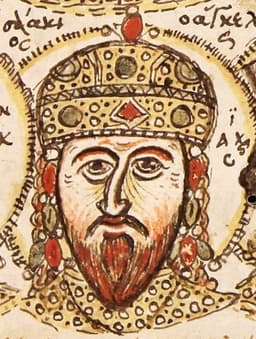
Isaac II Angelos
Emperor · Medieval
35.4Total

Napoleon Bonaparte
General · Modern
70.9Total
Basic Information
Born
1156
1769
Died
1204
1821
Era
Medieval
Modern
Nationality
Byzantine Empire
France
Occupation
Emperor
General
Civilization
Western
Western
Score Comparison
Military (10%)
10.2
94.0
Political (20%)
32.1
72.0
Influence (20%)
45.5
40.0
Legacy (20%)
38.3
80.0
Leadership (15%)
31.2
78.0
Strategy (15%)
39.6
90.0
TOTAL
35.4
70.9
Isaac II Angelos — Complete Timeline
1185 AD
Accession as emperor after overthrowing Andronikos IPolitical Action◆ Major
Isaac II Angelos led a popular revolt that overthrew Andronikos I Komnenos, and was proclaimed emperor. His accession ended the Komnenian dynasty's rule and began the Angelid dynasty, but the empire was weakened by internal strife and external threats.
RevoltDynastic ChangePopular Uprising
Impact: national
1190 AD
Defeat at the Battle of TryavnaWar◆ Major
Isaac II led a campaign against the Bulgarian rebels under Ivan Asen I and Peter IV. The Byzantine army was ambushed and defeated at Tryavna, with Isaac barely escaping. The defeat solidified the Second Bulgarian Empire's independence from Byzantine rule.
Byzantine-Bulgarian WarsMilitary DefeatRebellion
Impact: regionaldestructive
1195 AD
Blinding and deposition by Alexios III AngelosPolitical Action◆ Major
Isaac II was overthrown and blinded by his brother Alexios III Angelos in a palace coup. Isaac was imprisoned, and Alexios III seized the throne. The blinding was a traditional Byzantine punishment for usurpers, but it left Isaac incapacitated and the empire divided.
CoupDynastic ConflictBlinding
Impact: nationaltragic
1203 AD
Restoration and flight during the Fourth CrusadePolitical Action◆ Major
Isaac II was restored to the throne by the Fourth Crusade, alongside his son Alexios IV Angelos, after the crusaders besieged Constantinople. However, the restored regime failed to pay the promised rewards to the crusaders, leading to renewed conflict and Isaac's death in prison in 1204.
Fourth CrusadeRestorationSiege of Constantinople
Impact: regionaltragic
Napoleon Bonaparte — Complete Timeline
1799 AD
Coup of 18 BrumaireOther◆ Major
Napoleon Bonaparte, with support from his brother Lucien and key political figures, overthrew the Directory in a bloodless coup. He established the Consulate with himself as First Consul, effectively becoming the ruler of France. This event ended the French Revolution's most unstable period.
French RevolutionCoupRise to Power
Impact: regional
1804 AD
Promulgation of the Napoleonic CodeOther◆ Major
Napoleon enacted the Civil Code of the French, known as the Napoleonic Code, a comprehensive set of laws that replaced the fragmented feudal legal systems. The code established legal equality, protected property rights, and secularized law. It became the basis for legal systems in many European and world countries.
Legal ReformNapoleonic CodeCivil Law
Impact: globalconstructive
1805 AD
Battle of AusterlitzWar◆ Major
Napoleon's Grande Arm
Napoleonic WarsBattleDecisive Victory
Impact: global
1812 AD
Invasion of RussiaWar◆ Major
Napoleon led the Grande Arm
Napoleonic WarsInvasionDisaster
Impact: globaldestructive
1815 AD
Battle of WaterlooWar◆ Major
Napoleon's French army was defeated by the combined forces of the Duke of Wellington's Anglo-Allied army and Gebhard Leberecht von Bl
Napoleonic WarsBattleFinal Defeat
Impact: globaldestructive
Expert Analysis
isaac-ii-angelos-vs-napoleon-bonaparte
# The Emperor and the Angel: Two Faces of Power in Crisis
In the summer of 1203, a blind old man sat trembling on the throne of Constantinople. He had been pulled from a dungeon, his eyes gouged out eight years earlier by his own brother, and now he was emperor again—not through strength, but through the mercy of crusaders who had come not to save Byzantium, but to plunder it. Just a few hundred miles west, another man was preparing to conquer the world. Napoleon Bonaparte, then a young artillery officer, had not yet fired the shot that would make him famous. Yet in 1796, as he led his ragged army into Italy, he carried a certainty that Isaac II Angelos had never known: the conviction that history bends to the will of a single man.
What separates a figure who reshapes the world from one who is crushed by it? The answer lies not merely in talent, but in the strange alchemy of character, circumstance, and the choices that turn opportunity into destiny.
Origins
Napoleon Bonaparte was born in 1769 on the island of Corsica, a land that France had purchased only a year earlier. His family was minor nobility, but poor—the kind of poverty that sharpens ambition. He spoke French with an Italian accent, was mocked at military school, and carried a lifelong chip on his shoulder. That chip became a driving force. France itself was in upheaval when he came of age, the old order collapsing into revolution, and for a man of talent and no pedigree, the chaos was a ladder.
Isaac II Angelos was born in 1156 into the Byzantine purple. His family was not the ruling branch, but they were Angeloi—a name that meant "messengers," though in time it would come to mean something closer to "disaster." Byzantium in the late twelfth century was a fortress under siege, shrinking from Norman attacks, Bulgarian revolts, and the endless scheming of its own aristocracy. Isaac grew up in a world where power was inherited but never secure, where every cousin was a potential assassin, and where the throne was less a seat than a trap.
Rise to Power
Napoleon’s rise was a masterpiece of speed and audacity. In 1793, at age twenty-four, he drove the British out of Toulon with a brilliant use of artillery. By 1796, he was commanding the Army of Italy, where he turned starving soldiers into a conquering force, winning battle after battle against the Austrians. His political genius matched his military skill: he knew when to be ruthless and when to charm, when to seize power and when to let others hand it to him. In 1799, he staged a coup and made himself First Consul. By 1804, he was Emperor of the French.
Isaac II’s rise was a revolt, not a campaign. In 1185, when the brutal Emperor Andronikos I was terrorizing Constantinople, Isaac was a minor noble who happened to survive a purge. When a mob rose up, they found him hiding in a church and dragged him to the throne. He was crowned not because he was strong, but because he was available. The people wanted a change; Isaac was the change they got.
Leadership & Governance
Napoleon governed with the energy of a man who believed that order could be imposed by will. His Napoleonic Code, enacted in 1804, standardized French law across a fractured nation and became a model for much of Europe. He built schools, roads, and a centralized bureaucracy. He rewarded talent over birth, making generals of common soldiers and dukes of grocers. His military strategy was a revolution in itself: rapid marches, massed artillery, and the destruction of enemy armies rather than the capture of cities.
Isaac II governed like a man waiting for the next blow. He faced revolts from the moment he took power. In 1185, the Normans invaded Thessalonica; Isaac barely held on. In 1190, he led a campaign against the Bulgarian rebels Ivan Asen I and Peter IV. At the Battle of Tryavna, his army was ambushed in a mountain pass and routed. Isaac himself barely escaped. He was not a coward, but he lacked the instinct for command—the ability to see the battlefield as a whole, to anticipate the enemy’s mind. His political rule was no better: he emptied the treasury on bribes and ceremonies, alienated the army, and trusted his brother Alexios, who in 1195 blinded and deposed him.
Triumph & Tragedy
Napoleon’s greatest moment was Austerlitz in 1805, where he destroyed the combined armies of Russia and Austria in a single day. It was a triumph of deception, speed, and nerve. His worst was the invasion of Russia in 1812, where he lost half a million men to winter, hunger, and the Russian refusal to fight a decisive battle. He was exiled to Elba in 1814, returned for a hundred days, and was finally crushed at Waterloo in 1815.
Isaac’s tragedy was more personal and more complete. His restoration in 1203 was a humiliation: the Fourth Crusade, originally aimed at Egypt, was diverted to Constantinople by Venetian politics and dynastic intrigue. The crusaders restored Isaac and his son Alexios IV, but the city could not pay the promised reward. In early 1204, a palace coup overthrew them again. In April, the crusaders stormed the walls and sacked Constantinople—the greatest Christian city in the world, looted by Christians. Isaac died in prison, perhaps of poison, perhaps of despair, as his empire was torn apart.
Character & Destiny
Napoleon was driven by a hunger that never slept. He worked eighteen-hour days, dictated letters to multiple secretaries at once, and believed that “impossible is a word to be found only in the dictionary of fools.” His confidence was his strength and his flaw: it gave him the audacity to conquer, but also the arrogance to believe he could conquer Russia, or Spain, or the British navy. He was a man who could not stop, and that is why he fell.
Isaac was driven by fear. He had seen what happened to emperors who lost: Andronikos I was torn apart by a mob. Isaac’s caution was not wisdom but paralysis. He could not trust his generals, so he led campaigns himself and lost. He could not trust his family, but he had no one else, so his brother betrayed him. He was a man who could not act, and that is why he fell.
Legacy
Napoleon left a Europe transformed. The Napoleonic Code, the metric system, the abolition of feudalism, the rise of nationalism—these outlived his empire. He is remembered as a genius of war and a titan of history, a figure who still sparks debate between those who see a liberator and those who see a tyrant.
Isaac II Angelos left a ruined empire. The Fourth Crusade, which he inadvertently summoned, broke Byzantium permanently. The empire would limp on for another two centuries, but it never recovered Constantinople’s wealth or prestige. He is remembered, if at all, as a symbol of decline—a man who was given a throne and could not hold it, who saw his capital sacked and died blind in a dungeon.
Conclusion
Two men, two worlds, two destinies. Napoleon Bonaparte rose from the margins to dominate an age, driven by ambition and a ruthless clarity of purpose. Isaac II Angelos rose from the center to preside over a collapse, paralyzed by fear and the weight of a decaying system. One forged a new Europe; the other watched the old one burn. Their stories remind us that history is not a lottery. It rewards those who see clearly, act decisively, and understand that power, once seized, must be wielded—or it will consume the one who holds it.
Rankings
🥇
Napoleon BonaparteLeader
Mil: 94.0Pol: 72.0Inf: 40.0
70.9
🥈
Isaac II Angelos
Mil: 10.2Pol: 32.1Inf: 45.5
35.4
+35.5 behind
How This Comparison Works
Algorithm
Each figure is scored on 6 dimensions (0—100 scale) based on structured historical data: Military (10%), Political (20%), Influence (20%), Legacy (20%), Leadership (15%), Strategy (15%). The weighted total produces the final ranking.
Data Sources
Scores are computed from structured sub-indicators in the database. Scale factors adjust for era (Ancient ×0.85, Modern ×1.0) and civilization size (Eastern ×1.05, Other ×0.80) to account for differences in population and military scale.
Maximum 3 Figures
Comparisons are limited to 2—3 figures to ensure readability and statistical meaningfulness.
Error Margins
±5 points per dimension — Sub-scores are derived from historical records with inherent uncertainty. Two figures within 5 points on a dimension should be considered roughly equivalent in that area.
Total Score Accuracy
±3 points overall — The weighted combination of 6 dimensions produces a total score with approximately ±3 points of uncertainty. Differences of less than 3 points are not statistically significant— the figures are effectively tied.
Known Limitations
- Historical records are incomplete and uneven across civilizations
- Figures from oral-tradition societies may be underrepresented
- Occupation labels can misclassify multi-role figures
- Scores measure capability and impact, not moral character
- Quantitative scoring is a comparison tool, not absolute truth
Capability Radar
Military (10%) — Battles & Warfare
Battles
10
95
Win Rate
10
90
Expansion
5
95
Political (20%) — Governance & Reform
Reform
10
95
Diplomacy
10
80
Economy
10
85
Influence (20%) — Cultural & Global Reach
Cultural
5
85
Global
5
90
Legacy (20%) — Historical Impact
Historical
20
95
Longevity
10
90
Leadership (15%) — Power & Stability
Tenure
30
85
Stability
5
70
Strategy (15%) — Tactics & Innovation
Strategy
10
95
Tactics
10
98
Reform
5
92
Similar Comparisons
Comments & Discussion
DaggerOverDuty6/17/2026
Napoleon's 'rags-to-empire' story is romantic, but Isaac's tragedy is more historically instructive. In 1185, Isaac seized the throne by rallying Constantinople's mob—raw populism—while Napoleon climbed via meritocratic artillery exams. But Isaac inherited a treasury drained by Andronikos I and faced Norman invasions; Napoleon inherited revolutionary France's unstoppable war machine. One man built a ladder; the other climbed into a burning building. Blind in both eyes or blind to reality? Isaac'
铁纪律官6/17/2026
别把拿破仑捧成神,他只是没碰上拜占庭那摊烂账。伊萨克二世上台时国库空得像乞丐的碗,诺曼人刚屠了塞萨洛尼基,而拿破仑1796年指挥的意大利军团,背后是法国国民公会的全额拨款。拿炮兵中尉跟瞎眼皇帝比?不公!伊萨克若在瓦卢瓦王朝当兵,也许也能踢翻半个欧洲。时势造英雄,不是英雄造时势。
DivineRightDenier6/17/2026
Napoleon's 'destiny' is a historical mirage created by his own propaganda. Contrast their legitimacy: Isaac II was a blood claimant to the Komnenian dynasty, crowned in Hagia Sophia by the Patriarch—legal continuity. Bonaparte was a general who shot his way onto the throne via the 18 Brumaire coup, then invented a 'Carolingian' myth. Isaac's fall came from foreign invasion (the Fourth Crusade); Napoleon's from hubris (Russia 1812, Waterloo). Which is more admirable? A king crushed by history's t
古文考据狂6/17/2026
比较二人,得看‘天命’二字在中国史学的镜鉴。伊萨克二世以弑兄得位(1185年政变绞死安德洛尼库斯),却困于宦官党争与十字军贪婪,活脱脱一个东汉末世昏君;拿破仑则类曹操,挟革命以令诸侯,颁布《拿破仑法典》如颁‘新周礼’。但曹操未能代汉,拿破仑亦败于滑铁卢——英雄与乱臣贼子的分界线,只在成败之间。伊萨克的盲目,是拜占庭官僚体制的癌变;拿破仑的滑铁卢,是个人野心透支国力的绝命诗。