Loading...
Ivan Alexander vs Napoleon Bonaparte
Napoleon Bonaparte leads by 16.2 pts · 2 figures compared
…
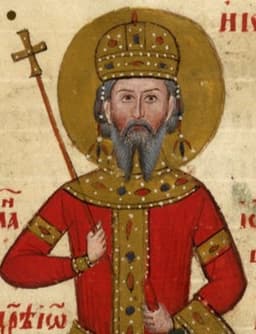
Ivan Alexander
Emperor · Medieval
54.7Total

Napoleon Bonaparte
General · Modern
70.9Total
Basic Information
Born
1300
1769
Died
1371
1821
Era
Medieval
Modern
Nationality
Bulgaria
France
Occupation
Emperor
General
Civilization
Western
Western
Score Comparison
Military (10%)
10.0
94.0
Political (20%)
68.0
72.0
Influence (20%)
56.7
40.0
Legacy (20%)
50.0
80.0
Leadership (15%)
74.0
78.0
Strategy (15%)
57.5
90.0
TOTAL
54.7
70.9
Ivan Alexander — Complete Timeline
1331 AD
Coronation as TsarPolitical Action◆ Major
Ivan Alexander was crowned Tsar of Bulgaria after overthrowing his predecessor. His reign marked the last period of cultural and political flourishing before the Ottoman conquest.
CoronationReignBulgarian Empire
Impact: nationalconstructive
1340 AD
Compilation of the Law CodeReform◆ Major
Ivan Alexander oversaw the compilation of a comprehensive law code, the 'Zakonik' (Law of the Tsar). This codified Byzantine and Bulgarian legal traditions, strengthening central authority.
Law CodeReformLegal System
Impact: nationalconstructive
1350 AD
Patronage of the Tarnovo Literary SchoolCultural◆ Major
Ivan Alexander patronized the Tarnovo Literary School, which produced illuminated manuscripts like the 'Manasses Chronicle' and the 'Gospels of Tsar Ivan Alexander'. This was the peak of medieval Bulgarian culture.
CulturalManuscriptsTarnovo School
Impact: regionalconstructive
1355 AD
Division of the EmpirePolitical Action◆ Major
Ivan Alexander divided Bulgaria between his two sons, Ivan Shishman and Ivan Sratsimir, weakening the state. This fragmentation facilitated the later Ottoman conquest.
DivisionSuccessionWeakening
Impact: nationaldestructive
Napoleon Bonaparte — Complete Timeline
1799 AD
Coup of 18 BrumaireOther◆ Major
Napoleon Bonaparte, with support from his brother Lucien and key political figures, overthrew the Directory in a bloodless coup. He established the Consulate with himself as First Consul, effectively becoming the ruler of France. This event ended the French Revolution's most unstable period.
French RevolutionCoupRise to Power
Impact: regional
1804 AD
Promulgation of the Napoleonic CodeOther◆ Major
Napoleon enacted the Civil Code of the French, known as the Napoleonic Code, a comprehensive set of laws that replaced the fragmented feudal legal systems. The code established legal equality, protected property rights, and secularized law. It became the basis for legal systems in many European and world countries.
Legal ReformNapoleonic CodeCivil Law
Impact: globalconstructive
1805 AD
Battle of AusterlitzWar◆ Major
Napoleon's Grande Arm
Napoleonic WarsBattleDecisive Victory
Impact: global
1812 AD
Invasion of RussiaWar◆ Major
Napoleon led the Grande Arm
Napoleonic WarsInvasionDisaster
Impact: globaldestructive
1815 AD
Battle of WaterlooWar◆ Major
Napoleon's French army was defeated by the combined forces of the Duke of Wellington's Anglo-Allied army and Gebhard Leberecht von Bl
Napoleonic WarsBattleFinal Defeat
Impact: globaldestructive
Expert Analysis
ivan-alexander-vs-napoleon-bonaparte
# The Emperor and the Tsar: Two Visions of Power in an Age of Crisis
On a June morning in 1815, Napoleon Bonaparte watched his Grand Army crumble in the muddy fields of Waterloo, his dream of European domination dissolving into rain and retreat. Four centuries earlier, in 1371, another ruler faced his own twilight: Ivan Alexander of Bulgaria, the last great tsar of a medieval kingdom, died just as the Ottoman tide was about to swallow his realm whole. One man conquered a continent; the other presided over a culture’s final bloom before extinction. Both were leaders of extraordinary ambition, yet their paths diverged so sharply that comparing them reveals something essential about the relationship between personality, opportunity, and fate.
Origins
Napoleon was born in 1769 on the island of Corsica, a provincial backwater recently annexed by France. His family was minor nobility, but his education at French military academies gave him the tools to climb. The French Revolution had shattered the old order, creating a vacuum where talent could vault over birth. Napoleon was a child of upheaval, raised in a world where the rules were being rewritten daily.
Ivan Alexander came into the world around 1300, in a Bulgaria that had already known centuries of glory and decline. He was a scion of the Shishman dynasty, a noble house that seized power through intrigue and assassination. His Bulgaria was a patchwork of feudal loyalties, hemmed in by the rising Serbian Empire and the Byzantine remnants. Where Napoleon’s world was dynamic and expanding, Ivan Alexander’s was contracting, its possibilities narrowing with each passing decade.
Rise to Power
Napoleon’s ascent was a rocket trajectory. In 1796, at age 26, he took command of the French army in Italy and within months had humiliated the Austrians. His Italian campaign of 1796–1797 was a masterpiece of speed and audacity—he moved faster than his enemies could think, living off the land and winning battles through sheer tactical brilliance. By 1799, he had seized power in a coup, and by 1804, he crowned himself Emperor of the French. Every step was a gamble, and every gamble paid off.
Ivan Alexander’s rise was quieter, more precarious. In 1331, he overthrew his predecessor and was crowned Tsar of Bulgaria. He did not conquer his throne through brilliant campaigns but through noble maneuvering and the support of boyars—the Bulgarian aristocracy. His power rested on alliances, not victories. Where Napoleon could demand obedience, Ivan Alexander had to negotiate it.
Leadership & Governance
Napoleon ruled through force of will and a genius for organization. His Napoleonic Code, enacted in 1804, standardized French law and became a model for much of Europe. He built a centralized state, appointed officials based on merit, and created a system where even former enemies could find a place—if they were useful. His military leadership was legendary: at Austerlitz in 1805, he crushed the combined armies of Russia and Austria with a tactical feint that left his enemies shattered. His score of 94 for military genius is no exaggeration.
Ivan Alexander governed differently. In 1340, he compiled the “Zakonik,” a comprehensive law code that drew on Byzantine traditions. He patronized the Tarnovo Literary School, which produced illuminated manuscripts like the *Manasses Chronicle*, a masterpiece of medieval art. His leadership score of 85 reflects a ruler who understood that culture and law could sustain a kingdom as surely as armies. But his strategy score of 46 reveals a fatal weakness: he lacked the military vision to defend what he had built.
Triumph & Tragedy
Napoleon’s greatest moment was perhaps Austerlitz, where he achieved a victory so complete that it reshaped the European map. But his tragedy was equally grand: the invasion of Russia in 1812, where 600,000 men marched east and fewer than 100,000 returned. The disaster was born of overreach—Napoleon could not stop, could not consolidate, could not accept limits.
Ivan Alexander’s triumph was cultural, not military. Under his patronage, Bulgarian art and literature reached heights unseen since the First Bulgarian Empire. But his tragedy was political. In 1355, he divided his kingdom between his two sons, Ivan Shishman and Ivan Sratsimir. This fragmentation, born of paternal love or perhaps political necessity, left Bulgaria vulnerable. Within decades, the Ottoman Turks would conquer both halves, extinguishing Bulgarian independence for nearly five centuries.
Character & Destiny
Napoleon was restless, insatiable, a man who defined himself by action. “There is no immortality,” he once said, “but the memory that is left in the minds of men.” He could not bear stillness; every victory demanded another. This drive made him great, but it also destroyed him. He could not compromise, could not share power, could not build a lasting peace.
Ivan Alexander was a builder of a different kind—a patron, a codifier, a man who sought to preserve and beautify what he had inherited. But he lacked Napoleon’s ruthless clarity. Where Napoleon would have crushed his rivals or centralized his rule, Ivan Alexander divided his empire. His caution, his desire to accommodate, his preference for culture over conquest—these were virtues in a stable world, but fatal in an age of predators.
Legacy
Napoleon’s legacy is written in the laws of Europe, the maps of nations, the very idea of the modern state. He is remembered as a conqueror, a reformer, a tyrant, a genius. His scores—82 for influence, 78 for legacy—reflect a figure who reshaped history, for better and worse.
Ivan Alexander’s legacy is quieter but no less real. He is the last great Bulgarian tsar, the man who gave his people a final golden age before the darkness. His scores—76 for influence, 67 for legacy—capture a ruler who preserved rather than expanded, who enriched rather than conquered. He is remembered not for battles won, but for books illuminated and laws codified.
Conclusion
Standing at the end of their stories, Napoleon and Ivan Alexander seem almost like opposites: the Corsican who would remake the world, the Bulgarian who would preserve it. But both were men of their time, shaped by forces they could not fully control. Napoleon rode the wave of revolution; Ivan Alexander tried to hold back the Ottoman flood. One succeeded brilliantly, then failed catastrophically; the other succeeded modestly, then faded into eclipse. Their lives remind us that leadership is not merely a matter of talent, but of timing. A great man in a rising age can become a legend; a great man in a falling age can become a footnote. And sometimes, the difference between the two is not character, but luck.
Rankings
🥇
Napoleon BonaparteLeader
Mil: 94.0Pol: 72.0Inf: 40.0
70.9
🥈
Ivan Alexander
Mil: 10.0Pol: 68.0Inf: 56.7
54.7
+16.2 behind
How This Comparison Works
Algorithm
Each figure is scored on 6 dimensions (0—100 scale) based on structured historical data: Military (10%), Political (20%), Influence (20%), Legacy (20%), Leadership (15%), Strategy (15%). The weighted total produces the final ranking.
Data Sources
Scores are computed from structured sub-indicators in the database. Scale factors adjust for era (Ancient ×0.85, Modern ×1.0) and civilization size (Eastern ×1.05, Other ×0.80) to account for differences in population and military scale.
Maximum 3 Figures
Comparisons are limited to 2—3 figures to ensure readability and statistical meaningfulness.
Error Margins
±5 points per dimension — Sub-scores are derived from historical records with inherent uncertainty. Two figures within 5 points on a dimension should be considered roughly equivalent in that area.
Total Score Accuracy
±3 points overall — The weighted combination of 6 dimensions produces a total score with approximately ±3 points of uncertainty. Differences of less than 3 points are not statistically significant— the figures are effectively tied.
Known Limitations
- Historical records are incomplete and uneven across civilizations
- Figures from oral-tradition societies may be underrepresented
- Occupation labels can misclassify multi-role figures
- Scores measure capability and impact, not moral character
- Quantitative scoring is a comparison tool, not absolute truth
Capability Radar
Military (10%) — Battles & Warfare
Battles
45
95
Win Rate
40
90
Expansion
35
95
Political (20%) — Governance & Reform
Reform
55
95
Diplomacy
50
80
Economy
60
85
Influence (20%) — Cultural & Global Reach
Cultural
65
85
Global
30
90
Legacy (20%) — Historical Impact
Historical
55
95
Longevity
40
90
Leadership (15%) — Power & Stability
Tenure
60
85
Stability
45
70
Strategy (15%) — Tactics & Innovation
Strategy
55
95
Tactics
50
98
Reform
40
92
Similar Comparisons
Comments & Discussion
No comments yet. Be the first to share your thoughts!