Loading...
Jacques Chirac vs Napoleon Bonaparte
Napoleon Bonaparte leads by 10.2 pts · 2 figures compared
…
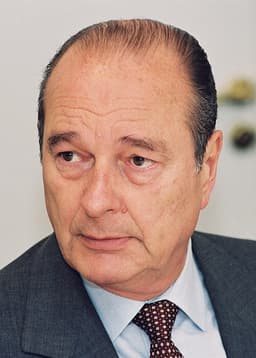
Jacques Chirac
Politician · Modern
60.7Total

Napoleon Bonaparte
General · Modern
70.9Total
Basic Information
Born
1932
1769
Died
—
1821
Era
Modern
Modern
Nationality
France
France
Occupation
Politician
General
Civilization
Western
Western
Score Comparison
Military (10%)
10.0
94.0
Political (20%)
72.0
72.0
Influence (20%)
82.0
40.0
Legacy (20%)
50.0
80.0
Leadership (15%)
78.0
78.0
Strategy (15%)
41.7
90.0
TOTAL
60.7
70.9
Jacques Chirac — Complete Timeline
1995 AD
Election as President of FrancePolitical Action◆ Major
Chirac was elected President of France, defeating Socialist candidate Lionel Jospin. His victory ended 14 years of Socialist presidency under Mitterrand, and he promised to reduce unemployment and social divisions.
ElectionPresidencyPolitical Change
Impact: national
Recognition of France's Role in the HolocaustPolitical Action◆ Major
Chirac officially recognized the French state's responsibility for the deportation of Jews during World War II, reversing the previous official position that the Vichy regime was not legitimate. This marked a significant shift in French historical memory.
HolocaustVichy FranceHistorical Memory
Impact: nationalconstructive
2003 AD
Opposition to the Iraq WarPolitical Action◆ Major
Chirac led France's opposition to the US-led invasion of Iraq, threatening to veto a UN Security Council resolution authorizing force. His stance garnered international support and strained Franco-American relations, but was popular in France and the Arab world.
Iraq WarForeign PolicyUN Security Council
Impact: global
Napoleon Bonaparte — Complete Timeline
1799 AD
Coup of 18 BrumaireOther◆ Major
Napoleon Bonaparte, with support from his brother Lucien and key political figures, overthrew the Directory in a bloodless coup. He established the Consulate with himself as First Consul, effectively becoming the ruler of France. This event ended the French Revolution's most unstable period.
French RevolutionCoupRise to Power
Impact: regional
1804 AD
Promulgation of the Napoleonic CodeOther◆ Major
Napoleon enacted the Civil Code of the French, known as the Napoleonic Code, a comprehensive set of laws that replaced the fragmented feudal legal systems. The code established legal equality, protected property rights, and secularized law. It became the basis for legal systems in many European and world countries.
Legal ReformNapoleonic CodeCivil Law
Impact: globalconstructive
1805 AD
Battle of AusterlitzWar◆ Major
Napoleon's Grande Arm
Napoleonic WarsBattleDecisive Victory
Impact: global
1812 AD
Invasion of RussiaWar◆ Major
Napoleon led the Grande Arm
Napoleonic WarsInvasionDisaster
Impact: globaldestructive
1815 AD
Battle of WaterlooWar◆ Major
Napoleon's French army was defeated by the combined forces of the Duke of Wellington's Anglo-Allied army and Gebhard Leberecht von Bl
Napoleonic WarsBattleFinal Defeat
Impact: globaldestructive
Expert Analysis
jacques-chirac-vs-napoleon-bonaparte
# The Emperor and the Mayor: Two French Visions of Power
On a rainy June evening in 1815, a man in a grey overcoat watched his empire dissolve into the mud of Waterloo. On a sunny May morning in 1995, another man stood at the Arc de Triomphe, acknowledging a nation that had chosen him as its president. Between these two moments lies not just a century and a half, but two fundamentally different ideas of what it means to lead France. Napoleon Bonaparte, the Corsican artilleryman who became master of Europe, and Jacques Chirac, the Parisian civil servant who became a master of the possible. One sought to conquer the world; the other sought to navigate it. Why such different paths, and what drove such different outcomes?
Origins
Napoleon was born in 1769 on the island of Corsica, a recent French acquisition where his family spoke Italian and resented the mainland. His father, a minor nobleman, secured him a place at French military academies, where the young Bonaparte was mocked for his accent and poverty. This outsider status forged a relentless ambition—he had everything to prove and nothing to lose. The chaos of the French Revolution provided the crucible. By 1795, at age 26, he had saved the revolutionary government from a royalist mob and been promoted to general.
Jacques Chirac was born in 1932 in Paris, the only child of a wealthy banker and a devout Catholic mother. His path was smoother: the elite Lycée Louis-le-Grand, then Sciences Po, then Harvard for a summer, then the École Nationale d'Administration—the factory of French technocrats. Chirac was never an outsider. He was the system's golden boy, groomed for power from the start. The difference is crucial: Napoleon fought his way into a world that rejected him; Chirac was welcomed into a world that expected him.
Rise to Power
Napoleon’s ascent was a series of gambles. In 1796, he took command of a starving, unpaid army in Italy and turned it into a legend, winning a dozen battles in a year. He was 26. By 1799, he had overthrown the government in a coup and made himself First Consul. By 1804, he crowned himself Emperor. Each step was a risk that could have killed him—literally, as he often led charges under enemy fire.
Chirac’s rise was a study in patience. He became Prime Minister in 1974 at age 42, but lost his bid for the presidency in 1981 and again in 1988. He waited, served as Mayor of Paris for 18 years, and finally won the presidency in 1995 at age 62. Where Napoleon seized, Chirac endured. One took power by force of will; the other by force of time.
Leadership & Governance
Napoleon governed with a pen as sharp as his sword. His Napoleonic Code, enacted in 1804, standardized French law across a fragmented continent, enshrining equality before the law and merit-based advancement. He built schools, roads, and a banking system. But he also centralized power absolutely, crushed dissent, and reinstated slavery in the colonies. His military score of 94 reflects a tactical genius who won 60 of his 70 battles—but his political score of 75 hints at his fatal inability to compromise.
Chirac governed as a pragmatist. His domestic reforms—pension changes, tax cuts—were incremental, not revolutionary. His greatest political act came in 1995 when he recognized France’s responsibility for deporting Jews during World War II, reversing decades of official denial. It was a moral gesture, not a military one. His leadership score of 82.6 reflects a man who understood that power is often about saying the right thing at the right time. His military score of 37.5 is almost comically low—but Chirac never claimed to be a soldier.
Triumph & Tragedy
Napoleon’s greatest moment was Austerlitz in 1805, where he crushed the combined armies of Russia and Austria with a masterful feint. His greatest tragedy was the invasion of Russia in 1812, where 600,000 men marched east and fewer than 100,000 returned. The pattern is clear: his ambition, his greatest strength, became his fatal flaw.
Chirac’s triumph was his opposition to the 2003 Iraq War. He threatened to veto the UN resolution, stood firm against American pressure, and became a global symbol of resistance. For a moment, France spoke for the world. His tragedy was more personal: his conviction for embezzlement in 2011, a stain on a long career. But even that was a minor scandal compared to Napoleon’s exile and death on a remote Atlantic island.
Character & Destiny
Napoleon was driven by an almost pathological need for validation. "I am not a man, but a thing," he once said. "I have no real friends, only those who serve me." His personality demanded total control, total victory, total glory. When he lost, he could not accept it—he returned from exile in 1815 to try again, and lost again.
Chirac was warmer, more human. He was known for his handshake, his love of beer and sumo wrestling, his ability to remember names. He was not a visionary but a survivor. "I am a man of compromise," he admitted. "I have no ideology, only a method." That method kept him in power for decades, but it also meant he left no grand monument, no Napoleonic Code, no enduring transformation.
Legacy
Napoleon’s legacy is a paradox. He is remembered as both a tyrant and a reformer, a conqueror and a lawgiver. His name appears on streets, codes, and wars across the world. His total score of 82.4 reflects a man who changed history, for better and worse.
Chirac’s legacy is quieter. He is remembered for saying "no" to war in Iraq, for saying "yes" to French responsibility for the Holocaust, for being the man who held France together in a changing world. His total score of 65.8 is lower, but perhaps that is the point. Napoleon reshaped the world; Chirac simply steered France through it.
Conclusion
Standing at the end of their stories, we see two Frenchmen who embodied two Frances: the France that dreams of glory and the France that endures. Napoleon believed that history is made by men who impose their will. Chirac believed that history is made by men who outlast their rivals. One built an empire that crumbled in a single day; the other built a career that lasted a lifetime. Perhaps the real question is not which was greater, but which we need more. In an age of grand ambitions and catastrophic failures, Chirac’s caution looks less like weakness and more like wisdom. But in an age of mediocrity, Napoleon’s fire still burns. The answer, like France itself, depends on the hour.
Rankings
🥇
Napoleon BonaparteLeader
Mil: 94.0Pol: 72.0Inf: 40.0
70.9
🥈
Jacques Chirac
Mil: 10.0Pol: 72.0Inf: 82.0
60.7
+10.2 behind
How This Comparison Works
Algorithm
Each figure is scored on 6 dimensions (0—100 scale) based on structured historical data: Military (10%), Political (20%), Influence (20%), Legacy (20%), Leadership (15%), Strategy (15%). The weighted total produces the final ranking.
Data Sources
Scores are computed from structured sub-indicators in the database. Scale factors adjust for era (Ancient ×0.85, Modern ×1.0) and civilization size (Eastern ×1.05, Other ×0.80) to account for differences in population and military scale.
Maximum 3 Figures
Comparisons are limited to 2—3 figures to ensure readability and statistical meaningfulness.
Error Margins
±5 points per dimension — Sub-scores are derived from historical records with inherent uncertainty. Two figures within 5 points on a dimension should be considered roughly equivalent in that area.
Total Score Accuracy
±3 points overall — The weighted combination of 6 dimensions produces a total score with approximately ±3 points of uncertainty. Differences of less than 3 points are not statistically significant— the figures are effectively tied.
Known Limitations
- Historical records are incomplete and uneven across civilizations
- Figures from oral-tradition societies may be underrepresented
- Occupation labels can misclassify multi-role figures
- Scores measure capability and impact, not moral character
- Quantitative scoring is a comparison tool, not absolute truth
Capability Radar
Military (10%) — Battles & Warfare
Battles
0
95
Win Rate
0
90
Expansion
0
95
Political (20%) — Governance & Reform
Reform
60
95
Diplomacy
70
80
Economy
55
85
Influence (20%) — Cultural & Global Reach
Cultural
50
85
Global
60
90
Legacy (20%) — Historical Impact
Historical
55
95
Longevity
40
90
Leadership (15%) — Power & Stability
Tenure
75
85
Stability
65
70
Strategy (15%) — Tactics & Innovation
Strategy
0
95
Tactics
0
98
Reform
5
92
Similar Comparisons
Comments & Discussion
Corsican Cannon6/17/2026
Napoleon redefined warfare with speed and decisive force—his 1805 Ulm campaign trapped an entire army in days without a major battle. Chirac’s military legacy? Banning nuclear tests in 1995 after one last blast at Mururoa. That’s not leadership; it’s a symbolic shrug. One man conquered Europe; the other canceled a few experiments. Don’t pretend these are comparable visions of power.
塞纳河上的影子6/17/2026
拿破仑的滑铁卢战役死了四万七千人,他可没写过悔过书。希拉克呢?1995年上台后,他承认了维希政权在1942年冬天把犹太人送进集中营,说是“法国的污点”。这不是忏悔,是政治作秀。一个真刀真枪干到底,一个只会低头道歉——法国需要的是统帅,不是心理医生。
Data Detonator6/17/2026
Let’s crunch numbers: Napoleon’s Grande Armée peaked at 600,000 men in 1812, but over 90% died in Russia. Chirac’s France in 2003? Zero troops lost in major combat during his tenure. You call Napoleon a genius; I call him a statistical catastrophe. Chirac knew survival beats spectacle. Check the GDP growth rates if you want to see who actually sustained French power.
旧制度的新斗篷6/17/2026
别傻了,拿破仑和希拉克都继承了法国的老毛病——中央集权。拿破仑用《民法典》把革命成果锁死了,希拉克呢?1997年宪法改革根本没动省长制度,巴黎还是那个铁腕中心。你以为他为民办事?不过是用新的“帝国”统治旧的国家。从枫丹白露到爱丽舍宫,换汤不换药。
Classics & Contradictions6/17/2026
As a historian, I appreciate contrasts: Napoleon’s legacy is the Arc de Triomphe—built for glory, now a traffic roundabout. Chirac’s is the Musée du Quai Branly—built to honor non-Western art, a soft rebuke to imperial arrogance. One gilded his ego; the other curated a guilty conscience. Neither truly solved France’s identity problem, but Chirac at least knew the Empire was over. Napoleon never learned that lesson.