Loading...
Jacques Chirac vs Nayib Bukele
Jacques Chirac leads by 6.3 pts · 2 figures compared
…
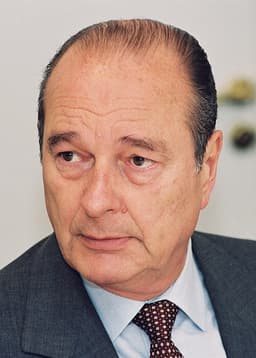
Jacques Chirac
Politician · Modern
60.7Total

Nayib Bukele
Politician · Modern
54.4Total
Basic Information
Born
1932
1981
Died
—
—
Era
Modern
Modern
Nationality
France
El Salvador
Occupation
Politician
Politician
Civilization
Western
Western
Score Comparison
Military (10%)
10.0
49.5
Political (20%)
72.0
60.0
Influence (20%)
82.0
61.0
Legacy (20%)
50.0
43.3
Leadership (15%)
78.0
68.0
Strategy (15%)
41.7
41.9
TOTAL
60.7
54.4
Jacques Chirac — Complete Timeline
1995 AD
Election as President of FrancePolitical Action◆ Major
Chirac was elected President of France, defeating Socialist candidate Lionel Jospin. His victory ended 14 years of Socialist presidency under Mitterrand, and he promised to reduce unemployment and social divisions.
ElectionPresidencyPolitical Change
Impact: national
Recognition of France's Role in the HolocaustPolitical Action◆ Major
Chirac officially recognized the French state's responsibility for the deportation of Jews during World War II, reversing the previous official position that the Vichy regime was not legitimate. This marked a significant shift in French historical memory.
HolocaustVichy FranceHistorical Memory
Impact: nationalconstructive
2003 AD
Opposition to the Iraq WarPolitical Action◆ Major
Chirac led France's opposition to the US-led invasion of Iraq, threatening to veto a UN Security Council resolution authorizing force. His stance garnered international support and strained Franco-American relations, but was popular in France and the Arab world.
Iraq WarForeign PolicyUN Security Council
Impact: global
Nayib Bukele — Complete Timeline
2012 AD
Elected Mayor of Nuevo CuscatlanPolitical Action
Nayib Bukele was elected mayor of Nuevo Cuscatlan as a candidate of the Farabundo Marti National Liberation Front (FMLN). His administration focused on transparency and urban development, gaining him a reputation as a reformist.
MayorFMLNLocal Government
constructive
2015 AD
Elected Mayor of San SalvadorPolitical Action◆ Major
Bukele was elected mayor of San Salvador, the capital, as an FMLN candidate. He implemented urban renewal projects, including the revitalization of the historic center, and used social media to engage citizens.
MayorSan SalvadorUrban Renewal
constructive
2019 AD
Elected President of El SalvadorPolitical Action◆ Major
Bukele won the presidential election as the candidate of the Grand Alliance for National Unity (GANA), defeating the FMLN and ARENA candidates. He broke the two-party system, running as an outsider and promising to fight corruption.
ElectionPresidentOutsider
Impact: nationalconstructive
2020 AD
Forced the Legislative Assembly to Approve Security FundingPolitical Action◆ Major
Bukele entered the Legislative Assembly with military personnel to pressure lawmakers into approving a $109 million loan for security equipment. The move was widely condemned as an authoritarian act and a violation of the separation of powers.
AuthoritarianismSeparation of PowersMilitary
Impact: nationaldestructive
2021 AD
Adopted Bitcoin as Legal TenderReform
Bukele's government passed the Bitcoin Law, making El Salvador the first country in the world to adopt Bitcoin as legal tender alongside the US dollar. The move aimed to promote financial inclusion and attract investment, but faced criticism from the IMF and concerns about volatility.
BitcoinCryptocurrencyFinancial Innovation
Impact: globalconstructive
2022 AD
Declared a State of Exception to Combat GangsPolitical Action◆ Major
Bukele's government declared a state of exception, suspending constitutional rights to crack down on gang violence. The policy led to the arrest of over 70,000 suspected gang members, dramatically reducing homicides but drawing accusations of human rights abuses.
Gang CrackdownState of ExceptionHuman Rights
Impact: nationaldestructive
Expert Analysis
Origins
Jacques Chirac was born on November 29, 1932, in Paris, France, into a well-off family. His father was a bank executive. Chirac studied at the elite Sciences Po and École Nationale d'Administration (ENA), the traditional training ground for French civil servants. He served in the military during the Algerian War.
Nayib Bukele was born on July 24, 1981, in San Salvador, El Salvador, to a family of Palestinian descent. His father was a chemist and businessman. Bukele studied at the Central American University but did not graduate. He entered politics early, joining the FMLN party.
Rise to Power
Chirac rose through the French political system, serving as Prime Minister twice (1974-1976 and 1986-1988) under President Valéry Giscard d'Estaing and later under François Mitterrand. He founded the neo-Gaullist party RPR. After losing the 1988 presidential election, he finally won the presidency in 1995, defeating Socialist Lionel Jospin. His victory ended 14 years of Socialist control.
Bukele's rise was faster and more disruptive. He was elected mayor of Nuevo Cuscatlán in 2012 and then mayor of San Salvador in 2015 as an FMLN candidate. He was expelled from FMLN in 2017 and formed his own party, Nuevas Ideas. In 2019, he won the presidency as the candidate of GANA, breaking the two-party system dominated by FMLN and ARENA. He took office on June 1, 2019, at age 37.
Leadership & Governance
Chirac's leadership style was pragmatic and focused on national unity. Domestically, he implemented economic reforms like privatization and reduced social spending, but faced massive strikes in 1995. His foreign policy was assertive, particularly in opposing the US-led Iraq War in 2003, which boosted his popularity at home but strained relations with the US. He also recognized France's role in the Holocaust in 1995, a major shift in official memory.
Bukele governs with a populist, confrontational style, often bypassing traditional institutions. He adopted Bitcoin as legal tender in 2021, making El Salvador the first country to do so, a risky experiment. His government declared a state of exception in 2022, suspending constitutional rights to crack down on gangs, leading to over 60,000 arrests. He also forced the Legislative Assembly to approve security funding by entering with military personnel in 2020. His approval ratings remain high, but critics warn of democratic backsliding.
Triumph & Tragedy
Chirac's greatest triumph was his opposition to the Iraq War, which cemented his legacy as a defender of multilateralism and French sovereignty. He also successfully hosted the 2003 G8 summit in Évian. His major failure was the 2005 referendum on the European Constitution, which French voters rejected, a blow to his European vision. Additionally, his later years were marred by a conviction for embezzlement during his time as mayor of Paris (though he was not imprisoned due to age and health).
Bukele's triumph is the dramatic reduction in gang violence: the murder rate fell from 51 per 100,000 in 2019 to 2.4 in 2023. His Bitcoin adoption, however, has been a failure, with the cryptocurrency's volatility causing losses and limited adoption. His heavy-handed security measures have led to accusations of human rights abuses, and his power consolidation threatens democratic checks.
Character & Destiny
Chirac was known for his charm, energy, and political adaptability. He was a skilled coalition-builder but also indecisive at times. His character shaped his fate: his opposition to the Iraq War was a principled stand that defined his presidency, but his inability to push through domestic reforms limited his impact. Historians rate him as a competent but not transformative leader.
Bukele is charismatic, tech-savvy, and authoritarian in style. He uses social media to communicate directly with supporters, bypassing traditional media. His destiny is tied to his gamble on Bitcoin and his security crackdown. If these succeed, he may be seen as a visionary; if they fail, he will be remembered as a populist who eroded democracy.
Legacy
Chirac's legacy is mixed. He is remembered for his opposition to the Iraq War, his recognition of Holocaust responsibility, and his role in European integration. However, his domestic achievements were limited. His total score is 60.7, with high marks for influence (82.0) and leadership (78.0), but low for military (10.0) and strategy (41.7).
Bukele's legacy is still forming. He has transformed El Salvador's security landscape but at the cost of democratic norms. His Bitcoin policy may be a footnote or a pioneering step. His total score is 54.4, with moderate leadership (68.0) and influence (61.0), but low legacy (43.3) due to the recency of his tenure.
Conclusion
Jacques Chirac had a greater impact on global affairs, given his role in shaping European and international relations, particularly his principled stand on the Iraq War. His influence score of 82.0 reflects this. Bukele's impact is more localized and controversial. While his security gains are tangible, his methods and Bitcoin experiment carry significant risks. Chirac's legacy, though imperfect, is more durable and broadly respected. Thus, Chirac emerges as the more significant historical figure.
Rankings
🥇
Jacques ChiracLeader
Mil: 10.0Pol: 72.0Inf: 82.0
60.7
🥈
Nayib Bukele
Mil: 49.5Pol: 60.0Inf: 61.0
54.4
+6.3 behind
How This Comparison Works
Algorithm
Each figure is scored on 6 dimensions (0—100 scale) based on structured historical data: Military (10%), Political (20%), Influence (20%), Legacy (20%), Leadership (15%), Strategy (15%). The weighted total produces the final ranking.
Data Sources
Scores are computed from structured sub-indicators in the database. Scale factors adjust for era (Ancient ×0.85, Modern ×1.0) and civilization size (Eastern ×1.05, Other ×0.80) to account for differences in population and military scale.
Maximum 3 Figures
Comparisons are limited to 2—3 figures to ensure readability and statistical meaningfulness.
Error Margins
±5 points per dimension — Sub-scores are derived from historical records with inherent uncertainty. Two figures within 5 points on a dimension should be considered roughly equivalent in that area.
Total Score Accuracy
±3 points overall — The weighted combination of 6 dimensions produces a total score with approximately ±3 points of uncertainty. Differences of less than 3 points are not statistically significant— the figures are effectively tied.
Known Limitations
- Historical records are incomplete and uneven across civilizations
- Figures from oral-tradition societies may be underrepresented
- Occupation labels can misclassify multi-role figures
- Scores measure capability and impact, not moral character
- Quantitative scoring is a comparison tool, not absolute truth
Capability Radar
Military (10%) — Battles & Warfare
Battles
0
27
Win Rate
0
32
Expansion
0
37
Political (20%) — Governance & Reform
Reform
60
70
Diplomacy
70
60
Economy
55
65
Influence (20%) — Cultural & Global Reach
Cultural
50
45
Global
60
50
Legacy (20%) — Historical Impact
Historical
55
40
Longevity
40
20
Leadership (15%) — Power & Stability
Tenure
75
55
Stability
65
50
Strategy (15%) — Tactics & Innovation
Strategy
0
35
Tactics
0
39
Reform
5
47
Similar Comparisons
Comments & Discussion
No comments yet. Be the first to share your thoughts!