Loading...
Jacques Chirac vs Rene Schick Gutierrez
Jacques Chirac leads by 20.2 pts · 2 figures compared
…
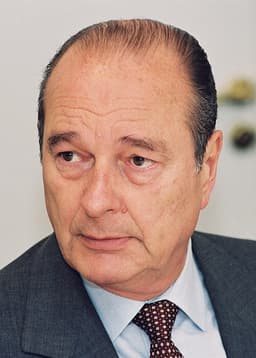
Jacques Chirac
Politician · Modern
60.7Total

Rene Schick Gutierrez
Politician · Modern
40.5Total
Basic Information
Born
1932
1909
Died
—
1966
Era
Modern
Modern
Nationality
France
Nicaragua
Occupation
Politician
Politician
Civilization
Western
Western
Score Comparison
Military (10%)
10.0
49.9
Political (20%)
72.0
29.3
Influence (20%)
82.0
45.5
Legacy (20%)
50.0
35.0
Leadership (15%)
78.0
45.0
Strategy (15%)
41.7
42.6
TOTAL
60.7
40.5
Jacques Chirac — Complete Timeline
1995 AD
Election as President of FrancePolitical Action◆ Major
Chirac was elected President of France, defeating Socialist candidate Lionel Jospin. His victory ended 14 years of Socialist presidency under Mitterrand, and he promised to reduce unemployment and social divisions.
ElectionPresidencyPolitical Change
Impact: national
Recognition of France's Role in the HolocaustPolitical Action◆ Major
Chirac officially recognized the French state's responsibility for the deportation of Jews during World War II, reversing the previous official position that the Vichy regime was not legitimate. This marked a significant shift in French historical memory.
HolocaustVichy FranceHistorical Memory
Impact: nationalconstructive
2003 AD
Opposition to the Iraq WarPolitical Action◆ Major
Chirac led France's opposition to the US-led invasion of Iraq, threatening to veto a UN Security Council resolution authorizing force. His stance garnered international support and strained Franco-American relations, but was popular in France and the Arab world.
Iraq WarForeign PolicyUN Security Council
Impact: global
Rene Schick Gutierrez — Complete Timeline
1963 AD
Appointment as Puppet PresidentPolitical Action◆ Major
Schick was elected president of Nicaragua as the candidate of the Nationalist Liberal Party, controlled by the Somoza family. He served as a figurehead president while the Somozas retained real power.
NicaraguaSomozaPuppet
Impact: national
1966 AD
Death in Office from Heart AttackOther
Schick died of a heart attack while still in office. His death led to a new presidential election, which was won by Anastasio Somoza Debayle, further consolidating the Somoza dynasty's rule.
NicaraguaSomozaDeath
Impact: national
Expert Analysis
Origins
Jacques Chirac was born on November 29, 1932, in Paris, France, into a middle-class family. His father was a bank executive, and his mother was a homemaker. Chirac studied at the prestigious Sciences Po and the École Nationale d'Administration (ENA), graduating in 1957. He served as an officer in the French Army during the Algerian War (1958-1962), an experience that shaped his later political views.
Rene Schick Gutierrez was born on April 23, 1909, in León, Nicaragua, into a politically connected family. He studied law at the National Autonomous University of Nicaragua and later worked as a lawyer and judge. Schick was a member of the Nationalist Liberal Party (PLN), which was dominated by the Somoza family, and he rose through the ranks as a loyal party figure.
Rise to Power
Chirac entered politics in the 1960s, serving as a junior minister under Prime Minister Georges Pompidou. He became Minister of Agriculture in 1972 and later Minister of the Interior in 1974. In 1974, he was appointed Prime Minister by President Valéry Giscard d'Estaing, but resigned in 1976 due to policy differences. He then founded the neo-Gaullist party Rally for the Republic (RPR) and became Mayor of Paris in 1977, a position he held until 1995. Chirac ran for president three times: he lost to François Mitterrand in 1981 and 1988, but won in 1995, defeating Socialist Lionel Jospin.
Schick was elected president of Nicaragua in 1963 as the candidate of the PLN, which was controlled by the Somoza family. The election was widely considered a sham, with Schick serving as a figurehead for the Somoza dynasty. His rise was due to his loyalty to the regime, not through popular support or independent political achievement.
Leadership & Governance
Chirac's leadership style was pragmatic and populist. As president, he pursued a mix of conservative and social policies. Domestically, he focused on reducing unemployment and cutting taxes, but his most notable reforms included the introduction of the 35-hour work week (though this was implemented by his government under Prime Minister Lionel Jospin) and the creation of the French social security system. Internationally, Chirac was a strong advocate for European integration and opposed the 2003 Iraq War, famously stating that France would veto any UN resolution authorizing force. He also recognized France's role in the Holocaust in 1995, a significant break from previous administrations.
Schick's governance was largely symbolic. He had no independent power; real authority rested with the Somoza family, particularly Anastasio Somoza Debayle, who commanded the National Guard. Schick did not initiate any major reforms or policies. His presidency was marked by corruption and repression, as the Somoza regime continued to suppress opposition and maintain control through force.
Triumph & Tragedy
Chirac's greatest triumph was his opposition to the Iraq War, which boosted France's international standing and earned him widespread approval at home. His recognition of France's Holocaust responsibility was also a historic step toward national reconciliation. However, his legacy is tarnished by a 2011 conviction for embezzlement and breach of trust while serving as Mayor of Paris (the "Paris City Hall jobs scandal"). He was sentenced to two years in prison (suspended) for diverting public funds to pay for political allies' jobs. Additionally, his economic policies failed to significantly reduce unemployment, which remained high throughout his presidency.
Schick's triumph is minimal; his main achievement was maintaining stability for the Somoza regime, but at the cost of democratic legitimacy. His tragedy was his complete lack of autonomy and his death in office from a heart attack on October 3, 1966. His death led to the election of Anastasio Somoza Debayle, who intensified repression, leading to the Sandinista revolution in 1979.
Character & Destiny
Chirac was known for his energy, ambition, and political savvy. He was a skilled negotiator and a charismatic public speaker. His character combined pragmatism with a strong sense of national pride. His destiny was to be a transformative figure in French politics, bridging the Gaullist and post-Gaullist eras. However, his involvement in corruption scandals diminished his moral authority.
Schick was a loyalist with no independent vision. He was a lawyer and bureaucrat who accepted the role of puppet president. His destiny was to be a footnote in Nicaraguan history, remembered only as a placeholder for the Somoza dynasty. He lacked the ambition or capability to challenge the regime, and his death marked the end of his minor role.
Legacy
Chirac's legacy is mixed but substantial. He is remembered for his stance against the Iraq War, which solidified France's independent foreign policy. His recognition of Holocaust responsibility was a landmark moral act. In France, he is seen as a skilled politician who modernized the Gaullist movement. His scores reflect his political influence (72.0) and leadership (78.0) but lower military (10.0) and strategy (41.7). His total score is 60.7.
Schick's legacy is negligible. He is largely forgotten outside of Nicaragua, and even there, he is overshadowed by the Somoza family. His scores are low across the board: political 29.3, influence 45.5, leadership 45.0, total 40.5. He had no lasting impact on Nicaragua's political development, which continued under the Somoza dictatorship until 1979.
Conclusion
Jacques Chirac had a significantly greater impact than Rene Schick Gutierrez. Chirac's total score of 60.7 surpasses Schick's 40.5 by 20.2 points. Chirac influenced French foreign policy, European integration, and historical memory. Schick was a passive figure in a repressive regime, with no independent achievements. While Chirac's legacy is flawed, his actions shaped global events. Schick's presidency was a brief, inconsequential interlude in a dictatorship. The clear position is that Chirac was the more impactful leader.
Rankings
🥇
Jacques ChiracLeader
Mil: 10.0Pol: 72.0Inf: 82.0
60.7
🥈
Rene Schick Gutierrez
Mil: 49.9Pol: 29.3Inf: 45.5
40.5
+20.2 behind
How This Comparison Works
Algorithm
Each figure is scored on 6 dimensions (0—100 scale) based on structured historical data: Military (10%), Political (20%), Influence (20%), Legacy (20%), Leadership (15%), Strategy (15%). The weighted total produces the final ranking.
Data Sources
Scores are computed from structured sub-indicators in the database. Scale factors adjust for era (Ancient ×0.85, Modern ×1.0) and civilization size (Eastern ×1.05, Other ×0.80) to account for differences in population and military scale.
Maximum 3 Figures
Comparisons are limited to 2—3 figures to ensure readability and statistical meaningfulness.
Error Margins
±5 points per dimension — Sub-scores are derived from historical records with inherent uncertainty. Two figures within 5 points on a dimension should be considered roughly equivalent in that area.
Total Score Accuracy
±3 points overall — The weighted combination of 6 dimensions produces a total score with approximately ±3 points of uncertainty. Differences of less than 3 points are not statistically significant— the figures are effectively tied.
Known Limitations
- Historical records are incomplete and uneven across civilizations
- Figures from oral-tradition societies may be underrepresented
- Occupation labels can misclassify multi-role figures
- Scores measure capability and impact, not moral character
- Quantitative scoring is a comparison tool, not absolute truth
Capability Radar
Military (10%) — Battles & Warfare
Battles
0
26
Win Rate
0
33
Expansion
0
36
Political (20%) — Governance & Reform
Reform
60
5
Diplomacy
70
10
Economy
55
10
Influence (20%) — Cultural & Global Reach
Cultural
50
5
Global
60
5
Legacy (20%) — Historical Impact
Historical
55
5
Longevity
40
5
Leadership (15%) — Power & Stability
Tenure
75
20
Stability
65
15
Strategy (15%) — Tactics & Innovation
Strategy
0
38
Tactics
0
41
Reform
5
45
Similar Comparisons
Comments & Discussion
No comments yet. Be the first to share your thoughts!