Loading...
This comparison has not been analyzed yet.
One-time AI generation (~1 minute). Scores and timeline are already available below.
Jalal Talabani vs Nikita Khrushchev
Nikita Khrushchev leads by 9.1 pts · 2 figures compared
…

Jalal Talabani
Politician · Modern
55.5Total
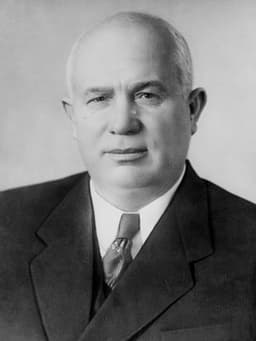
Nikita Khrushchev
Politician · Modern
64.6Total
Basic Information
Born
1933
1894
Died
—
1971
Era
Modern
Modern
Nationality
Iraq
Russia
Occupation
Politician
Politician
Civilization
Middle Eastern
Western
Score Comparison
Military (10%)
23.4
43.3
Political (20%)
68.0
70.0
Influence (20%)
61.0
82.0
Legacy (20%)
49.2
52.0
Leadership (15%)
72.0
72.0
Strategy (15%)
46.3
54.8
TOTAL
55.5
64.6
Jalal Talabani — Complete Timeline
2005 AD
Elected President of IraqPolitical Action
Jalal Talabani was elected President of Iraq by the National Assembly, becoming the first Kurdish head of state in the country's history. His election was a landmark for Kurdish representation in post-Saddam Iraq.
PresidencyKurdish RightsPost-Saddam
Impact: nationalconstructive
Negotiated Iraqi ConstitutionPolitical Action◆ Major
As president, Talabani played a key role in negotiating the new Iraqi constitution, which established a federal system and recognized Kurdish autonomy. The constitution was approved by referendum in October 2005.
ConstitutionFederalismKurdistan
Impact: nationalconstructive
2009 AD
Re-elected for Second TermPolitical Action
Talabani was re-elected for a second term as president, reflecting his continued role as a unifying figure in Iraq's fragile political landscape. His tenure saw ongoing sectarian tensions and the withdrawal of US troops.
Re-electionPolitical Stability
Impact: national
Nikita Khrushchev — Complete Timeline
1956 AD
Secret Speech on the Cult of PersonalityPolitical Action
Khrushchev delivered a closed-session speech to the 20th Congress of the Communist Party, denouncing Stalin's cult of personality and crimes. This speech initiated de-Stalinization, leading to political reforms and the release of political prisoners.
De-StalinizationSpeechCommunist Party
Impact: globalconstructive
1957 AD
Launch of Sputnik 1Invention◆ Major
Under Khrushchev's leadership, the Soviet Union launched Sputnik 1, the first artificial satellite to orbit Earth. This achievement sparked the Space Race and demonstrated Soviet technological superiority at the time.
Space RaceSatelliteTechnology
Impact: globalconstructive
1958 AD
Berlin UltimatumPolitical Action◆ Major
Khrushchev issued an ultimatum demanding the withdrawal of Western forces from West Berlin within six months. The ultimatum escalated Cold War tensions but was eventually dropped after negotiations, leading to the Berlin Crisis of 1961.
Cold WarBerlinUltimatum
Impact: global
1962 AD
Cuban Missile CrisisWar
Khrushchev authorized the placement of Soviet nuclear missiles in Cuba, leading to a 13-day confrontation with the United States. The crisis ended with a negotiated withdrawal of missiles from both Cuba and Turkey, averting nuclear war.
Cold WarNuclear CrisisCuba
Impact: global
1964 AD
Ouster from PowerPolitical Action◆ Major
Khrushchev was removed from his positions as First Secretary and Premier by the Communist Party leadership, led by Leonid Brezhnev. The ouster was due to his erratic policies, the Cuban Missile Crisis fallout, and agricultural failures.
CoupBrezhnevSoviet Union
Impact: nationaltragic
This comparison has not been analyzed yet.
One-time AI generation (~1 minute). Scores and timeline are already available below.
Rankings
🥇
Nikita KhrushchevLeader
Mil: 43.3Pol: 70.0Inf: 82.0
64.6
🥈
Jalal Talabani
Mil: 23.4Pol: 68.0Inf: 61.0
55.5
+9.1 behind
How This Comparison Works
Algorithm
Each figure is scored on 6 dimensions (0—100 scale) based on structured historical data: Military (10%), Political (20%), Influence (20%), Legacy (20%), Leadership (15%), Strategy (15%). The weighted total produces the final ranking.
Data Sources
Scores are computed from structured sub-indicators in the database. Scale factors adjust for era (Ancient ×0.85, Modern ×1.0) and civilization size (Eastern ×1.05, Other ×0.80) to account for differences in population and military scale.
Maximum 3 Figures
Comparisons are limited to 2—3 figures to ensure readability and statistical meaningfulness.
Error Margins
±5 points per dimension — Sub-scores are derived from historical records with inherent uncertainty. Two figures within 5 points on a dimension should be considered roughly equivalent in that area.
Total Score Accuracy
±3 points overall — The weighted combination of 6 dimensions produces a total score with approximately ±3 points of uncertainty. Differences of less than 3 points are not statistically significant— the figures are effectively tied.
Known Limitations
- Historical records are incomplete and uneven across civilizations
- Figures from oral-tradition societies may be underrepresented
- Occupation labels can misclassify multi-role figures
- Scores measure capability and impact, not moral character
- Quantitative scoring is a comparison tool, not absolute truth
Capability Radar
Military (10%) — Battles & Warfare
Battles
25
5
Win Rate
26
10
Expansion
30
20
Political (20%) — Governance & Reform
Reform
55
80
Diplomacy
70
70
Economy
40
55
Influence (20%) — Cultural & Global Reach
Cultural
50
60
Global
45
70
Legacy (20%) — Historical Impact
Historical
55
75
Longevity
40
55
Leadership (15%) — Power & Stability
Tenure
65
75
Stability
45
50
Strategy (15%) — Tactics & Innovation
Strategy
36
15
Tactics
37
10
Reform
41
30
Similar Comparisons
Comments & Discussion
No comments yet. Be the first to share your thoughts!