Loading...
James I of Scotland vs Napoleon Bonaparte
Napoleon Bonaparte leads by 26.3 pts · 2 figures compared
…
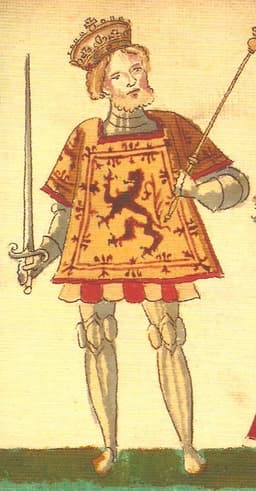
James I of Scotland
Emperor · Medieval
44.6Total

Napoleon Bonaparte
General · Modern
70.9Total
Basic Information
Born
1394
1769
Died
1437
1821
Era
Medieval
Modern
Nationality
Scotland
France
Occupation
Emperor
General
Civilization
Western
Western
Score Comparison
Military (10%)
21.2
94.0
Political (20%)
43.7
72.0
Influence (20%)
54.9
40.0
Legacy (20%)
45.0
80.0
Leadership (15%)
48.4
78.0
Strategy (15%)
36.8
90.0
TOTAL
44.6
70.9
James I of Scotland — Complete Timeline
1406 AD
Capture by English PiratesOther
James I was captured by English pirates while traveling to France for safety. He was handed over to Henry IV of England and imprisoned in the Tower of London, remaining a captive for 18 years. His father Robert III died soon after, leaving Scotland without a king.
CaptureImprisonmentRegency
Impact: nationaltragic
1424 AD
Release and Return to ScotlandPolitical Action◆ Major
James I was released from English captivity after the Treaty of London, which required a ransom of 40,000 pounds. He returned to Scotland and was crowned at Scone, beginning his personal rule after 18 years of regency.
ReleaseCoronationRansom
Impact: nationalconstructive
Publication of The Kingis QuairCultural
James I wrote The Kingis Quair, a poetic allegory of his imprisonment and love for Joan Beaufort. The poem is considered a major work of Middle Scots literature and reflects the influence of Chaucer on Scottish poetry.
PoetryLiteratureImprisonment
Impact: nationalconstructive
1425 AD
Execution of Albany StewartsPolitical Action◆ Major
James I executed Murdoch Stewart, Duke of Albany, and his sons at Stirling Castle for treason. The executions eliminated the powerful Albany family, who had ruled as regents during James's captivity, and consolidated royal power.
ExecutionNoble PurgeCentralization
Impact: nationaldestructive
1437 AD
Assassination at PerthPolitical Action
James I was assassinated by a group of nobles led by Sir Robert Graham at the Blackfriars monastery in Perth. The murder was a response to James's centralizing policies and harsh treatment of the nobility. His death plunged Scotland into another period of regency.
AssassinationNoble RevoltRegency
Impact: nationaltragic
Napoleon Bonaparte — Complete Timeline
1799 AD
Coup of 18 BrumaireOther◆ Major
Napoleon Bonaparte, with support from his brother Lucien and key political figures, overthrew the Directory in a bloodless coup. He established the Consulate with himself as First Consul, effectively becoming the ruler of France. This event ended the French Revolution's most unstable period.
French RevolutionCoupRise to Power
Impact: regional
1804 AD
Promulgation of the Napoleonic CodeOther◆ Major
Napoleon enacted the Civil Code of the French, known as the Napoleonic Code, a comprehensive set of laws that replaced the fragmented feudal legal systems. The code established legal equality, protected property rights, and secularized law. It became the basis for legal systems in many European and world countries.
Legal ReformNapoleonic CodeCivil Law
Impact: globalconstructive
1805 AD
Battle of AusterlitzWar◆ Major
Napoleon's Grande Arm
Napoleonic WarsBattleDecisive Victory
Impact: global
1812 AD
Invasion of RussiaWar◆ Major
Napoleon led the Grande Arm
Napoleonic WarsInvasionDisaster
Impact: globaldestructive
1815 AD
Battle of WaterlooWar◆ Major
Napoleon's French army was defeated by the combined forces of the Duke of Wellington's Anglo-Allied army and Gebhard Leberecht von Bl
Napoleonic WarsBattleFinal Defeat
Impact: globaldestructive
Expert Analysis
james-i-of-scotland-vs-napoleon-bonaparte
### The Prisoner and the Conqueror: Two Paths of Royal Ambition
On a cold February night in 1437, a king screamed for help as assassins hacked through the floorboards of a Blackfriars monastery in Perth. James I of Scotland, a poet and centralizer, died alone, his reforms unfinished. Just over three centuries later, on a June evening in 1815, another ruler watched his world collapse at Waterloo. Napoleon Bonaparte, master of Europe, rode from the field in a carriage, headed for exile. Both men sought to reshape their kingdoms. One was murdered by his nobles; the other died on a remote Atlantic island. Why did their ambitions lead to such different ends?
### Origins
Napoleon Bonaparte was born in 1769 on Corsica, an island recently annexed by France. His family was minor nobility, but his education at French military academies forged him into a child of the Enlightenment—rational, ambitious, and distrustful of old hierarchies. The French Revolution, erupting when he was twenty, shattered the old order and opened a path for talent over birth. James I, born in 1394, came into a different world: medieval Scotland, a land of clan loyalties, weak central authority, and constant English predation. He was a child of dynastic accident, a prince whose father was murdered when James was twelve, leaving him king in name only.
### Rise to Power
Napoleon’s ascent was meteoric and self-made. At twenty-four, he drove the British out of Toulon; at twenty-six, he crushed a royalist uprising in Paris. By thirty, he was First Consul of France, and by thirty-five, Emperor. Each step was a gamble he won through military brilliance and ruthless political cunning. James I’s rise was entirely different. In 1406, while traveling to France for safety, the eleven-year-old king was captured by English pirates and handed to Henry IV of England. He spent eighteen years as a hostage, learning English courtly culture, writing poetry—including *The Kingis Quair*, a beautiful allegory of his captivity and love for Joan Beaufort—and waiting. He returned to Scotland in 1424 only after a ransom of 40,000 pounds was paid. He did not conquer his throne; he inherited it, then had to reclaim it from nobles who had ruled without him.
### Leadership & Governance
Napoleon governed as a military genius and a political revolutionary. His Napoleonic Code standardized French law, abolished feudal privileges, and spread meritocracy across Europe. He built roads, reformed education, and centralized the state with the efficiency of an artillery barrage. His military score of 94 reflects his near-invincibility on the battlefield—until it faltered. Yet his political score of 75 shows his limits: he could conquer but struggled to consolidate, alienating allies with his ambition.
James I governed from a position of weakness. After eighteen years of captivity, he found a kingdom where nobles, especially the Albany Stewarts, had grown powerful during his absence. In 1425, he struck: he executed Murdoch Stewart, Duke of Albany, and his sons at Stirling Castle for treason. It was a brutal, necessary act of centralization—eliminating the most powerful rival family. He then reformed the Scottish crown’s finances, curbed noble lawlessness, and promoted justice. But his methods were harsh, his trust thin. His military score of 30 and political score of 49.8 reflect a ruler who was more a prisoner of his circumstances than a master of them.
### Triumph & Tragedy
Napoleon’s greatest moment was Austerlitz in 1805, where he destroyed a Russo-Austrian army with a strategy so perfect it became a textbook example. His tragedy was the invasion of Russia in 1812—600,000 men marched east, fewer than 100,000 returned. Waterloo was the final blow, a battle he almost won but lost to Prussian reinforcements and his own hesitation. James I’s triumph was the execution of the Albany Stewarts and the assertion of royal authority—a genuine achievement after decades of noble dominance. His tragedy was his assassination in 1437, at the hands of Sir Robert Graham and a conspiracy of disgruntled nobles. He died in a monastery, betrayed by those he had tried to control.
### Character & Destiny
Napoleon was a whirlwind of confidence, intelligence, and insatiable ambition. “Impossible is a word to be found only in the dictionary of fools,” he once said. That drive made him, then broke him. He could not stop conquering, and so he fell. James I was a poet-captive, shaped by solitude and loss. His *Kingis Quair* reveals a man who endured, who loved, who believed in order. But his captivity left him isolated from the networks of trust that medieval kingship required. He ruled through fear, not loyalty, and fear eventually turned to daggers.
### Legacy
Napoleon’s legacy is monumental. The Napoleonic Code influences legal systems worldwide. His wars redrew Europe’s map. He is remembered as both a liberator and a tyrant, a symbol of human potential and human overreach. His scores—Military 94, Influence 82, Legacy 78—reflect a figure who changed history, for better and worse. James I’s legacy is quieter but real. His poetry is a treasure of Scots literature. His centralization set the stage for later Stewart kings, though his murder showed how fragile that work was. His scores—Influence 73.1, Legacy 59.5—speak to a ruler who mattered in his time but whose name is now known mostly to scholars.
### Conclusion
Napoleon and James I both tried to forge order from chaos, but they lived in different eras of possibility. Napoleon had the gunpowder, the bureaucracy, and the revolutionary fervor to reshape a continent. James I had only a crown, a poem, and a determination to rule. One died in exile, the other in a pool of blood. Their stories remind us that ambition is universal, but the stage upon which it plays out—whether a battlefield of nations or a hall of clans—determines the final act.
Rankings
🥇
Napoleon BonaparteLeader
Mil: 94.0Pol: 72.0Inf: 40.0
70.9
🥈
James I of Scotland
Mil: 21.2Pol: 43.7Inf: 54.9
44.6
+26.3 behind
How This Comparison Works
Algorithm
Each figure is scored on 6 dimensions (0—100 scale) based on structured historical data: Military (10%), Political (20%), Influence (20%), Legacy (20%), Leadership (15%), Strategy (15%). The weighted total produces the final ranking.
Data Sources
Scores are computed from structured sub-indicators in the database. Scale factors adjust for era (Ancient ×0.85, Modern ×1.0) and civilization size (Eastern ×1.05, Other ×0.80) to account for differences in population and military scale.
Maximum 3 Figures
Comparisons are limited to 2—3 figures to ensure readability and statistical meaningfulness.
Error Margins
±5 points per dimension — Sub-scores are derived from historical records with inherent uncertainty. Two figures within 5 points on a dimension should be considered roughly equivalent in that area.
Total Score Accuracy
±3 points overall — The weighted combination of 6 dimensions produces a total score with approximately ±3 points of uncertainty. Differences of less than 3 points are not statistically significant— the figures are effectively tied.
Known Limitations
- Historical records are incomplete and uneven across civilizations
- Figures from oral-tradition societies may be underrepresented
- Occupation labels can misclassify multi-role figures
- Scores measure capability and impact, not moral character
- Quantitative scoring is a comparison tool, not absolute truth
Capability Radar
Military (10%) — Battles & Warfare
Battles
10
95
Win Rate
10
90
Expansion
10
95
Political (20%) — Governance & Reform
Reform
50
95
Diplomacy
30
80
Economy
40
85
Influence (20%) — Cultural & Global Reach
Cultural
50
85
Global
20
90
Legacy (20%) — Historical Impact
Historical
40
95
Longevity
30
90
Leadership (15%) — Power & Stability
Tenure
40
85
Stability
20
70
Strategy (15%) — Tactics & Innovation
Strategy
10
95
Tactics
10
98
Reform
10
92
Similar Comparisons
Comments & Discussion
战场观察者6/17/2026
拿破仑打了六十多场战役,詹姆斯一世连一场像样的仗都没打过——这算什么比较?拿破仑靠军事天才崛起,用大炮和法典重塑欧洲;詹姆斯一世一辈子最硬核的战绩就是砍了几个不顺从的贵族。他的“改革”不过是中世纪权力的内耗游戏,跟拿破仑的帝国野心完全不是一个量级。说詹姆斯是“诗人国王”像是在夸他,但他那点文化成就根本撑不起“王者”的称号。
HISTORY_SNARK6/17/2026
Comparing a puppet king to a world-historic titan is like comparing a village bakery to Amazon. James I was a medieval footnote—his biggest claim to fame is that he died dramatically in a sewer drain. Napoleon reshaped legal codes and redrew borders; James struggled to control a few hundred Scottish clans. The only parallel is that both faced violent ends, but Napoleon’s exile on St. Helena was a geopolitical chess move, while James’s murder was a messy family squabble. Context matters: one was
经典学究6/17/2026
从王朝价值看,拿破仑是历史怪胎,詹姆斯一世才是中世纪的正常帝王。拿破仑靠革命暴力和个人野心颠覆传统秩序,是典型的僭主;詹姆斯一世在囚禁中学习了英格兰的治理经验,回国后试图用法律和宗教巩固王室,这更接近马基雅维利笔下理想的“新君主”。他的税务改革和议会调整虽然没能完全成功,但比拿破仑的帝国更符合欧洲政治演变的逻辑。拿破仑的失败几乎是必然的,而詹姆斯的悲剧在于他太超前了。
数据侦探6/17/2026
历史比较不能只看名气,要看实质产出。拿破仑在十几年间让法国陷入战争泥潭,死亡人数超过百万;詹姆斯一世统治了13年,苏格兰内部相对稳定,经济略有起色。拿破仑的“法典”确实伟大,但詹姆斯推行了《国王法案》规范继承权,同样是国家基础建设。拿人口死伤率算,詹姆斯一世的“统治成本”远远低于拿破仑。所谓“世界征服者”不过是另一种形式的破坏者,而詹姆斯至少死前没把国家拖入深渊。
WaterlooWonk6/17/2026
Napoleon's story is a 19th-century meritocracy dream, but James I? He was a medieval hostage who spent 18 years as a prisoner in England—that’s not a rise, that’s a slow burn. Napoleon seized power with gunpowder and charisma; James returned from captivity with a chip on his shoulder and a list of reforms to break the Scottish nobility's grip. One was a conqueror of continents; the other, a poet king who barely survived his own court. It’s tragedy versus spectacle—James’s murder in Perth was a f