Loading...
James V of Scotland vs Napoleon Bonaparte
Napoleon Bonaparte leads by 30.2 pts · 2 figures compared
…
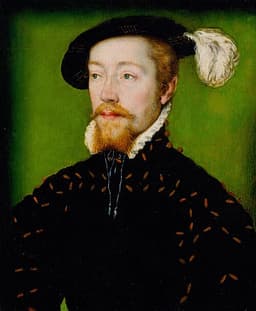
James V of Scotland
Emperor · Medieval
40.7Total

Napoleon Bonaparte
General · Modern
70.9Total
Basic Information
Born
1512
1769
Died
1542
1821
Era
Medieval
Modern
Nationality
Scotland
France
Occupation
Emperor
General
Civilization
Western
Western
Score Comparison
Military (10%)
22.6
94.0
Political (20%)
36.5
72.0
Influence (20%)
48.6
40.0
Legacy (20%)
40.0
80.0
Leadership (15%)
48.4
78.0
Strategy (15%)
35.7
90.0
TOTAL
40.7
70.9
James V of Scotland — Complete Timeline
1538 AD
Marriage to Mary of GuisePolitical Action◆ Major
James V married Mary of Guise, a French noblewoman, as his second wife. The marriage strengthened the Auld Alliance with France and produced a daughter, Mary, who would become Mary Queen of Scots.
MarriageAuld AllianceFrance
Impact: nationalconstructive
1540 AD
Execution of James Hamilton of FinnartPolitical Action
James V executed James Hamilton of Finnart, a powerful noble and former regent, for treason. The execution was part of James's policy to curb noble power and centralize royal authority, but it created lasting enmity with the Hamilton family.
ExecutionNoble PurgeCentralization
Impact: nationaldestructive
Suppression of the Lords of the IslesPolitical Action◆ Major
James V conducted a campaign to suppress the Lords of the Isles, who had long held semi-independent power in the Highlands and Islands. He executed the last Lord of the Isles, Donald Dubh, and annexed their territories to the crown.
SuppressionHighlandsCentralization
Impact: regionaldestructive
1542 AD
Battle of Solway MossWar
James V's Scottish army was routed by a smaller English force at Solway Moss near the River Esk. The defeat was a humiliating disaster, with many Scottish nobles captured. James V died shortly after, reportedly of despair.
BattleDefeatDeath
Impact: nationaltragic
Napoleon Bonaparte — Complete Timeline
1799 AD
Coup of 18 BrumaireOther◆ Major
Napoleon Bonaparte, with support from his brother Lucien and key political figures, overthrew the Directory in a bloodless coup. He established the Consulate with himself as First Consul, effectively becoming the ruler of France. This event ended the French Revolution's most unstable period.
French RevolutionCoupRise to Power
Impact: regional
1804 AD
Promulgation of the Napoleonic CodeOther◆ Major
Napoleon enacted the Civil Code of the French, known as the Napoleonic Code, a comprehensive set of laws that replaced the fragmented feudal legal systems. The code established legal equality, protected property rights, and secularized law. It became the basis for legal systems in many European and world countries.
Legal ReformNapoleonic CodeCivil Law
Impact: globalconstructive
1805 AD
Battle of AusterlitzWar◆ Major
Napoleon's Grande Arm
Napoleonic WarsBattleDecisive Victory
Impact: global
1812 AD
Invasion of RussiaWar◆ Major
Napoleon led the Grande Arm
Napoleonic WarsInvasionDisaster
Impact: globaldestructive
1815 AD
Battle of WaterlooWar◆ Major
Napoleon's French army was defeated by the combined forces of the Duke of Wellington's Anglo-Allied army and Gebhard Leberecht von Bl
Napoleonic WarsBattleFinal Defeat
Impact: globaldestructive
Expert Analysis
james-v-of-scotland-vs-napoleon-bonaparte
# The Conqueror and the Broken King
On a December morning in 1542, a Scottish king lay dying in Falkland Palace, his face turned to the wall, refusing food or comfort. James V was just thirty years old. Three weeks earlier, his army had been routed by a much smaller English force at the Battle of Solway Moss—not a great clash of empires, but a humiliating skirmish near the River Esk that shattered his spirit. As he gasped his last, he reportedly murmured that the Stewart dynasty had begun with a lass and would end with one—a prophecy fulfilled when his infant daughter Mary took the throne.
Two and a half centuries later, another man would stand on the deck of a ship in the Mediterranean, watching the pyramids of Egypt rise against a desert dawn. Napoleon Bonaparte was also thirty years old, but he was ascending, not descending. His army had just won the Battle of the Pyramids, and all of Europe lay before him like a ripe fruit waiting to be plucked.
What separates a man who conquers a continent from a man who dies of despair after a single defeat? The answer lies not merely in talent, but in the peculiar alchemy of character, circumstance, and the age into which each was born.
Origins
James V inherited a kingdom that was poor, fractious, and perpetually overshadowed by its southern neighbor. Born in 1512, he became king as an infant after his father James IV died at the disastrous Battle of Flodden—a pattern of defeat that haunted the Stewarts. Scotland in the 16th century was a land of powerful nobles who treated the crown as a convenience, not a command. James grew up in a world of shifting alliances, where loyalty was measured in cattle and the English border was a wound that never healed.
Napoleon, by contrast, was born in 1769 on Corsica, an island that had just become French. His family were minor nobility, but they were outsiders—Italian-speaking Corsicans in a French world. This marginality gave him something James never had: a sense that the world was there to be taken, not inherited. Where James saw limits, Napoleon saw opportunities.
The difference in their eras was even more profound. James lived in a medieval world where power was personal, based on blood and land. Napoleon came of age in the wake of the French Revolution, when old certainties were being swept away and talent could vault a man from obscurity to empire.
Rise to Power
James V became king at seventeen months. His rise was not a climb but a waiting game—years of regents, noble feuds, and careful maneuvering. When he finally took personal control, his method was brutal and direct. In 1540, he executed James Hamilton of Finnart, a powerful noble and former regent, for treason. That same year, he suppressed the Lords of the Isles, breaking the semi-independent power of the Highland chieftains. These were the actions of a king trying to build a modern state with medieval tools—force, fear, and the occasional marriage alliance.
Napoleon’s rise was altogether different. He was a young artillery officer who shot his way to fame at the Siege of Toulon in 1793. The Revolution had created a vacuum of power and a demand for men who could deliver victory. Napoleon did not inherit an army—he built one, forged in the fires of the Italian campaign of 1796-97. His path was not one of careful maneuvering but of audacious gambles that paid off spectacularly.
The key difference: James had to make do with what he was given, while Napoleon could create what he needed.
Leadership & Governance
James V ruled as a Renaissance monarch in a kingdom that was still feudal. He married Mary of Guise in 1538, strengthening the Auld Alliance with France—a diplomatic move that gave Scotland a powerful ally but also tied its fortunes to a foreign power. His governance was personal, based on loyalty and fear. He had no grand code of laws, no sweeping reforms. He was trying to hold together a kingdom that was always threatening to fall apart.
Napoleon, by contrast, was a reformer on a continental scale. The Napoleonic Code, implemented in 1804, standardized French law and influenced legal systems across Europe. He restructured education, created the Bank of France, and established a meritocratic bureaucracy. His military genius was matched by an organizational brilliance that could turn conquered territories into functioning parts of an empire.
Yet there was a dark symmetry. James V’s Scotland was too poor and divided to project power. Napoleon’s France was so powerful that it eventually provoked the entire continent to unite against it. James failed because he had too little; Napoleon failed because he had too much and reached too far.
Triumph & Tragedy
James V’s greatest triumph was perhaps his suppression of the Lords of the Isles, which brought the Highlands under royal control for the first time. But his tragedy came quickly: the Battle of Solway Moss in 1542, where a Scottish army of perhaps 15,000 was routed by an English force of 3,000. The defeat was not just military—it was existential. James had staked his reputation on this campaign, and when it failed, he simply gave up. He died of despair, or possibly a broken heart, leaving an infant daughter and a kingdom in chaos.
Napoleon’s triumphs were staggering: Austerlitz in 1805, Jena in 1806, the invasion of Russia in 1812 that began with such promise. But his tragedy was equally grand: the retreat from Moscow, the defeat at Leipzig in 1813, the final humiliation at Waterloo in 1815. Yet even in defeat, Napoleon did not die of despair. He wrote memoirs, schemed, and remained defiant until the end. Exiled to Saint Helena, he lived for six more years, still plotting, still believing.
Character & Destiny
James V was a king who could not endure failure. His personality was shaped by a childhood of insecurity and a reign of constant threat. When the one great gamble of his life failed, he had no reserves of resilience. He was a man of his time—a medieval king whose identity was so bound up with his role that defeat meant annihilation.
Napoleon was different. He was an outsider who had clawed his way to power, and that struggle had forged in him an almost inhuman resilience. He once said, “Impossible is a word to be found only in the dictionary of fools.” He could lose an army, an empire, a war—and still believe that tomorrow he would find a way back. This was not wisdom; it was obsession. But it was the obsession of a man who had created himself, not inherited a role.
Legacy
James V is remembered today primarily as the father of Mary, Queen of Scots, and as a king who died of shame. His legacy is a cautionary tale: the failure of a ruler who could not adapt to the changing demands of kingship. His scores in military and political leadership are low—16.7 and 45.8 respectively—reflecting a reign that was competent but tragic.
Napoleon’s legacy is vast and contested. His military genius is undisputed—with a strategy score of 93 and military score of 94, he ranks among history’s greatest commanders. His political and legal reforms shaped modern Europe. But he also brought ruin to millions and sowed the seeds of nationalist wars that would rage for a century. He is remembered as both liberator and tyrant, genius and monster.
Conclusion
Standing at the end of history, we might ask: who was the greater failure? James V, who died because he could not bear a single defeat? Or Napoleon, who died in exile after conquering a continent and losing it all? Perhaps the answer is that failure is not measured by the scale of the fall, but by what one does with the time between the fall and the end.
James V had three weeks. Napoleon had six years. One turned his face to the wall; the other kept writing, kept dreaming, kept defying the world until his last breath. In that difference lies not just the story of two men, but the story of what separates a king from a conqueror—and what makes one man die of despair while another dies still believing that tomorrow, somehow, he will rise again.
Rankings
🥇
Napoleon BonaparteLeader
Mil: 94.0Pol: 72.0Inf: 40.0
70.9
🥈
James V of Scotland
Mil: 22.6Pol: 36.5Inf: 48.6
40.7
+30.2 behind
How This Comparison Works
Algorithm
Each figure is scored on 6 dimensions (0—100 scale) based on structured historical data: Military (10%), Political (20%), Influence (20%), Legacy (20%), Leadership (15%), Strategy (15%). The weighted total produces the final ranking.
Data Sources
Scores are computed from structured sub-indicators in the database. Scale factors adjust for era (Ancient ×0.85, Modern ×1.0) and civilization size (Eastern ×1.05, Other ×0.80) to account for differences in population and military scale.
Maximum 3 Figures
Comparisons are limited to 2—3 figures to ensure readability and statistical meaningfulness.
Error Margins
±5 points per dimension — Sub-scores are derived from historical records with inherent uncertainty. Two figures within 5 points on a dimension should be considered roughly equivalent in that area.
Total Score Accuracy
±3 points overall — The weighted combination of 6 dimensions produces a total score with approximately ±3 points of uncertainty. Differences of less than 3 points are not statistically significant— the figures are effectively tied.
Known Limitations
- Historical records are incomplete and uneven across civilizations
- Figures from oral-tradition societies may be underrepresented
- Occupation labels can misclassify multi-role figures
- Scores measure capability and impact, not moral character
- Quantitative scoring is a comparison tool, not absolute truth
Capability Radar
Military (10%) — Battles & Warfare
Battles
15
95
Win Rate
10
90
Expansion
10
95
Political (20%) — Governance & Reform
Reform
30
95
Diplomacy
35
80
Economy
30
85
Influence (20%) — Cultural & Global Reach
Cultural
20
85
Global
10
90
Legacy (20%) — Historical Impact
Historical
25
95
Longevity
15
90
Leadership (15%) — Power & Stability
Tenure
40
85
Stability
20
70
Strategy (15%) — Tactics & Innovation
Strategy
15
95
Tactics
20
98
Reform
10
92
Similar Comparisons
Comments & Discussion
SolwaySkeptic6/17/2026
Let’s be real—comparing Solway Moss to the Battle of the Pyramids is like comparing a pub brawl to a symphony. James V didn’t die of despair; he died of political exhaustion. His real failure was trusting useless French allies and ignoring the power of the Scottish border lords. Napoleon’s genius wasn’t just military—it was exploiting the chaos of a revolutionary age. James was a feudal king in a world that had already moved on.|
悲喜剧史官6/17/2026
拿Solway Moss跟金字塔战役比,太离谱了。詹姆斯五世输的不是仗,是时代。他死前的预言“始于少女,终于少女”倒有点史诗感,但拿破仑的崛起靠的是法国大革命的制度崩塌,不是个人魅力。詹姆斯要是生在1799年,大概也就是个地方领主,连个科西嘉小贵族都混不上。别拿悲剧当英雄。|