Loading...
Jayavarman II vs Napoleon Bonaparte
Napoleon Bonaparte leads by 11.7 pts · 2 figures compared
…
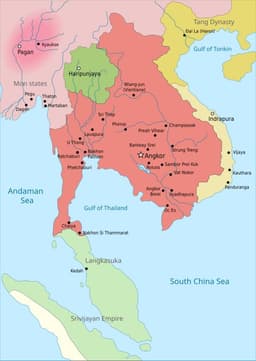
Jayavarman II
Emperor · Medieval
59.2Total

Napoleon Bonaparte
General · Modern
70.9Total
Basic Information
Born
770
1769
Died
835
1821
Era
Medieval
Modern
Nationality
Cambodia
France
Occupation
Emperor
General
Civilization
Eastern
Western
Score Comparison
Military (10%)
60.0
94.0
Political (20%)
72.0
72.0
Influence (20%)
68.0
40.0
Legacy (20%)
40.0
80.0
Leadership (15%)
66.0
78.0
Strategy (15%)
55.0
90.0
TOTAL
59.2
70.9
Jayavarman II — Complete Timeline
802 AD
Proclaimed Devaraja CultCultural
Jayavarman II performed a ritual on Mount Mahendraparvata proclaiming himself a 'devaraja' (god-king), establishing the cult of the divine ruler. This act unified the Khmer principalities and founded the Khmer Empire, legitimizing his rule through Hindu cosmology.
Khmer EmpireDevarajaFounding
Impact: regionalconstructive
Founded the Khmer EmpirePolitical Action
Jayavarman II unified the warring Khmer states under his rule, establishing the Khmer Empire with its capital at Mahendraparvata. This marked the beginning of a powerful empire that would dominate Southeast Asia for centuries.
Khmer EmpireUnificationFounding
Impact: regionalconstructive
Established Capital at MahendraparvataPolitical Action◆ Major
Jayavarman II established his capital at Mahendraparvata, a mountain temple complex in the Kulen Hills. This site became the ceremonial and political center of the early Khmer Empire.
Khmer EmpireCapitalMahendraparvata
Impact: regionalconstructive
Napoleon Bonaparte — Complete Timeline
1799 AD
Coup of 18 BrumaireOther◆ Major
Napoleon Bonaparte, with support from his brother Lucien and key political figures, overthrew the Directory in a bloodless coup. He established the Consulate with himself as First Consul, effectively becoming the ruler of France. This event ended the French Revolution's most unstable period.
French RevolutionCoupRise to Power
Impact: regional
1804 AD
Promulgation of the Napoleonic CodeOther◆ Major
Napoleon enacted the Civil Code of the French, known as the Napoleonic Code, a comprehensive set of laws that replaced the fragmented feudal legal systems. The code established legal equality, protected property rights, and secularized law. It became the basis for legal systems in many European and world countries.
Legal ReformNapoleonic CodeCivil Law
Impact: globalconstructive
1805 AD
Battle of AusterlitzWar◆ Major
Napoleon's Grande Arm
Napoleonic WarsBattleDecisive Victory
Impact: global
1812 AD
Invasion of RussiaWar◆ Major
Napoleon led the Grande Arm
Napoleonic WarsInvasionDisaster
Impact: globaldestructive
1815 AD
Battle of WaterlooWar◆ Major
Napoleon's French army was defeated by the combined forces of the Duke of Wellington's Anglo-Allied army and Gebhard Leberecht von Bl
Napoleonic WarsBattleFinal Defeat
Impact: globaldestructive
Expert Analysis
jayavarman-ii-vs-napoleon-bonaparte
# The God-King and the Emperor: Two Paths to Immortality
On a mountain in the dense jungles of Southeast Asia, a man crowned himself a living god in the year 802. Half a world away and a thousand years later, another man placed a crown upon his own head in the cathedral of Notre Dame, declaring himself emperor of the French. Jayavarman II and Napoleon Bonaparte never knew of each other's existence, yet both understood a profound truth: that power, to be absolute, must be sanctified. One built an empire that would last six centuries; the other built one that collapsed in twenty years. What made the difference?
Origins
Jayavarman II emerged from the shadows of the eighth century, a time when the Khmer people were fragmented into petty kingdoms warring across the floodplains of the Mekong. Born around 770, he was likely a prince exiled or sent abroad, spending his youth at the court of the Sailendra dynasty in Java. There he absorbed not only military tactics but something far more potent: the Javanese concept of divine kingship, where rulers were living embodiments of the gods. When he returned to Cambodia around 790, he carried this idea like a seed.
Napoleon Bonaparte was born in 1769 on the Mediterranean island of Corsica, recently annexed by France. His family was minor nobility, but poor—eight children squeezed into modest lodgings. The French Revolution, which erupted when he was twenty, shattered the old order and created a vacuum. A young artillery officer with a gift for mathematics and a hunger for glory, Napoleon was a child of chaos, not tradition. Where Jayavarman inherited a sacred vision, Napoleon inherited a broken world.
Rise to Power
Jayavarman's ascent was slow, patient, and geographic. He began by securing the support of local chiefs in the Kulen Hills, then methodically conquered or negotiated submission from neighboring principalities. His key turning point came in 802, not on a battlefield but on a mountaintop. At Mount Mahendraparvata, he performed a ritual proclaiming himself *devaraja*—god-king. This was not mere theater. By fusing his political authority with Hindu cosmology, he made rebellion against him into sacrilege. The Khmer states, exhausted by endless conflict, accepted a king who was also a god.
Napoleon's rise was explosive, a series of lightning campaigns that left Europe breathless. In 1796, at twenty-six, he took command of the starving, mutinous Army of Italy and turned it into a conquering force. Victory followed victory: Lodi, Arcola, Rivoli. By 1799, he staged a coup and made himself First Consul. In 1804, he crowned himself Emperor—snatching the crown from the Pope's hands and placing it on his own head, a gesture of pure will. Where Jayavarman claimed divinity through ritual, Napoleon claimed it through audacity.
Leadership & Governance
Jayavarman governed through integration. He did not destroy the local cults and chieftains he conquered; he absorbed them into a hierarchy with himself at the apex. The *devaraja* cult required a temple complex and a priesthood, which became the engine of Khmer civilization. His capital at Mahendraparvata was a mountain temple, a physical representation of the cosmic mountain where gods dwelt. This was not just architecture—it was statecraft. Every stone declared: *I am the center of the world.*
Napoleon governed through rationalization. The Napoleonic Code swept away feudal privileges, established equality before the law, and standardized French administration. He built roads, founded banks, and reformed education. But his genius was also his flaw: he could not stop conquering. Military strategy, at which he scored 93 out of 100, was his language. Every treaty was a prelude to the next war. He governed like a general, which meant he never learned to govern in peace.
Triumph & Tragedy
Jayavarman's triumph was the foundation of an empire that would produce Angkor Wat, one of humanity's greatest monuments. His tragedy is that we know almost nothing of his personal life—no letters, no diary, only inscriptions on stone. He became a symbol, not a man.
Napoleon's triumph was the Battle of Austerlitz in 1805, where he destroyed an Austro-Russian army and redrew the map of Europe. His tragedy was the invasion of Russia in 1812, where 600,000 men marched east and fewer than 100,000 returned. He was exiled to Elba, escaped, ruled for a Hundred Days, and was crushed at Waterloo in 1815. He died in 1821 on the remote island of Saint Helena, a prisoner.
Character & Destiny
Jayavarman's personality is opaque, but his actions suggest a man of immense patience and strategic vision. He did not need to conquer everything—he needed to create a system that would outlast him. He succeeded. The Khmer Empire endured until the fall of Angkor in 1431, over six centuries.
Napoleon's personality is blindingly clear: restless, brilliant, arrogant, insatiable. "Impossible is a word to be found only in the dictionary of fools," he once said. But that refusal to accept limits became his doom. He could not consolidate because he could not stop. His total score of 82.4 reflects a man of extraordinary talent who was also his own worst enemy.
Legacy
Jayavarman II is remembered as the founder of the Khmer Empire and the father of the Angkor period. His *devaraja* cult shaped Cambodian kingship for centuries. Today, his image appears on currency, and his name is taught to every schoolchild. His influence score of 72.3 and legacy score of 70.8 reflect a quiet, enduring power.
Napoleon is remembered as one of history's greatest generals and its most ambitious modern ruler. His legal code governs much of Europe today. His influence score of 82.0 and legacy score of 78.0 reflect a man who changed the world—but failed to hold it.
Conclusion
One man crowned himself a god on a mountain and built an empire of stone that outlasted the ages. The other crowned himself an emperor in a cathedral and built an empire of will that burned out like a comet. Jayavarman II understood that power must be rooted in belief; Napoleon believed that power was enough in itself. In the end, the god-king left a civilization. The emperor left a legend. Perhaps that is the deepest difference of all: one built for eternity, the other for glory.
Rankings
🥇
Napoleon BonaparteLeader
Mil: 94.0Pol: 72.0Inf: 40.0
70.9
🥈
Jayavarman II
Mil: 60.0Pol: 72.0Inf: 68.0
59.2
+11.7 behind
How This Comparison Works
Algorithm
Each figure is scored on 6 dimensions (0—100 scale) based on structured historical data: Military (10%), Political (20%), Influence (20%), Legacy (20%), Leadership (15%), Strategy (15%). The weighted total produces the final ranking.
Data Sources
Scores are computed from structured sub-indicators in the database. Scale factors adjust for era (Ancient ×0.85, Modern ×1.0) and civilization size (Eastern ×1.05, Other ×0.80) to account for differences in population and military scale.
Maximum 3 Figures
Comparisons are limited to 2—3 figures to ensure readability and statistical meaningfulness.
Error Margins
±5 points per dimension — Sub-scores are derived from historical records with inherent uncertainty. Two figures within 5 points on a dimension should be considered roughly equivalent in that area.
Total Score Accuracy
±3 points overall — The weighted combination of 6 dimensions produces a total score with approximately ±3 points of uncertainty. Differences of less than 3 points are not statistically significant— the figures are effectively tied.
Known Limitations
- Historical records are incomplete and uneven across civilizations
- Figures from oral-tradition societies may be underrepresented
- Occupation labels can misclassify multi-role figures
- Scores measure capability and impact, not moral character
- Quantitative scoring is a comparison tool, not absolute truth
Capability Radar
Military (10%) — Battles & Warfare
Battles
45
95
Win Rate
60
90
Expansion
65
95
Political (20%) — Governance & Reform
Reform
80
95
Diplomacy
65
80
Economy
60
85
Influence (20%) — Cultural & Global Reach
Cultural
75
85
Global
60
90
Legacy (20%) — Historical Impact
Historical
80
95
Longevity
75
90
Leadership (15%) — Power & Stability
Tenure
70
85
Stability
65
70
Strategy (15%) — Tactics & Innovation
Strategy
60
95
Tactics
55
98
Reform
70
92
Similar Comparisons
Comments & Discussion
No comments yet. Be the first to share your thoughts!