Loading...
Jeanine Anez vs Napoleon Bonaparte
Napoleon Bonaparte leads by 32.2 pts · 2 figures compared
…
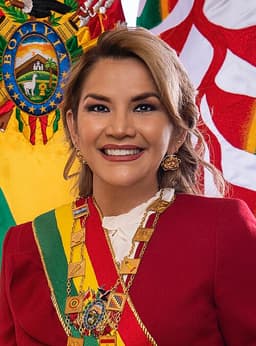
Jeanine Anez
Politician · Modern
38.7Total

Napoleon Bonaparte
General · Modern
70.9Total
Basic Information
Born
1967
1769
Died
—
1821
Era
Modern
Modern
Nationality
Bolivia
France
Occupation
Politician
General
Civilization
Western
Western
Score Comparison
Military (10%)
49.5
94.0
Political (20%)
26.4
72.0
Influence (20%)
47.1
40.0
Legacy (20%)
35.8
80.0
Leadership (15%)
31.2
78.0
Strategy (15%)
43.7
90.0
TOTAL
38.7
70.9
Jeanine Anez — Complete Timeline
2019 AD
Became Interim PresidentPolitical Action◆ Major
After the resignation of President Evo Morales following disputed elections, Jeanine
Interim PresidencyCrisis
Impact: national
Suppressed ProtestsPolitical Action◆ Major
Áñez's government faced widespread protests from supporters of Evo Morales. Her administration was accused of using excessive force, including military and police crackdowns, resulting in deaths and injuries, particularly in Senkata and Sacaba.
RepressionProtests
Impact: nationaldestructive
2020 AD
Called for New ElectionsPolitical Action◆ Major
Áñez's government organized new general elections in 2020, which were won by Luis Arce, a candidate from Morales' party. She stepped down after the election, ending her interim presidency.
ElectionsTransition
Impact: nationalconstructive
2021 AD
Arrested and ImprisonedPolitical Action◆ Major
Áñez was arrested and imprisoned on charges of terrorism, sedition, and conspiracy related to her role in the 2019 political crisis. Her imprisonment was seen by supporters as political persecution and by opponents as justice for human rights abuses.
ArrestImprisonmentLegal
Impact: nationaltragic
Napoleon Bonaparte — Complete Timeline
1799 AD
Coup of 18 BrumaireOther◆ Major
Napoleon Bonaparte, with support from his brother Lucien and key political figures, overthrew the Directory in a bloodless coup. He established the Consulate with himself as First Consul, effectively becoming the ruler of France. This event ended the French Revolution's most unstable period.
French RevolutionCoupRise to Power
Impact: regional
1804 AD
Promulgation of the Napoleonic CodeOther◆ Major
Napoleon enacted the Civil Code of the French, known as the Napoleonic Code, a comprehensive set of laws that replaced the fragmented feudal legal systems. The code established legal equality, protected property rights, and secularized law. It became the basis for legal systems in many European and world countries.
Legal ReformNapoleonic CodeCivil Law
Impact: globalconstructive
1805 AD
Battle of AusterlitzWar◆ Major
Napoleon's Grande Arm
Napoleonic WarsBattleDecisive Victory
Impact: global
1812 AD
Invasion of RussiaWar◆ Major
Napoleon led the Grande Arm
Napoleonic WarsInvasionDisaster
Impact: globaldestructive
1815 AD
Battle of WaterlooWar◆ Major
Napoleon's French army was defeated by the combined forces of the Duke of Wellington's Anglo-Allied army and Gebhard Leberecht von Bl
Napoleonic WarsBattleFinal Defeat
Impact: globaldestructive
Expert Analysis
jeanine-anez-vs-napoleon-bonaparte
# The Emperor and the Interim President: Two Faces of Power in the Western Tradition
On a June morning in 1815, Napoleon Bonaparte surveyed the muddy fields of Waterloo, his Grande Armée poised for what would be his final gamble. Across the Atlantic and two centuries later, in November 2019, Jeanine Áñez walked into the presidential palace in La Paz, a lawyer and senator who had never commanded an army, yet found herself at the helm of a fractured nation. What connects these two figures—one a titan who reshaped Europe, the other a footnote in Bolivian history—is not their achievements but the question their lives pose: What does it mean to seize power, and what does power cost in return?
Origins
Napoleon was born in 1769 on the island of Corsica, a year after France purchased the territory from Genoa. His family was minor nobility, but his father’s death left them in straitened circumstances. The young Napoleon, short and intense, attended military school in Brienne, where he was mocked for his accent and provincial origins. Yet this outsider status forged a relentless ambition. The French Revolution, which erupted when he was twenty, shattered the old order and opened paths unimaginable under the monarchy. Napoleon’s Corsican origins, his genius for mathematics and artillery, and his hunger to prove himself all converged in a world that rewarded talent over birth.
Jeanine Áñez was born in 1967 in Santa Cruz, Bolivia, a lowland region that long resented the dominance of the highland capital, La Paz. She studied law and became a television presenter before entering politics as a senator for the opposition. Her Bolivia was a nation of deep ethnic and economic divides, where indigenous majorities had only recently gained political voice through Evo Morales, the country’s first indigenous president. Áñez represented a conservative, mestizo elite that saw Morales’s socialist policies as authoritarian. Unlike Napoleon, she had no military background, no grand strategic vision—only a lawyer’s instinct for procedure and a politician’s sense of opportunity.
Rise to Power
Napoleon’s ascent was a masterpiece of timing and audacity. In 1793, at age twenty-four, he drove British forces from Toulon, earning promotion to brigadier general. The Directory, a corrupt and unstable government, gave him command of the Italian campaign in 1796. There he stunned Europe with lightning marches and decisive battles—Lodi, Arcole, Rivoli—turning a starving army into a conquering force. By 1799, he returned from Egypt to a France desperate for order, and in the coup of 18 Brumaire, he overthrew the Directory and installed himself as First Consul. He was thirty.
Áñez’s rise was less dramatic but no less opportunistic. In October 2019, Bolivia held presidential elections that the Organization of American States found marred by irregularities. Morales, seeking a fourth term, claimed victory; protests erupted. On November 10, Morales resigned under pressure from the military and fled to Mexico. The constitution provided a clear line of succession through the vice president and congressional leaders, but all had resigned or were in hiding. Áñez, as second vice president of the Senate, declared herself interim president on November 12. She had not won an election, nor had she been next in line—she simply walked into the vacuum. Within hours, she was sworn in, a Bible in one hand, a cross in the other.
Leadership & Governance
Napoleon governed with the energy of a man who believed he could bend reality to his will. He centralized the French state, created the Bank of France, and negotiated the Concordat with the Pope, reconciling the nation with the Church. His greatest achievement was the Napoleonic Code of 1804, a legal framework that enshrined equality before the law, property rights, and secular governance—principles that spread across Europe. Militarily, he was a genius: at Austerlitz in 1805, he destroyed a larger Austro-Russian army with a feigned retreat that remains a textbook maneuver. But his ambition knew no bounds. The invasion of Russia in 1812 cost half a million lives and shattered his aura of invincibility.
Áñez governed a country of eleven million with none of Napoleon’s resources or vision. Her first acts were symbolic: she removed indigenous symbols from the presidential palace and declared that the Bible had returned to government. Her administration faced accusations of excessive force against Morales supporters, with at least thirty deaths in protests. She called new elections for 2020, but her own brief run for president ended in failure. Her governance was reactive, not visionary—a holding action in a polarized nation. She lacked the military genius to enforce order or the political wisdom to build consensus.
Triumph & Tragedy
Napoleon’s triumph was the creation of an empire that stretched from Spain to Poland, a system of client states and reforms that dismantled feudalism. His tragedy was the inability to stop: the Peninsular War bled France dry, the Russian winter devoured his army, and at Leipzig in 1813, the “Battle of Nations” ended his German empire. Exiled to Elba, he escaped in 1815 and ruled for a Hundred Days before Waterloo ended it all. He died in exile on Saint Helena in 1821, at fifty-one, his body consumed by cancer and isolation.
Áñez’s triumph was simply surviving as interim president for a year, organizing elections that handed power to her opponent without a coup. Her tragedy came later: in March 2021, she was arrested and imprisoned on charges of terrorism, sedition, and conspiracy for her role in the 2019 crisis. As of 2024, she remains in detention, a symbol of Bolivia’s unresolved conflicts. Her greatest failure was not military defeat but the collapse of legitimacy—she never escaped the shadow of having seized power.
Character & Destiny
Napoleon’s character was a furnace of will, intelligence, and ego. He once said, “Power is my mistress,” and he meant it. His decisions flowed from a conviction that history was his to write. This hubris led him to overreach, but it also drove reforms that outlasted his empire. He was a product of the Enlightenment and the Revolution, a man who believed in merit and order, yet who crushed the republic he once served.
Áñez’s character was shaped by a different world—a Bolivian democracy fragile and young. She was not a visionary but a placeholder, a conservative who mistook procedure for principle. Her decisions reflected a narrow legalism that ignored the deep social fractures beneath. She saw herself as a defender of democracy against Morales’s “self-coup,” but her actions deepened the crisis. Her destiny was not to conquer but to be consumed.
Legacy
Napoleon’s legacy is monumental. The Napoleonic Code influences legal systems from Louisiana to Japan. He reshaped nationalism, warfare, and statecraft. Yet he is remembered as both liberator and tyrant, a man who spread revolution and then betrayed it. His name evokes glory and tragedy, ambition and ruin.
Áñez’s legacy is small and contested. She is a footnote in Bolivia’s turbulent history, remembered by supporters as a defender of democracy and by critics as a usurper who used state violence. Her imprisonment may become a cause, but she will never be a Napoleon. The difference lies not in the men and women themselves but in the scale of their eras and the depth of their ambition. Napoleon sought to remake the world; Áñez sought only to hold the line. One shaped an age; the other was shaped by a moment.
Conclusion
Standing at the edge of these two lives, we see the vast gulf the Western tradition contains. Napoleon Bonaparte and Jeanine Áñez both seized power in times of crisis, both believed they were saving their nations, and both ended in exile or prison. But Napoleon’s fall was epic, a tragedy that haunted Europe for a century. Áñez’s fall is merely sad, a small story in a small country. The difference is not just talent or luck but the scope of the stage. Napoleon’s ambition was continental; Áñez’s was constitutional. One changed the laws of half the world; the other could not hold her own office. In the end, history remembers not just what we do but how grandly we fail.
Rankings
🥇
Napoleon BonaparteLeader
Mil: 94.0Pol: 72.0Inf: 40.0
70.9
🥈
Jeanine Anez
Mil: 49.5Pol: 26.4Inf: 47.1
38.7
+32.2 behind
How This Comparison Works
Algorithm
Each figure is scored on 6 dimensions (0—100 scale) based on structured historical data: Military (10%), Political (20%), Influence (20%), Legacy (20%), Leadership (15%), Strategy (15%). The weighted total produces the final ranking.
Data Sources
Scores are computed from structured sub-indicators in the database. Scale factors adjust for era (Ancient ×0.85, Modern ×1.0) and civilization size (Eastern ×1.05, Other ×0.80) to account for differences in population and military scale.
Maximum 3 Figures
Comparisons are limited to 2—3 figures to ensure readability and statistical meaningfulness.
Error Margins
±5 points per dimension — Sub-scores are derived from historical records with inherent uncertainty. Two figures within 5 points on a dimension should be considered roughly equivalent in that area.
Total Score Accuracy
±3 points overall — The weighted combination of 6 dimensions produces a total score with approximately ±3 points of uncertainty. Differences of less than 3 points are not statistically significant— the figures are effectively tied.
Known Limitations
- Historical records are incomplete and uneven across civilizations
- Figures from oral-tradition societies may be underrepresented
- Occupation labels can misclassify multi-role figures
- Scores measure capability and impact, not moral character
- Quantitative scoring is a comparison tool, not absolute truth
Capability Radar
Military (10%) — Battles & Warfare
Battles
26
95
Win Rate
33
90
Expansion
37
95
Political (20%) — Governance & Reform
Reform
10
95
Diplomacy
15
80
Economy
10
85
Influence (20%) — Cultural & Global Reach
Cultural
5
85
Global
5
90
Legacy (20%) — Historical Impact
Historical
10
95
Longevity
5
90
Leadership (15%) — Power & Stability
Tenure
10
85
Stability
5
70
Strategy (15%) — Tactics & Innovation
Strategy
39
95
Tactics
42
98
Reform
45
92
Similar Comparisons
Comments & Discussion
TheIronDuke6/17/2026
Comparing Áñez to Napoleon is like comparing a firecracker to a supernova. Napoleon didn't just 'seize power'—he engineered the Napoleonic Code, reorganized European education, and sold Louisiana to fund his wars. Áñez stepped into a vacuum after a fraudulent election, not a revolution. Put them side by side on a battlefield of ideas, and Napoleon's shadow swallows hers entirely. There's no shared question about power's cost; one paid it in exile, the other in a courtroom. Stop romanticizing the
炮兵司令6/17/2026
拿战狂热粉?别闹了。拿破仑在洛迪桥亲手举旗冲锋,26岁就指挥意大利军团打出六天六胜。阿涅斯连个排都没带过,她最接近战场的可能是议会拍桌吵架。这俩人摆一起比,简直是把山鹰和麻雀放同一个秤上——山鹰一个俯冲就能把对方历史地位碾成渣。别拿军靴和律师高跟鞋相提并论。|
DataSkeptic6/17/2026
Let's run the numbers: Napoleon commanded over 600,000 soldiers at his peak, fought 60+ battles, and directly conquered most of Europe. Áñez held power for exactly 11 months in a country of 11 million, with zero military campaigns to her name. The analysis wants to frame this as a lesson about power's cost, but that's false symmetry. Comparing them is like comparing a hurricane to a gentle breeze—both move air, but the scale doesn't match. Statistical outliers don't make for useful parallels.|
边疆观察者6/17/2026
从地缘政治角度看,这俩根本不在一个维度。拿破仑用大炮和法典重塑了欧洲边界,让德国从三百个邦国缩成几十个。阿涅斯呢?她的总统任期连玻利维亚和智利的出海口争议都没解决。一个是大陆棋手,一个是临时守门员。非要说共同点?大概都是趁乱上位,但拿破仑下棋时,阿涅斯连棋盘都没看清。|
RevisionistEcho6/17/2026
Everyone rushes to tear Áñez down, but let's not pretend Napoleon was a pure meritocrat—he made his brothers kings and restored hereditary titles. Meanwhile, Áñez, a provincial lawyer, actually stabilized a coup-prone Bolivia amid pandemic chaos. The 'cost of power' narrative conveniently forgets Napoleon's millions dead for ego. If we're measuring hubris, Waterloo-worshipers should look in the mirror before sneering at La Paz. Both grabbed power; only one caused a demographic disaster.|
波拿巴的砝码6/17/2026
数据不会说谎:拿破仑执政14年,法国人口从2800万跌到2600万,战场上埋了至少30万法国青年。阿涅斯任内玻利维亚新冠死人,但那是全球危机。