Loading...
Jeroboam I vs Napoleon Bonaparte
Napoleon Bonaparte leads by 23.9 pts · 2 figures compared
…
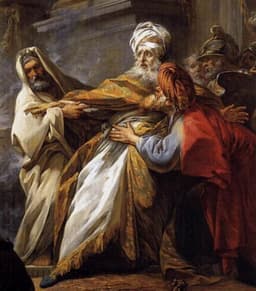
Jeroboam I
Emperor · Ancient
47.0Total

Napoleon Bonaparte
General · Modern
70.9Total
Basic Information
Born
-931
1769
Died
-910
1821
Era
Ancient
Modern
Nationality
Israel
France
Occupation
Emperor
General
Civilization
Middle Eastern
Western
Score Comparison
Military (10%)
50.0
94.0
Political (20%)
37.9
72.0
Influence (20%)
48.6
40.0
Legacy (20%)
41.7
80.0
Leadership (15%)
62.2
78.0
Strategy (15%)
43.7
90.0
TOTAL
47.0
70.9
Jeroboam I — Complete Timeline
931 BC
Proclamation as King of Northern IsraelPolitical Action
After Rehoboam refused to lighten the tax burden, the ten northern tribes proclaimed Jeroboam as their king at Shechem. This established the Kingdom of Israel, separate from the Kingdom of Judah, fulfilling the prophecy of Ahijah.
Kingdom SplitIsraelRehoboam
Impact: national
930 BC
Establishment of Golden Calves at Dan and BethelCultural◆ Major
Jeroboam set up two golden calves, one at Bethel and one at Dan, as alternative worship sites to Jerusalem. He appointed non-Levitical priests and instituted festivals, leading to the establishment of a separate religious cult in Israel.
IdolatryReligionNorthern Kingdom
Impact: nationaldestructive
913 BC
War with Abijah of JudahWar◆ Major
Jeroboam fought a prolonged war with Abijah, king of Judah. Abijah's forces defeated Jeroboam's army, capturing several cities including Bethel, Jeshanah, and Ephron. This weakened Jeroboam's kingdom and reduced his territory.
WarJudahAbijah
Impact: regionaldestructive
Napoleon Bonaparte — Complete Timeline
1799 AD
Coup of 18 BrumaireOther◆ Major
Napoleon Bonaparte, with support from his brother Lucien and key political figures, overthrew the Directory in a bloodless coup. He established the Consulate with himself as First Consul, effectively becoming the ruler of France. This event ended the French Revolution's most unstable period.
French RevolutionCoupRise to Power
Impact: regional
1804 AD
Promulgation of the Napoleonic CodeOther◆ Major
Napoleon enacted the Civil Code of the French, known as the Napoleonic Code, a comprehensive set of laws that replaced the fragmented feudal legal systems. The code established legal equality, protected property rights, and secularized law. It became the basis for legal systems in many European and world countries.
Legal ReformNapoleonic CodeCivil Law
Impact: globalconstructive
1805 AD
Battle of AusterlitzWar◆ Major
Napoleon's Grande Arm
Napoleonic WarsBattleDecisive Victory
Impact: global
1812 AD
Invasion of RussiaWar◆ Major
Napoleon led the Grande Arm
Napoleonic WarsInvasionDisaster
Impact: globaldestructive
1815 AD
Battle of WaterlooWar◆ Major
Napoleon's French army was defeated by the combined forces of the Duke of Wellington's Anglo-Allied army and Gebhard Leberecht von Bl
Napoleonic WarsBattleFinal Defeat
Impact: globaldestructive
Expert Analysis
jeroboam-i-vs-napoleon-bonaparte
# The Conqueror and the Schismatic
On a June morning in 1815, Napoleon Bonaparte watched his Imperial Guard march toward the ridge of Mont-Saint-Jean, the fate of Europe riding on their bayonets. Nearly three thousand years earlier and a thousand miles away, another king stood on a hill in central Palestine, watching his own army scatter before the forces of Judah. Both men had seized power through upheaval; both would see their kingdoms crumble. But while Napoleon’s story echoes through every military academy and legal code in the West, Jeroboam I is remembered primarily as a cautionary tale in scripture. What separates a titan from a footnote? The answer lies not in their ambitions—which were equally vast—but in the worlds they inhabited and the choices they made.
Origins
Napoleon Bonaparte was born in 1769 on the island of Corsica, a place recently annexed by France. His family were minor nobility, but they were not wealthy. The France of his youth was a powder keg of Enlightenment ideas, economic misery, and simmering class resentment. Young Napoleon attended military school on scholarship, where his Corsican accent marked him as an outsider. He devoured histories of Alexander and Caesar, but he also read Rousseau and Voltaire. He was a product of the eighteenth century’s restless energy: rational, ambitious, and entirely unmoored from tradition.
Jeroboam I was born around 931 BCE, a subject of the united kingdom of Israel under Solomon. The Bible describes him as a "mighty man of valor," but also as a fugitive. Solomon had noticed his talents and put him in charge of the forced labor levy, but when a prophet predicted Jeroboam would rule ten tribes, Solomon tried to kill him. Jeroboam fled to Egypt. His world was one of tribal loyalties, divine covenants, and the memory of David’s golden age. He had no Enlightenment to draw upon—only the raw tools of politics and religion.
Rise to Power
Napoleon’s ascent was a masterpiece of opportunism. The French Revolution had shattered the old order, creating a vacuum for anyone with talent and nerve. In 1793, at age twenty-four, he drove the British out of Toulon with a brilliant artillery plan. By 1796, he commanded the Army of Italy, where he turned starving soldiers into a conquering force through sheer charisma and speed. His 1798 Egyptian campaign failed strategically but made him a legend. Then, in November 1799, he staged the coup of 18 Brumaire, becoming First Consul. He was thirty years old.
Jeroboam’s path was different. He did not need to invent a new order—he needed to exploit the cracks in an old one. When Solomon’s son Rehoboam traveled to Shechem in 931 BCE to be crowned king of all Israel, Jeroboam returned from exile to lead a delegation demanding tax relief. Rehoboam famously refused, boasting that he would be harsher than his father. The ten northern tribes erupted. They proclaimed Jeroboam king at Shechem, and the kingdom split. Jeroboam did not conquer his throne; he inherited it through a rebellion he channeled but did not start.
Leadership & Governance
Napoleon governed with the energy of a man who believed he could codify everything. His Napoleonic Code, enacted in 1804, standardized French law across a patchwork of feudal customs, enshrining equality before the law, property rights, and secular administration. It was a genuinely revolutionary document, exported across Europe. Militarily, he was a genius of maneuver: he defeated Austria at Marengo in 1800, crushed Prussia at Jena in 1806, and forced Russia into a treaty at Tilsit in 1807. His Grand Army was a machine of mass mobilization, living off the land and striking with devastating speed.
Jeroboam faced a different challenge. He ruled a kingdom that was culturally and religiously identical to its rival, Judah. His capital was insecure because the Temple in Jerusalem remained the spiritual heart of all Israelites. To prevent his subjects from traveling south, he made a fateful decision in 930 BCE: he set up two golden calves—one at Bethel, one at Dan—and declared, "Behold your gods, O Israel, who brought you up out of Egypt." He appointed non-Levite priests and invented a new festival. Politically, it was a shrewd move to consolidate his rule. Religiously, it was a catastrophe. The biblical authors condemn him as the king who "made Israel to sin."
Triumph & Tragedy
Napoleon’s greatest triumph was Austerlitz, December 2, 1805. He lured the combined Russian and Austrian armies into a trap, smashed their center, and captured 20,000 prisoners. The Holy Roman Empire dissolved soon after. His tragedy came in 1812, when he invaded Russia with 600,000 men and returned with fewer than 100,000. The Russian winter, the scorched-earth tactics, and his own refusal to compromise destroyed his army. He was exiled to Elba in 1814, returned for the Hundred Days in 1815, and met final defeat at Waterloo.
Jeroboam’s military record was meager. He fought a prolonged war with Abijah, king of Judah, around 913 BCE. Abijah’s army defeated him, capturing several cities. The biblical account is sparse, but the pattern is clear: Jeroboam was not a great general. His tragedy was not a single battle but a slow erosion. He had secured a kingdom, but he could not secure its soul. The golden calves became a permanent stain, and every subsequent king of Israel was judged by the standard of "the sins of Jeroboam."
Character & Destiny
Napoleon was restless, driven, and supremely confident. His personality was his greatest weapon and his fatal flaw. He believed he could outrun any consequence, that his will could bend reality. He said, "Impossible is a word to be found only in the dictionary of fools." That confidence built an empire, but it also led him to invade Russia, refuse peace terms, and gamble everything at Waterloo. He died in exile on Saint Helena in 1821, at age fifty-one.
Jeroboam was cautious and calculating, but also short-sighted. He saw the immediate political danger—his people returning to Judah—but not the long-term spiritual cost of his solution. He was a survivor, not a visionary. The Bible notes that he "did not depart from his evil way." He died around 910 BCE, likely of natural causes, having ruled for twenty-one years. His kingdom would last another two centuries, but it never escaped his original sin.
Legacy
Napoleon’s legacy is immense. The Napoleonic Code influences civil law systems across Europe, Latin America, and parts of Asia. His military campaigns are studied at every war college. He reshaped nationalism, centralized the French state, and sold the Louisiana Purchase to the United States. He is remembered as both a liberator who spread revolutionary ideals and a tyrant who drowned them in blood.
Jeroboam’s legacy is narrower but profound. In Jewish and Christian tradition, his name became synonymous with apostasy. The prophet Hosea would later condemn Israel for "the calf of Beth-aven." Yet Jeroboam also created the first independent northern kingdom, a political entity that lasted until the Assyrian conquest in 722 BCE. He is a warning about the dangers of pragmatism without principle.
Conclusion
Napoleon and Jeroboam both seized the chaos of their times and built something new. One built an empire of laws and cannons that still echoes in our courtrooms and battlefields. The other built a kingdom of golden calves and tribal loyalty that survives only as a name in ancient texts. Their differences are not simply of scale but of kind. Napoleon operated in a world where human will could reshape institutions, where ambition was a virtue. Jeroboam operated in a world where divine covenant was the only foundation for power, and breaking it meant losing everything. The conqueror and the schismatic—each a mirror of the age that made him, each a lesson in the limits of human ambition.
Rankings
🥇
Napoleon BonaparteLeader
Mil: 94.0Pol: 72.0Inf: 40.0
70.9
🥈
Jeroboam I
Mil: 50.0Pol: 37.9Inf: 48.6
47.0
+23.9 behind
How This Comparison Works
Algorithm
Each figure is scored on 6 dimensions (0—100 scale) based on structured historical data: Military (10%), Political (20%), Influence (20%), Legacy (20%), Leadership (15%), Strategy (15%). The weighted total produces the final ranking.
Data Sources
Scores are computed from structured sub-indicators in the database. Scale factors adjust for era (Ancient ×0.85, Modern ×1.0) and civilization size (Eastern ×1.05, Other ×0.80) to account for differences in population and military scale.
Maximum 3 Figures
Comparisons are limited to 2—3 figures to ensure readability and statistical meaningfulness.
Error Margins
±5 points per dimension — Sub-scores are derived from historical records with inherent uncertainty. Two figures within 5 points on a dimension should be considered roughly equivalent in that area.
Total Score Accuracy
±3 points overall — The weighted combination of 6 dimensions produces a total score with approximately ±3 points of uncertainty. Differences of less than 3 points are not statistically significant— the figures are effectively tied.
Known Limitations
- Historical records are incomplete and uneven across civilizations
- Figures from oral-tradition societies may be underrepresented
- Occupation labels can misclassify multi-role figures
- Scores measure capability and impact, not moral character
- Quantitative scoring is a comparison tool, not absolute truth
Capability Radar
Military (10%) — Battles & Warfare
Battles
20
95
Win Rate
20
90
Expansion
15
95
Political (20%) — Governance & Reform
Reform
40
95
Diplomacy
30
80
Economy
30
85
Influence (20%) — Cultural & Global Reach
Cultural
30
85
Global
20
90
Legacy (20%) — Historical Impact
Historical
40
95
Longevity
30
90
Leadership (15%) — Power & Stability
Tenure
60
85
Stability
20
70
Strategy (15%) — Tactics & Innovation
Strategy
20
95
Tactics
20
98
Reform
15
92
Similar Comparisons
Comments & Discussion
General_Grouchy6/17/2026
"Napoleon lost at Waterloo because Grouchy was late, Jeroboam lost because God said so. Great military analysis of the Carthaginian or Roman variety, but that's not how the ancient Near East worked. Jeroboam's silver calves were a political gamble, not stupidity. Napoleon's Continental System was the same. Both overreached, except one had a literate bureaucracy and the other didn't. That's all."
历史暴君控6/17/2026
"拿破仑在欧洲横冲直撞时算是个颠覆者,可耶罗波安分裂以色列的举动——在但和伯特利立金牛犊,设凡民祭司,改住棚节日期——这套操作才是真正的制度性叛逆。拿破仑顶多改了改法律,耶罗波安是在直接重建国教体系。你以为谁更狠?搞分裂比搞征服难多了。"
Le_Sceptique_de_la_Donnée6/17/2026
"LOL comparing power projections across millennia with zero reliable census data from the Levant is just bad science. Napoleon's Grande Armée had muster rolls, payrolls, regimental histories. Jeroboam? Three paragraphs in Kings and some speculative archaeology. Apples to hand grenades. We can quantify Napoleon's geopolitical impact; the biblical king's whole story might be theological fiction or heavily redacted. Not a fair fight."
乱世分析家6/17/2026
"拿破仑和耶罗波安最大的共同点:都是权力缺口中的暴发户。前者在法国大革命后的废墟里爬上来,后者在所罗门死后利用北方部落的不满起义。区别在于,拿破仑打的是欧洲列强联盟,耶罗波安面对的只是南方小国犹大。结果呢?两边都没能建立起持久的王朝。拿破仑的儿子没继位,耶罗波安的儿子拿答被篡位。英雄到头来都是守不住的暴发户。"
Legacy_Trope_Thrasher6/17/2026
"You call Napoleon a titan? He's a historical trope: the outsider who remakes the map and then freezes to death in his own hubris. Jeroboam is the same trope—crafting shrines at Dan and Bethel to keep his people from traveling to Jerusalem—only his stage was a tiny hill country kingdom. Napoleon's stage was Europe. That's the only difference. Scale, not substance. Both split kingdoms; both lost them."