Loading...
John II of Castile vs Napoleon Bonaparte
Napoleon Bonaparte leads by 34.6 pts · 2 figures compared
…
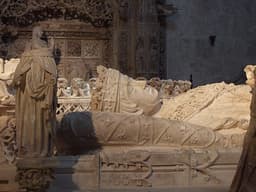
John II of Castile
Emperor · Medieval
36.3Total

Napoleon Bonaparte
General · Modern
70.9Total
Basic Information
Born
1405
1769
Died
1454
1821
Era
Medieval
Modern
Nationality
Castile
France
Occupation
Emperor
General
Civilization
Western
Western
Score Comparison
Military (10%)
10.2
94.0
Political (20%)
30.7
72.0
Influence (20%)
46.3
40.0
Legacy (20%)
37.5
80.0
Leadership (15%)
34.6
78.0
Strategy (15%)
45.0
90.0
TOTAL
36.3
70.9
John II of Castile — Complete Timeline
1423 AD
Appointed Álvaro de Luna as ConstablePolitical Action◆ Major
John II appointed
Castilian PoliticsRoyal FavoritismÁlvaro de Luna
Impact: national
1445 AD
Battle of OlmedoWar◆ Major
John II and
Castilian Civil WarBattleNoble Rebellion
Impact: national
1453 AD
Execution of Álvaro de LunaPolitical Action
Under pressure from the nobility and his second wife, Isabella of Portugal, John II ordered the execution of his longtime favorite
Castilian PoliticsRoyal FavoritismExecution
Impact: nationaltragic
Napoleon Bonaparte — Complete Timeline
1799 AD
Coup of 18 BrumaireOther◆ Major
Napoleon Bonaparte, with support from his brother Lucien and key political figures, overthrew the Directory in a bloodless coup. He established the Consulate with himself as First Consul, effectively becoming the ruler of France. This event ended the French Revolution's most unstable period.
French RevolutionCoupRise to Power
Impact: regional
1804 AD
Promulgation of the Napoleonic CodeOther◆ Major
Napoleon enacted the Civil Code of the French, known as the Napoleonic Code, a comprehensive set of laws that replaced the fragmented feudal legal systems. The code established legal equality, protected property rights, and secularized law. It became the basis for legal systems in many European and world countries.
Legal ReformNapoleonic CodeCivil Law
Impact: globalconstructive
1805 AD
Battle of AusterlitzWar◆ Major
Napoleon's Grande Arm
Napoleonic WarsBattleDecisive Victory
Impact: global
1812 AD
Invasion of RussiaWar◆ Major
Napoleon led the Grande Arm
Napoleonic WarsInvasionDisaster
Impact: globaldestructive
1815 AD
Battle of WaterlooWar◆ Major
Napoleon's French army was defeated by the combined forces of the Duke of Wellington's Anglo-Allied army and Gebhard Leberecht von Bl
Napoleonic WarsBattleFinal Defeat
Impact: globaldestructive
Expert Analysis
john-ii-of-castile-vs-napoleon-bonaparte
# The Emperor and the King: Two Faces of Power in Western History
In the spring of 1453, a frail king sat alone in his chamber in Valladolid, weeping. John II of Castile had just signed the death warrant for Álvaro de Luna, the man who had ruled his kingdom for three decades. Across the centuries, in another spring—that of 1815—a different ruler stood on a Belgian field at Waterloo, watching his legions break against the British squares. One man had lost his closest ally; the other, his empire. Both had held power in their hands, yet the gulf between them tells us everything about what it means to rule, and what it means to fail.
Origins
Napoleon Bonaparte was born in 1769 on Corsica, an island that had become French only the year before. His family was minor nobility, poor enough to need scholarships, proud enough to resent the French mainland. This outsider’s edge never left him. He studied at military academies in Brienne and Paris, where classmates mocked his accent and his poverty. The French Revolution, erupting when he was twenty, shattered the old order and opened paths that birth alone could never have granted.
John II of Castile, born in 1405, inherited a throne. His father, Henry III, died when John was barely two years old. The boy-king grew up surrounded by regents and tutors, learning that his will meant nothing. His mother, Catherine of Lancaster, and his uncle, Ferdinand of Aragon, fought over him like dogs over a bone. By the time he reached adulthood, John had learned one lesson above all: that power belonged to others, and he was merely its symbol.
Rise to Power
Napoleon’s ascent was a series of calculated explosions. At twenty-four, he drove the British out of Toulon. At twenty-six, he saved the revolutionary government from a royalist uprising, earning command of the Army of Italy. Then came the Italian campaign of 1796—a masterpiece of speed, deception, and audacity that made him the most famous man in France. By 1799, he was First Consul. By 1804, Emperor. Each step was earned through victory, and each victory fed his conviction that he was destiny’s chosen instrument.
John II’s rise was no rise at all. In 1423, at age eighteen, he appointed Álvaro de Luna as his Constable—effectively handing the kingdom to his favorite. The appointment was not a seizure of power but a surrender of it. John had found someone strong enough to protect him from the nobles who terrified him, and he clung to Luna as a child clings to a guardian. Where Napoleon seized his moment, John abdicated his.
Leadership & Governance
Napoleon governed as he fought: with relentless energy, total control, and a vision of order imposed from above. The Napoleonic Code, enacted in 1804, standardized French law, abolished feudal privileges, and enshrined merit over birth. He built roads, founded banks, reformed education, and negotiated the Concordat with the Pope. His political score of 75 reflects real achievement—but also his fatal flaw: he could not stop. He conquered not because he needed to, but because conquest was the only language he knew.
John II governed through Luna, and Luna governed through patronage and fear. The Battle of Olmedo in 1445 was their greatest victory—a crushing defeat of the rebellious League of Nobles that temporarily stabilized the kingdom. But it was Luna’s victory, not John’s. The king had no military score worth noting (43.3), no strategic mind (30.0), and no capacity to rule alone. His political score of 42.3 tells the story: he was not a ruler but a placeholder.
Triumph & Tragedy
Napoleon’s greatest moment came in 1805 at Austerlitz, where he destroyed the combined armies of Russia and Austria in a battle so perfect it became a textbook example of military genius. His worst came at Waterloo in 1815, where a combination of bad weather, late arrivals, and stubborn British resistance ended his empire. Between those two poles lies the tragedy of a man who could win any battle except the final one.
John II’s triumph was Olmedo—but even that was Luna’s doing. His tragedy was the execution of Luna in 1453. For thirty years, Luna had been his shield, his sword, his surrogate king. But John’s second wife, Isabella of Portugal, hated Luna and poisoned the king’s mind against him. Under pressure, John signed the order. Then he watched his only friend die, and spent his remaining months in grief and regret. He died the following year, a king who had never truly ruled.
Character & Destiny
Napoleon’s character was a forge of contradictions: brilliant and arrogant, visionary and tyrannical, capable of inspiring love and hatred in equal measure. He believed in fate but acted as if he could bend it to his will. His downfall came not from a single mistake but from the very engine of his success—the inability to stop, to consolidate, to rest. As he himself said on Saint Helena, “There is no immortality but the memory that is left in the minds of men.” He left a memory that still burns.
John II’s character was defined by weakness. He was not stupid—his patronage of poetry and learning suggests a refined mind. But he lacked the steel that rule requires. He could not say no to Luna, and later could not say no to his wife. His destiny was to be a footnote in the history of his own kingdom, a king remembered only because his daughter, Isabella I of Castile, would become one of history’s greatest queens.
Legacy
Napoleon’s legacy is written across Europe: the Napoleonic Code, the metric system, the reorganization of German states, the sale of Louisiana, the very idea of modern meritocracy. His influence score of 82 and legacy score of 78 reflect a man who changed the world even in defeat. He is studied, debated, admired, and condemned—but never ignored.
John II’s legacy is a whisper. His legacy score of 49.4 places him among the forgettable monarchs. He is remembered, if at all, as the father of Isabella the Catholic and as the king who let Luna rule. His reign was a pause, a holding pattern, a time of waiting for the storm that would come after.
Conclusion
Standing at the edge of history, Napoleon and John II appear as opposites: the titan and the shadow, the conqueror and the conquered. But they share one thing—both were prisoners of their own natures. Napoleon could not stop conquering, and so he fell. John could not start ruling, and so he vanished. One burned too bright, the other never caught fire. And between them lies every lesson about power that history has to teach: that it must be seized, used, and finally released—or it will destroy the one who holds it.
Rankings
🥇
Napoleon BonaparteLeader
Mil: 94.0Pol: 72.0Inf: 40.0
70.9
🥈
John II of Castile
Mil: 10.2Pol: 30.7Inf: 46.3
36.3
+34.6 behind
How This Comparison Works
Algorithm
Each figure is scored on 6 dimensions (0—100 scale) based on structured historical data: Military (10%), Political (20%), Influence (20%), Legacy (20%), Leadership (15%), Strategy (15%). The weighted total produces the final ranking.
Data Sources
Scores are computed from structured sub-indicators in the database. Scale factors adjust for era (Ancient ×0.85, Modern ×1.0) and civilization size (Eastern ×1.05, Other ×0.80) to account for differences in population and military scale.
Maximum 3 Figures
Comparisons are limited to 2—3 figures to ensure readability and statistical meaningfulness.
Error Margins
±5 points per dimension — Sub-scores are derived from historical records with inherent uncertainty. Two figures within 5 points on a dimension should be considered roughly equivalent in that area.
Total Score Accuracy
±3 points overall — The weighted combination of 6 dimensions produces a total score with approximately ±3 points of uncertainty. Differences of less than 3 points are not statistically significant— the figures are effectively tied.
Known Limitations
- Historical records are incomplete and uneven across civilizations
- Figures from oral-tradition societies may be underrepresented
- Occupation labels can misclassify multi-role figures
- Scores measure capability and impact, not moral character
- Quantitative scoring is a comparison tool, not absolute truth
Capability Radar
Military (10%) — Battles & Warfare
Battles
10
95
Win Rate
10
90
Expansion
5
95
Political (20%) — Governance & Reform
Reform
10
95
Diplomacy
15
80
Economy
10
85
Influence (20%) — Cultural & Global Reach
Cultural
10
85
Global
5
90
Legacy (20%) — Historical Impact
Historical
15
95
Longevity
10
90
Leadership (15%) — Power & Stability
Tenure
30
85
Stability
10
70
Strategy (15%) — Tactics & Innovation
Strategy
5
95
Tactics
5
98
Reform
5
92
Similar Comparisons
Comments & Discussion
General_Marshal6/17/2026
Waterloo wasn't lost because of Napoleon's generalship—it was lost because he trusted Grouchy. The man had 30,000 fresh troops sitting at Wavre while Blücher crushed his flank. John II of Castile never commanded a battle in his life. He didn't lead troops, didn't storm a single breach. Napoleon in defeat was still more dangerous than John at his peak. That's the difference between a soldier-king and a crowned puppet.
数据侦探6/17/2026
别被拿破仑的传奇骗了。他1812年入侵俄国时带了60万人,回来不到4万。约翰二世治理卡斯蒂利亚42年,税收稳定,边境没丢一寸地。拿破仑14年就丢了两次皇位,国债翻了三倍。打仗好看有用吗?治国要的是数字,不是凯旋门。
Classics_Philologist6/17/2026
John II wept for Álvaro de Luna—his lover, his vizier, his true regent. That's a medieval tragedy worthy of Seneca. Napoleon abandoned Josephine like yesterday's newspaper and exiled his own brother from Holland. One man's grief was the measure of his humanity; the other's ambition was the measure of his emptiness. The king had a heart. The emperor had a census.
历史鉴赏家6/17/2026
对比太不公平了。拿破仑是火药时代的战神,约翰二世是中世纪末的傀儡王。但你知道吗?约翰的孙子是查理五世——太阳永不落山的皇帝。拿破仑的继承人呢?一个活在维也纳的胖子,连拿破仑的军靴都穿不上。真正的胜利不在战场上,在血脉里。
Revisionist_Bias6/17/2026
Nice framing, but let's talk about the bodies. Napoleon's wars killed at least 3 million Europeans. John II of Castile fought internal noble rebellions that totalled maybe 10,000 casualties. We wrap Napoleon's corpse in gold and call him a genius. We remember John II as a weeping weakling. Who actually caused more suffering? The "great man" theory is just conspiracy theory with better art.