Loading...
John II of Lorraine vs Napoleon Bonaparte
Napoleon Bonaparte leads by 33.4 pts · 2 figures compared
…
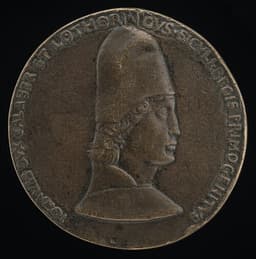
John II of Lorraine
Emperor · Medieval
37.5Total

Napoleon Bonaparte
General · Modern
70.9Total
Basic Information
Born
1426
1769
Died
1470
1821
Era
Medieval
Modern
Nationality
Lorraine
France
Occupation
Emperor
General
Civilization
Western
Western
Score Comparison
Military (10%)
21.2
94.0
Political (20%)
29.3
72.0
Influence (20%)
47.1
40.0
Legacy (20%)
37.5
80.0
Leadership (15%)
39.0
78.0
Strategy (15%)
39.6
90.0
TOTAL
37.5
70.9
John II of Lorraine — Complete Timeline
1458 AD
Claimed the Kingdom of NaplesPolitical Action◆ Major
John II inherited the Angevin claim to the Kingdom of Naples from his father Ren
ClaimItalian Campaign
Impact: regional
1470 AD
Died in BarcelonaPolitical Action◆ Major
John II died in Barcelona while on campaign to press his claim to Naples. His death left the Angevin claim unresolved and passed to his son Nicholas.
DeathUnfinished Campaign
Impact: regionaltragic
Napoleon Bonaparte — Complete Timeline
1799 AD
Coup of 18 BrumaireOther◆ Major
Napoleon Bonaparte, with support from his brother Lucien and key political figures, overthrew the Directory in a bloodless coup. He established the Consulate with himself as First Consul, effectively becoming the ruler of France. This event ended the French Revolution's most unstable period.
French RevolutionCoupRise to Power
Impact: regional
1804 AD
Promulgation of the Napoleonic CodeOther◆ Major
Napoleon enacted the Civil Code of the French, known as the Napoleonic Code, a comprehensive set of laws that replaced the fragmented feudal legal systems. The code established legal equality, protected property rights, and secularized law. It became the basis for legal systems in many European and world countries.
Legal ReformNapoleonic CodeCivil Law
Impact: globalconstructive
1805 AD
Battle of AusterlitzWar◆ Major
Napoleon's Grande Arm
Napoleonic WarsBattleDecisive Victory
Impact: global
1812 AD
Invasion of RussiaWar◆ Major
Napoleon led the Grande Arm
Napoleonic WarsInvasionDisaster
Impact: globaldestructive
1815 AD
Battle of WaterlooWar◆ Major
Napoleon's French army was defeated by the combined forces of the Duke of Wellington's Anglo-Allied army and Gebhard Leberecht von Bl
Napoleonic WarsBattleFinal Defeat
Impact: globaldestructive
Expert Analysis
john-ii-of-lorraine-vs-napoleon-bonaparte
# The Emperor and the Duke: Two Paths, One Destiny
In the winter of 1814, Napoleon Bonaparte stood in the courtyard of Fontainebleau, bidding farewell to his Old Guard as he abdicated for the first time. Four centuries earlier, another claimant to a throne—John II of Lorraine—died in Barcelona, far from the kingdom he had spent his life pursuing. One man conquered Europe and remade its laws; the other spent decades chasing a crown he never wore. What separates a titan from a footnote? The answer lies not in luck alone, but in the raw materials of character and circumstance.
Origins
Napoleon Bonaparte was born in 1769 on the island of Corsica, a recent French acquisition. His family was minor nobility, but his world was one of upheaval and ambition. The French Revolution, erupting when he was twenty, shattered the old order and opened paths that birth could never have granted. He was a child of the Enlightenment, educated in military academies, steeped in the ideas of Rousseau and the realities of gunpowder.
John II of Lorraine, born in 1426, inhabited a different universe. He was the son of René of Anjou, a prince who claimed kingdoms across Europe—Naples, Sicily, Jerusalem—but held little real power. John’s world was medieval: a patchwork of feudal loyalties, dynastic marriages, and endless lawsuits over thrones. His inheritance was not a nation but a claim—a legal abstraction that demanded blood and years to enforce.
The contrast is stark. Napoleon was forged in revolution, where merit could vault a man to the top. John was trapped in a system where legitimacy was everything, and even a king’s son could die a beggar for a crown.
Rise to Power
Napoleon’s ascent was meteoric. In 1793, at age twenty-four, he drove the British from Toulon, earning promotion to brigadier general. By 1796, he commanded the Army of Italy, where his lightning campaigns crushed the Austrians and made him a national hero. In 1799, he seized power in a coup, becoming First Consul. By 1804, he crowned himself Emperor. Each step was a gamble, but each was backed by undeniable talent—military genius, political cunning, and a ruthless ability to seize the moment.
John II’s rise was a slow, grinding struggle. In 1458, he inherited the Angevin claim to Naples from his father. For twelve years, he pressed that claim, raising armies, negotiating alliances, marching across Italy and France. But the Kingdom of Naples was held by the Aragonese, who were stronger, richer, and more ruthless. John never won a decisive battle, never captured a capital, never even set foot in Naples as its ruler. He died in Barcelona in 1470, still fighting, still claiming, still empty-handed.
Why the difference? Napoleon had a revolution that shattered the old rules. John had only the old rules—and they were stacked against him.
Leadership & Governance
As ruler, Napoleon was a force of nature. He reformed French law with the Napoleonic Code, creating a uniform legal system that still influences Europe today. He centralized administration, built roads and schools, and negotiated the Concordat with the Pope. His military campaigns—Austerlitz in 1805, Jena in 1806—were masterpieces of strategy, with his 94.0 military score reflecting near-perfect execution. He was a political pragmatist, scoring 75.0, who knew when to compromise and when to crush.
John II, by contrast, left no such legacy. His military score of 30.0 and political score of 39.2 reflect a man who could neither win battles nor forge lasting alliances. He was a claimant, not a ruler. He governed nothing, reformed nothing, built nothing. His only achievement was to keep a dying claim alive—and even that died with him.
The difference is not just talent. Napoleon had a nation to command; John had only a title.
Triumph & Tragedy
Napoleon’s greatest moment was Austerlitz, where he destroyed a Russo-Austrian army and redrew the map of Europe. His tragedy was the invasion of Russia in 1812, a catastrophic gamble that cost half a million lives and destroyed his Grand Army. He was exiled to Elba, returned for the Hundred Days, and met final defeat at Waterloo in 1815. He died in 1821 on Saint Helena, a prisoner of the British.
John II’s life had no Austerlitz. His greatest moment was simply being recognized as Duke of Lorraine. His tragedy was his entire career: a twelve-year pursuit of a throne he never touched, ending in a Barcelona inn. He died in 1470, his claim unresolved, his son inheriting only the same empty title.
Napoleon’s tragedy was the fall of an empire. John’s tragedy was that he never had one.
Character & Destiny
Napoleon was driven by an insatiable ambition and a cold, calculating intellect. He once said, “Impossible is a word to be found only in the dictionary of fools.” He believed he could shape history—and for a time, he did. His 80.0 leadership score reflects a man who inspired devotion and fear, who could rally armies and command loyalty.
John II was a man of his age—pious, persistent, but ultimately trapped. He believed in the sanctity of his claim, in the justice of his cause. But in a world where power flowed from blood and steel, belief was not enough. His 33.5 leadership score suggests a man who could not inspire the devotion needed to win a kingdom.
Napoleon’s character was forged in revolution, where the impossible became possible. John’s was forged in tradition, where the impossible remained impossible.
Legacy
Napoleon’s legacy is immense. The Napoleonic Code, the metric system, the modern concept of meritocracy—all bear his mark. He is remembered as a military genius, a reformer, and a cautionary tale about overreach. His 82.0 influence score and 78.0 legacy score reflect a man who changed the world, for better and worse.
John II of Lorraine is a footnote, remembered only by historians of medieval dynasties. His 62.5 influence score and 49.4 legacy score reflect a life that ended in failure. He left no laws, no reforms, no lasting mark—only an unresolved claim and a grave in a foreign city.
Conclusion
Standing at the end of their stories, we see two men who both wanted a crown. Napoleon seized his, ruled an empire, and changed the world. John II spent his life chasing a throne that was never his. The difference was not just talent or luck—it was the age they lived in. Napoleon’s world rewarded ambition and genius; John’s world rewarded birth and patience. One man bent history to his will; the other was broken by history’s indifference.
In the end, Napoleon’s fate was to be remembered as a titan who fell. John’s fate was to be forgotten. And perhaps that is the cruelest lesson of all: that history does not judge by effort, but by result.
Rankings
🥇
Napoleon BonaparteLeader
Mil: 94.0Pol: 72.0Inf: 40.0
70.9
🥈
John II of Lorraine
Mil: 21.2Pol: 29.3Inf: 47.1
37.5
+33.4 behind
How This Comparison Works
Algorithm
Each figure is scored on 6 dimensions (0—100 scale) based on structured historical data: Military (10%), Political (20%), Influence (20%), Legacy (20%), Leadership (15%), Strategy (15%). The weighted total produces the final ranking.
Data Sources
Scores are computed from structured sub-indicators in the database. Scale factors adjust for era (Ancient ×0.85, Modern ×1.0) and civilization size (Eastern ×1.05, Other ×0.80) to account for differences in population and military scale.
Maximum 3 Figures
Comparisons are limited to 2—3 figures to ensure readability and statistical meaningfulness.
Error Margins
±5 points per dimension — Sub-scores are derived from historical records with inherent uncertainty. Two figures within 5 points on a dimension should be considered roughly equivalent in that area.
Total Score Accuracy
±3 points overall — The weighted combination of 6 dimensions produces a total score with approximately ±3 points of uncertainty. Differences of less than 3 points are not statistically significant— the figures are effectively tied.
Known Limitations
- Historical records are incomplete and uneven across civilizations
- Figures from oral-tradition societies may be underrepresented
- Occupation labels can misclassify multi-role figures
- Scores measure capability and impact, not moral character
- Quantitative scoring is a comparison tool, not absolute truth
Capability Radar
Military (10%) — Battles & Warfare
Battles
10
95
Win Rate
10
90
Expansion
10
95
Political (20%) — Governance & Reform
Reform
10
95
Diplomacy
20
80
Economy
10
85
Influence (20%) — Cultural & Global Reach
Cultural
10
85
Global
10
90
Legacy (20%) — Historical Impact
Historical
15
95
Longevity
10
90
Leadership (15%) — Power & Stability
Tenure
15
85
Stability
10
70
Strategy (15%) — Tactics & Innovation
Strategy
10
95
Tactics
10
98
Reform
5
92
Similar Comparisons
Comments & Discussion
René's Rebuttal6/17/2026
Napoleon inherited a revolutionary army and a broken ancien régime; John II inherited a paper crown and a lawsuit over Naples that would make Dickens blush. Let’s be real: one man commanded the Grand Armée, the other commanded a few mercenaries and a lot of legal arguments. John never even saw the throne of Aragon—he died in Barcelona, still a claimant, while Napoleon reshaped Europe from Moscow to Madrid. Stop romanticizing the underdog; the Duke was a footnote because he lacked the tools, not
数据侦探6/17/2026
拿数据说话:拿破仑在1805-1809年间执行了至少四次大规模战役,每次动员超过20万人;而约翰二世终其一生只领导了两次真正意义上的军事行动,总兵力不超过1.5万。这差距不是性格能解释的,是资源网络的根本断层。拿破仑背后是新兴民族国家的税收和征兵制,约翰背后是封建采邑的骑士和有限粮饷。比什么?数据直接判死刑。
Legionary's Ghost6/17/2026
You're comparing a man who died in a Barcelona inn to one who died on St. Helena—both exiles, but of entirely different scales. Napoleon's 'failure' still involved ruling 70 million people and writing the Civil Code; John's 'success' was a few years as Duke of Calabria and a failed naval expedition to Naples. The Duke's entire life was a series of 'almost'—almost king, almost conqueror, almost relevant. Sorry, but history doesn't give medals for dedication to a lost cause.
古典学人6/17/2026
从古典语境看,拿破仑是罗马式的征服者——他像凯撒一样打破旧秩序,建立新法律;而约翰二世更像希腊悲剧中的角色——被命运和家族义务拖入无休止的战争,却从未掌控过自己的叙事。拿破仑在奥斯特里茨的演说能激励全欧洲,约翰二世在巴塞罗那的遗言不过是家族档案里的注脚。思想史层面,这是两个时代的碰撞:一个是启蒙的理性帝国,一个是中世纪的债务遗产。高下立判。
Revisionist Razor6/17/2026
Let's cut the hagiography: Napoleon was a military genius who bankrupted France twice and left it smaller than he found it; John II was a mediocre duke who wasted his father's fortune on phantom kingdoms. Both failed—Napoleon just made more headlines. The real difference? One had a continent to loot, the other had only a tax base of disloyal vassals. Give John Napoleon's resources, and he'd still lose; the man had zero strategic creativity beyond 'claim the throne and hope for a miracle.' Not a