Loading...
John VIII Palaiologos vs Napoleon Bonaparte
Napoleon Bonaparte leads by 29.6 pts · 2 figures compared
…
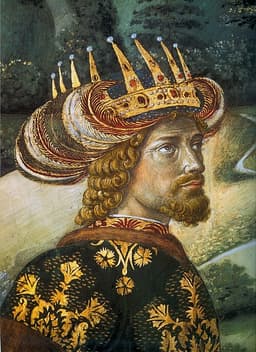
John VIII Palaiologos
Emperor · Medieval
41.3Total

Napoleon Bonaparte
General · Modern
70.9Total
Basic Information
Born
1392
1769
Died
1448
1821
Era
Medieval
Modern
Nationality
Byzantine Empire
France
Occupation
Emperor
General
Civilization
Western
Western
Score Comparison
Military (10%)
10.2
94.0
Political (20%)
36.5
72.0
Influence (20%)
53.3
40.0
Legacy (20%)
45.0
80.0
Leadership (15%)
41.5
78.0
Strategy (15%)
39.6
90.0
TOTAL
41.3
70.9
John VIII Palaiologos — Complete Timeline
1438 AD
Travel to Italy for the Council of FlorencePolitical Action◆ Major
John VIII traveled to Italy with a large delegation of Orthodox clergy to participate in the Council of Florence, which aimed to negotiate church union. His presence underscored the Byzantine Empire's desperation for Western aid.
CouncilDiplomacyByzantine Empire
Impact: regional
1439 AD
Acceptance of the Union of FlorencePolitical Action◆ Major
John VIII Palaiologos, as Byzantine emperor, agreed to the Union of Florence, which temporarily reunited the Eastern Orthodox Church with the Roman Catholic Church under papal authority. This was done to secure Western military aid against the Ottoman Empire, but the union was widely rejected by the Byzantine populace and clergy.
Church UnionDiplomacyOttoman Wars
Impact: regionaldestructive
1448 AD
Death embittered after failed union and Ottoman advancesOther
John VIII died embittered, having failed to secure effective Western military support despite the Union of Florence. The Ottoman Empire continued its conquests, and the union deepened internal divisions within Byzantium.
DeathByzantine EmpireOttoman Wars
Impact: nationaltragic
Napoleon Bonaparte — Complete Timeline
1799 AD
Coup of 18 BrumaireOther◆ Major
Napoleon Bonaparte, with support from his brother Lucien and key political figures, overthrew the Directory in a bloodless coup. He established the Consulate with himself as First Consul, effectively becoming the ruler of France. This event ended the French Revolution's most unstable period.
French RevolutionCoupRise to Power
Impact: regional
1804 AD
Promulgation of the Napoleonic CodeOther◆ Major
Napoleon enacted the Civil Code of the French, known as the Napoleonic Code, a comprehensive set of laws that replaced the fragmented feudal legal systems. The code established legal equality, protected property rights, and secularized law. It became the basis for legal systems in many European and world countries.
Legal ReformNapoleonic CodeCivil Law
Impact: globalconstructive
1805 AD
Battle of AusterlitzWar◆ Major
Napoleon's Grande Arm
Napoleonic WarsBattleDecisive Victory
Impact: global
1812 AD
Invasion of RussiaWar◆ Major
Napoleon led the Grande Arm
Napoleonic WarsInvasionDisaster
Impact: globaldestructive
1815 AD
Battle of WaterlooWar◆ Major
Napoleon's French army was defeated by the combined forces of the Duke of Wellington's Anglo-Allied army and Gebhard Leberecht von Bl
Napoleonic WarsBattleFinal Defeat
Impact: globaldestructive
Expert Analysis
john-viii-palaiologos-vs-napoleon-bonaparte
# The Emperor Who Bargained and the General Who Conquered
On a cold February morning in 1438, a Byzantine emperor disembarked from a Venetian galley at the port of Venice, his purple robes heavy with the weight of a dying empire. He had come to beg. Nearly four centuries later, on a December day in 1805, a short Corsican general watched from a hilltop as the sun rose over the frozen fields of Austerlitz, the greatest army in Europe arrayed before him. He had come to take.
John VIII Palaiologos and Napoleon Bonaparte never met, never shared a century, never breathed the same air. Yet their stories form a singular contrast in the annals of Western civilization: one man who inherited a corpse and tried to breathe life into it through compromise, and another who seized a living nation and drove it to the edge of immortality.
Origins
Napoleon was born in 1769 on the island of Corsica, a place only recently annexed by France, into a minor noble family of Italian ancestry. His father was a lawyer who had initially resisted French rule; young Napoleon grew up speaking Italian-accented French, an outsider among the Parisian elites who would later call him "the little Corsican." This marginality forged in him a ferocious will to prove himself—and a cold, calculating understanding of power as something to be taken, never given.
John VIII Palaiologos, by contrast, was born in 1392 into the most ancient throne in Christendom. The Palaiologoi had ruled Byzantium since 1259, but by John's birth the empire was a ghost of its former self: Constantinople, a few scattered islands, the Peloponnese, and little else. He was raised in the shadow of the Hagia Sophia, surrounded by courtiers who whispered of past glories while Ottoman armies camped within sight of the Theodosian Walls. Where Napoleon learned to seize opportunity, John learned to negotiate with necessity.
Rise to Power
Napoleon's ascent was a rocket's arc. He emerged from the chaos of the French Revolution, a young artillery officer who helped crush the royalist uprising in Paris in 1795. By 1796, at just twenty-six, he commanded the Army of Italy. He won six battles in a single month, forced Austria to the peace table, and returned to France a national hero. His coup of 18 Brumaire in 1799 made him First Consul; by 1804, he crowned himself Emperor of the French. Every step was taken, not inherited.
John's path was slower, more painful. He became co-emperor with his father Manuel II in the 1410s, but real power came only in 1425. By then, the Ottomans had already reduced Byzantium to a vassal state. John's first decade was spent rebuilding the Hexamilion Wall across the Isthmus of Corinth—a desperate effort to hold the Peloponnese—only to see the Ottomans tear it down in 1423. His rise was not a conquest but a holding action.
Leadership & Governance
Napoleon governed with the energy of a storm. He reorganized French administration, centralized the state, and created the Napoleonic Code—a legal system that swept away feudal privileges and established equality before the law. He built roads, founded banks, and reformed education. On the battlefield, he was a genius: his strategy at Austerlitz in 1805 remains a textbook example of how to destroy a numerically superior enemy by dividing and annihilating his forces. His political score of 75 reflects a man who could govern but could not compromise.
John VIII governed with the patience of a diplomat. His great act was the Union of Florence in 1439, when he traveled to Italy with a delegation of Orthodox clergy and agreed to reunite the Eastern and Western churches under papal authority. In exchange, he hoped for a crusade against the Ottomans. It was a masterstroke of political realism—but it was also a betrayal. The Byzantine populace, led by anti-unionist monks, rejected the union as heresy. John returned to Constantinople to find his own people calling him a traitor. His political score of 64.8 reflects a man who understood power but could not command loyalty.
Triumph & Tragedy
Napoleon's triumph was Austerlitz, where he crushed the combined armies of Russia and Austria. His tragedy was the invasion of Russia in 1812: 600,000 men marched east; fewer than 40,000 returned. He was exiled to Elba, escaped, and fell again at Waterloo in 1815. His ambition, which had made him master of Europe, became his undoing.
John's triumph was the Union itself—a diplomatic feat that briefly gave Byzantium a chance at survival. His tragedy was that it failed. No crusade came. The Ottomans advanced. When John died in 1448, he was embittered, knowing that his empire would not outlive his brother. Five years later, Constantinople fell.
Character & Destiny
Napoleon's character was will incarnate. He once said, "Impossible is a word to be found only in the dictionary of fools." He believed that a man could shape his own destiny through sheer force of intellect and ambition. This made him unstoppable—until it made him blind. He could not stop, could not consolidate, could not accept limits.
John's character was endurance shaped by despair. He knew that Byzantium was dying. His strategy was to buy time, to gamble everything on a single throw of the diplomatic dice. He was not a conqueror; he was a steward of ruin. Where Napoleon's pride led him to overreach, John's humility led him to be despised by his own people.
Legacy
Napoleon's legacy is written across Europe: the Napoleonic Code, the metric system, the modern nation-state. He is remembered as both liberator and tyrant, a man who spread revolutionary ideals even as he crowned himself emperor. His scores—Military 94, Strategy 93, Influence 82—reflect a figure who reshaped the world.
John VIII's legacy is quieter. He is remembered, if at all, as the emperor who sold his faith for nothing. But his scores—Influence 71, Leadership 76, Legacy 59—tell a different story. He was the last Byzantine emperor to travel to the West, the last to try to bridge the schism between East and West. His failure was not his alone; it was the failure of an entire civilization to adapt.
Conclusion
Standing at the edge of the Byzantine Empire's grave, John VIII Palaiologos made a desperate bargain. Standing at the height of France's power, Napoleon Bonaparte made a triumphant gamble. One lost everything; the other lost everything too, but only after reshaping the world. Their lives remind us that history judges not by effort but by outcome—and that the difference between a hero and a failure is often just the luck of the moment, the timing of the shot, the strength of the army at one's back. In the end, both men died embittered: John in a palace crumbling around him, Napoleon on a remote island in the South Atlantic. The difference was that Napoleon had once held the world in his hands, while John had only held a dream.
Rankings
🥇
Napoleon BonaparteLeader
Mil: 94.0Pol: 72.0Inf: 40.0
70.9
🥈
John VIII Palaiologos
Mil: 10.2Pol: 36.5Inf: 53.3
41.3
+29.6 behind
How This Comparison Works
Algorithm
Each figure is scored on 6 dimensions (0—100 scale) based on structured historical data: Military (10%), Political (20%), Influence (20%), Legacy (20%), Leadership (15%), Strategy (15%). The weighted total produces the final ranking.
Data Sources
Scores are computed from structured sub-indicators in the database. Scale factors adjust for era (Ancient ×0.85, Modern ×1.0) and civilization size (Eastern ×1.05, Other ×0.80) to account for differences in population and military scale.
Maximum 3 Figures
Comparisons are limited to 2—3 figures to ensure readability and statistical meaningfulness.
Error Margins
±5 points per dimension — Sub-scores are derived from historical records with inherent uncertainty. Two figures within 5 points on a dimension should be considered roughly equivalent in that area.
Total Score Accuracy
±3 points overall — The weighted combination of 6 dimensions produces a total score with approximately ±3 points of uncertainty. Differences of less than 3 points are not statistically significant— the figures are effectively tied.
Known Limitations
- Historical records are incomplete and uneven across civilizations
- Figures from oral-tradition societies may be underrepresented
- Occupation labels can misclassify multi-role figures
- Scores measure capability and impact, not moral character
- Quantitative scoring is a comparison tool, not absolute truth
Capability Radar
Military (10%) — Battles & Warfare
Battles
10
95
Win Rate
10
90
Expansion
5
95
Political (20%) — Governance & Reform
Reform
20
95
Diplomacy
60
80
Economy
15
85
Influence (20%) — Cultural & Global Reach
Cultural
30
85
Global
30
90
Legacy (20%) — Historical Impact
Historical
40
95
Longevity
30
90
Leadership (15%) — Power & Stability
Tenure
40
85
Stability
10
70
Strategy (15%) — Tactics & Innovation
Strategy
10
95
Tactics
10
98
Reform
5
92
Similar Comparisons
Comments & Discussion
EmperorBeggar6/17/2026
John VIII traveled to Italy not as an emperor but as a supplicant, trading Orthodox theology for hollow Western promises. Napoleon would’ve laughed at this—he understood that real power doesn’t come from begging councils but from cannons at the ready. John placated the Pope; Napoleon made popes bow. One preserved a corpse, the other created an empire.
FrozenEagle6/17/2026
Napoleon's Austerlitz victory was a tactical masterstroke—his 73,000 men crushed a larger Russo-Austrian army by feigning weakness on his right flank. John VIII couldn't even hold Constantinople against his own nobles, let alone the Ottomans. Strategic brilliance versus diplomatic desperation: there’s no comparison.
东方牧师6/17/2026
约翰八世是拜占庭的最后一缕祷告,他在费拉拉-佛罗伦萨大公会议上出卖东正教信仰以求西方援军,结果只换回一句空洞承诺。拿破仑用滑铁卢证明,就算输了战役也能书写历史,而约翰八世连打赢一场小规模冲突的机会都没有。信仰交易换不来枪炮,这是千年教训。
数据螺丝刀6/17/2026
军事对比呢?拿破仑在1805-1814年间动员了超过200万法国士兵,而约翰八世统治末期,拜占庭常备军可能不到7000人。兵力差三个数量级,战果自然天壤之别。一个靠组织效率和革命激情创造现代战争模板,一个守着破城墙靠外交辞令苟延残喘。数据不说谎:管理能力决定生死。
SteppeSkeptic6/17/2026
Historians romanticize the "last Byzantine emperor" trope, but John VIII was simply a mediocre manager presiding over collapse. Napoleon built institutions—the Code, the lycées, the centralized state—that outlasted his exile. John left nothing but theological squabbles and a city that fell 15 years after his death. Legacy isn’t measured by purple robes, but by durable systems.